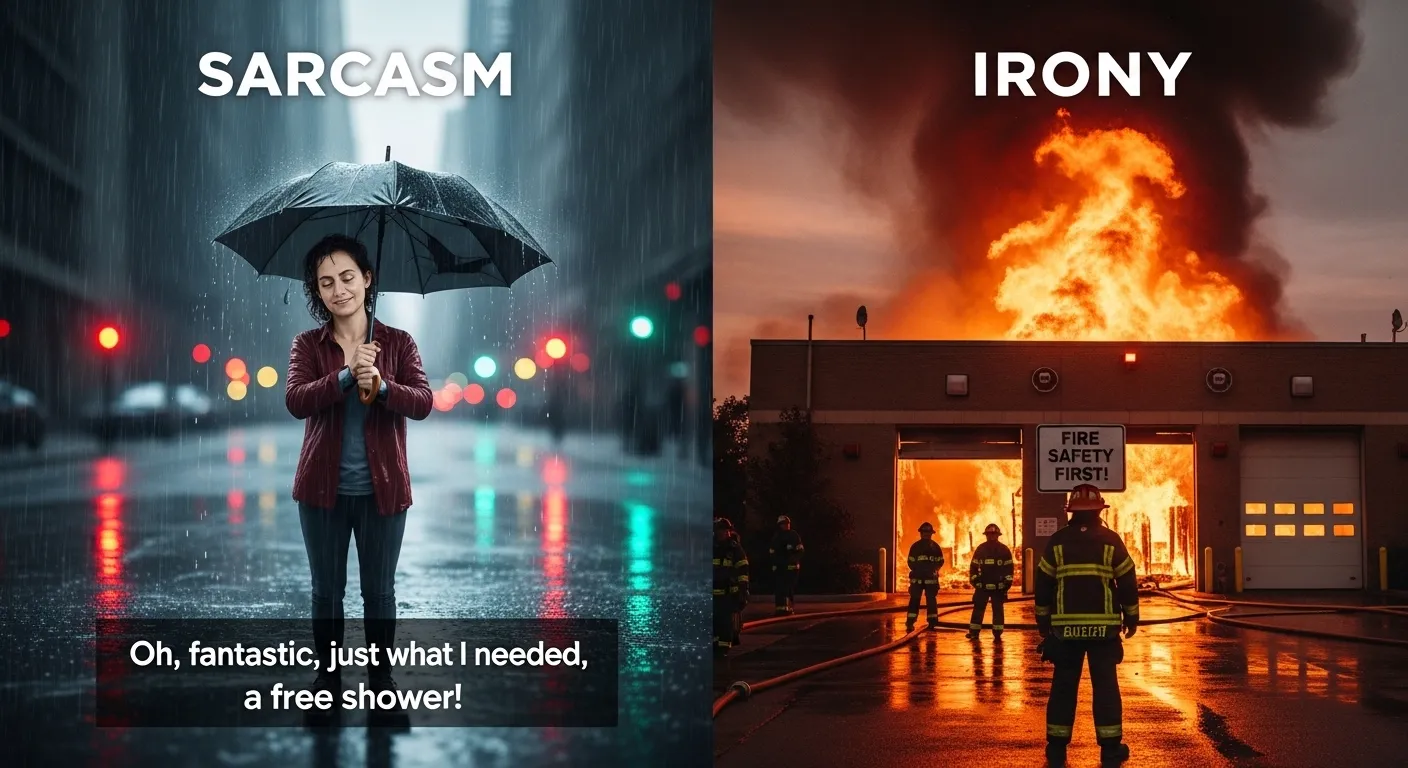
Imagine a student who studies very hard for an exam but fails it. His friend says, “Wow, that worked out perfectly!” The words sound positive, but the meaning is actually negative. This situation helps us understand the difference between sarcasm and irony.
Both sarcasm and irony are common in daily conversation, writing, and humor. However, many people do not clearly understand the difference between sarcasm and irony. Irony is when the result or meaning is different from what people expect. Sarcasm is a sharp or mocking comment where someone says the opposite of what they mean, often to criticize or make fun of someone.
Learning the difference between sarcasm and irony helps readers understand jokes, stories, and conversations better. When people know the difference between sarcasm and irony, they can communicate more clearly and avoid misunderstandings.
Key Difference Between the Both
The main difference between sarcasm and irony is intention.
- Irony is a situation where the outcome is different from what people expect.
- Sarcasm is a form of speech used to mock, criticize, or tease someone by saying the opposite of what is meant.
In simple words, sarcasm is usually intentional and mocking, while irony is often situational and not always meant to hurt someone.
Pronunciation
Sarcasm
UK: /ˈsɑː.kæz.əm/
US: /ˈsɑːr.kæz.əm/
Irony
UK: /ˈaɪ.rə.ni/
US: /ˈaɪ.rə.ni/
Difference Between Sarcasm and Irony
1. Basic Meaning
Sarcasm is a mocking statement. Irony is a contrast between expectation and reality.
Example 1: Saying “Great job!” after someone makes a mistake is sarcasm.
Example 2: A fire station burning down is irony.
2. Purpose
Sarcasm is used to criticize or tease. Irony usually happens naturally in situations.
Example 1: A teacher saying “You are very punctual” to a late student is sarcasm.
Example 2: A traffic police officer getting a speeding ticket is irony.
3. Tone
Sarcasm often has a sharp or humorous tone. Irony may not have a special tone.
Example 1: “Wonderful weather!” during a storm is sarcasm.
Example 2: A raincoat getting wet in the rain is irony.
4. Use in Speech
Sarcasm is mostly used in spoken language. Irony can appear in speech, stories, and situations.
Example 1: Friends use sarcasm while joking.
Example 2: Many stories use irony for surprise.
5. Emotional Effect
Sarcasm can sometimes hurt feelings. Irony usually creates surprise or humor.
Example 1: Sarcasm may embarrass someone.
Example 2: Irony may make people laugh.
6. Intent
Sarcasm is intentional. Irony may happen by accident.
Example 1: A person purposely uses sarcasm to criticize.
Example 2: Irony happens when events turn out differently than expected.
7. Form
Sarcasm is a type of verbal expression. Irony can be verbal, situational, or dramatic.
Example 1: Sarcasm is often spoken in conversation.
Example 2: Dramatic irony appears in movies and plays.
8. Use in Literature
Sarcasm is mostly dialogue. Irony is a common literary device.
Example 1: A character sarcastically mocks another character.
Example 2: A reader knows something a character does not (dramatic irony).
9. Relationship
Sarcasm is actually a type of verbal irony. Irony is the broader concept.
Example 1: Sarcasm is a specific form of irony used to mock.
Example 2: Irony includes many forms beyond sarcasm.
10. Common Use
Sarcasm appears more in daily speech. Irony appears more in stories and events.
Example 1: Friends joking with sarcasm.
Example 2: A situation turning out opposite to expectations.
Nature and Behaviour of Both
Sarcasm
Sarcasm is direct, sharp, and often humorous. It is used when someone wants to criticize or tease indirectly.
Irony
Irony is subtle and surprising. It shows the contrast between what people expect and what really happens.
Why People Are Confused About Their Use
People confuse sarcasm and irony because sarcasm is actually one form of irony. Also, both involve saying or experiencing something opposite to what is expected.
Difference and Similarity Table
| Feature | Sarcasm | Irony | Similarity |
| Meaning | Mocking speech | Unexpected contrast | Both involve opposite meaning |
| Use | Mostly spoken | Speech, writing, situations | Used for humor |
| Intent | Usually intentional | Sometimes accidental | Express contrast |
| Tone | Sharp or mocking | Neutral or surprising | Creative language |
Which Is Better in What Situation?
Sarcasm
Sarcasm works well in humor, jokes, and friendly teasing. It is often used in conversations among friends. However, it should be used carefully because it may sound rude or insulting in serious situations.
Irony
Irony works better in storytelling and literature. Writers use irony to create surprise or deeper meaning. It is also useful in speeches and essays to highlight unexpected results.
Use in Metaphors and Similes
Example:
His praise felt as sharp as sarcasm.
Example:
Life can be full of irony like a twist in a story.
Connotative Meaning
Sarcasm
Positive: humor among friends
Negative: mocking or rude tone
Example:
His sarcasm made everyone laugh.
Irony
Positive: clever and surprising
Neutral: unexpected situation
Example:
The irony of the event surprised everyone.
Idioms or Proverbs Related
“Oh great!” (used sarcastically)
Example:
“Oh great! Another meeting,” he said sarcastically.
“Life is full of irony”
Example:
He trained people to drive safely but crashed his own car. Life is full of irony.
Works in Literature
- Pride and Prejudice — Novel, Jane Austen, 1813 (uses verbal irony and sarcasm)
- The Gift of the Magi — Short story, O. Henry, 1905 (situational irony)
Movies Using Irony or Sarcasm
- Deadpool — 2016, USA (famous for sarcasm)
- The Truman Show — 1998, USA (dramatic irony)
Frequently Asked Questions
1. Is sarcasm the same as irony?
No. Sarcasm is a type of verbal irony used to mock someone.
2. Can irony exist without sarcasm?
Yes. Situational irony does not involve sarcasm.
3. Is sarcasm always negative?
Not always. Friends often use it playfully.
4. Why do writers use irony?
They use it to create surprise or deeper meaning.
5. Which is more common in conversation?
Sarcasm is more common in daily speech.
How Both Are Useful for Communication
Sarcasm and irony make language more expressive. They add humor, creativity, and deeper meaning to conversations, stories, and speeches.
Final Words
Sarcasm is sharp humor used in speech.
Irony is a broader concept showing contrast between expectation and reality.
Conclusion
Understanding the difference between sarcasm and irony helps people interpret language more accurately. Sarcasm is a type of verbal expression used to mock or criticize by saying the opposite of what is meant. Irony, on the other hand, describes situations where reality differs from expectation. While sarcasm often appears in everyday conversations, irony appears widely in literature, storytelling, and real-life events. Learning the difference between sarcasm and irony improves communication, reading skills, and appreciation of humor. When people recognize these two concepts, they can better understand jokes, stories, and deeper meanings in language.

I’m Zahid Abbas, an educator, researcher, and digital publishing strategist with a passion for linguistics, grammar, and clear communication. As a content creator and SEO specialist, I craft research-driven, reader-focused content that empowers learners and makes knowledge accessible worldwide.