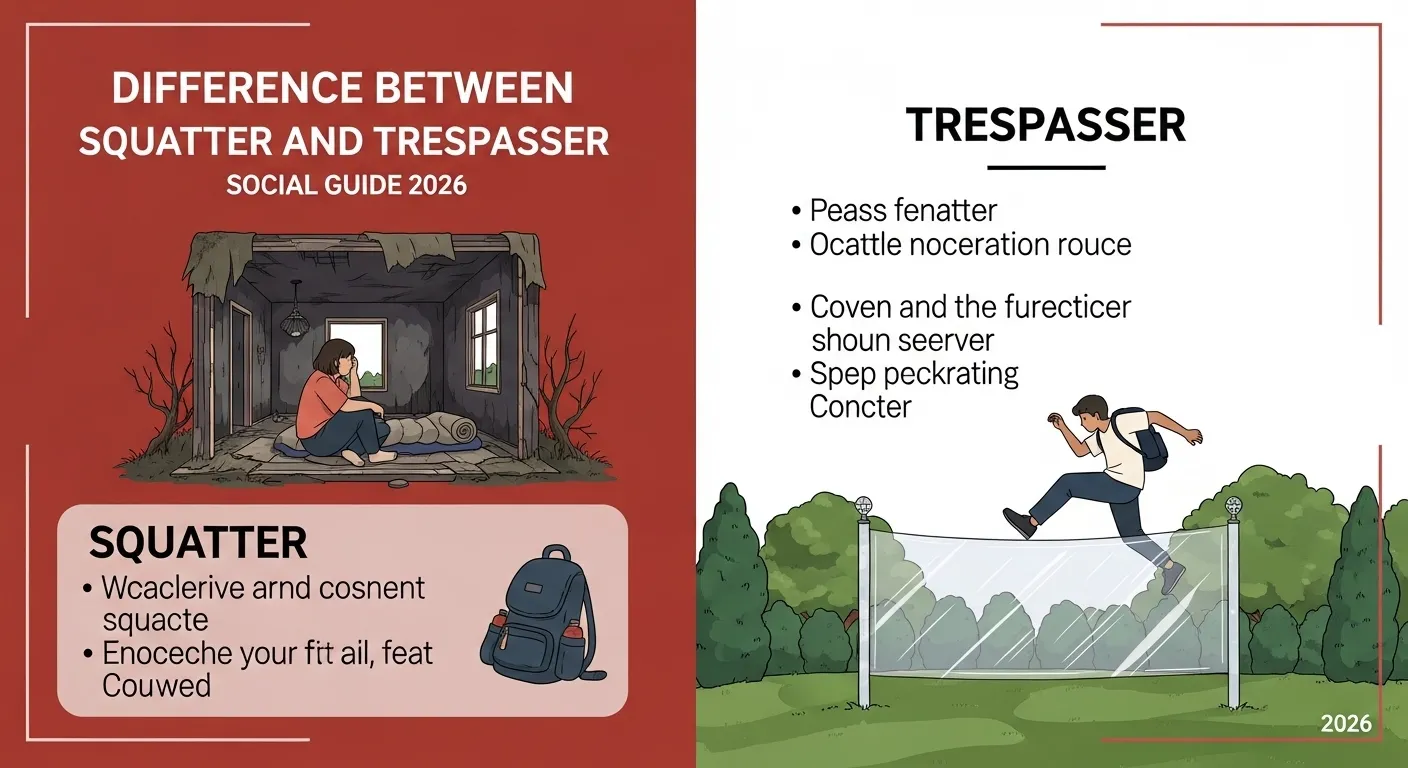
Last year, a family in a small town moved abroad for work. When they came back, they found strangers living in their empty house. The neighbors called them squatters. On the same street, a teenager once jumped a fence to take a shortcut. The owner called him a trespasser. This real story helps us understand the difference between squatter and trespasser. Many people mix up these two words. Yet, the difference between squatter and trespasser is important in law and daily life. The difference between squatter and trespasser affects property rights and police action. If we know the difference between squatter and trespasser, we can avoid legal trouble and social conflict.
Pronunciation
- Squatter
- US: /ˈskwɑːtər/
- UK: /ˈskwɒtər/
- Trespasser
- US: /ˈtrɛsˌpæsər/
- UK: /ˈtrɛspɑːsər/
Before we explore the law and society, let us clearly break down the main points.
Key Difference Between the Both
A squatter is a person who stays in a property without permission and often lives there for a long time.
A trespasser is a person who enters someone’s property without permission, usually for a short time.
Why Is Their Difference Necessary to Know for Learners and Experts?
Knowing this difference helps lawyers, police officers, students, and property owners. In society, property rights are serious matters. A squatter may claim legal rights after many years in some countries. A trespasser usually faces quick removal or legal action. If we do not know the difference, we may misuse the law or blame someone wrongly. Clear knowledge protects homes, land, and social peace.
Difference Between the Keywords
1. Length of Stay
Squatter: Stays for a long time.
- A man lives in an empty house for 5 years.
- A family stays in an unused building for months.
Trespasser: Stays for a short time.
- A boy enters a garden for 10 minutes.
- A stranger walks across private land once.
2. Purpose
Squatter: Wants to live or settle.
- A person uses an empty flat as a home.
- A group occupies land to build shelters.
Trespasser: May enter by mistake or for quick gain.
- A hiker gets lost on private land.
- A thief enters a yard at night.
3. Legal Rights
Squatter: May gain rights in some places after long stay.
- In some regions, long stay can lead to ownership claims.
- A court may review their case.
Trespasser: Has no legal claim.
- Police can remove them quickly.
- Owner can file a complaint at once.
4. Intention
Squatter: Plans to remain.
- Repairs the house.
- Connects water or electricity.
Trespasser: No plan to stay.
- Runs away when caught.
- Leaves after short visit.
5. Property Condition
Squatter: Often chooses empty property.
- Abandoned house.
- Unused land.
Trespasser: May enter any property.
- Active farm.
- Private backyard.
6. Social View
Squatter: Sometimes seen as homeless or needy.
- Poor family in empty building.
- Refugees in unused land.
Trespasser: Seen as lawbreaker.
- Person crossing fence.
- Stranger breaking into garage.
7. Legal Process
Squatter: Eviction may take time.
- Court notice needed.
- Legal hearing required.
Trespasser: Quick removal.
- Police warning.
- Immediate fine.
8. Awareness
Squatter: Often open about stay.
- Lives openly in house.
- Receives mail there.
Trespasser: Often secret.
- Hides in dark.
- Leaves no trace.
9. Damage
Squatter: May maintain or damage property.
- Paints walls.
- Breaks doors.
Trespasser: May cause sudden harm.
- Steals tools.
- Breaks window.
10. Risk Level
Squatter: Legal risk grows over time.
- Long court case.
- Ownership dispute.
Trespasser: Immediate legal risk.
- Arrest.
- Fine.
Nature and Behaviour of the Both
Squatter:
Often stays quietly. May act like owner. Sometimes fixes the place. May avoid conflict.
Trespasser:
Moves secretly. Leaves fast. May not care for property. Often avoids being seen.
Why People Are Confused About Their Use
People think both mean “illegal entry.” That is partly true. Both involve no permission. But time, purpose, and legal effect are different. Media and daily speech also mix the terms.
Table Showing Difference and Similarity
| Point | Squatter | Trespasser | Similarity |
|---|---|---|---|
| Permission | No | No | Both lack consent |
| Length | Long stay | Short stay | Illegal entry |
| Legal Rights | May gain rights | No rights | Face legal issues |
| Purpose | To live | To enter briefly | Use others’ property |
| Removal | Slow process | Quick action | Owner can complain |
Which Is Better in What Situation?
A squatter situation may need social help. For example, homeless families may need housing support. In such cases, social services should act with care. The law must balance kindness and property rights.
A trespasser situation needs quick action. For example, if someone enters land at night, safety is a concern. Police action protects owners. Quick steps stop crime and fear.
How the Keywords Are Used in Metaphors and Similes
- “He felt like a squatter in his own office.” (feeling unwelcome)
- “She entered the group like a trespasser.” (feeling out of place)
Connotative Meaning
Squatter: Often negative, sometimes neutral.
- Negative: “The squatters damaged the house.”
- Neutral: “The squatters asked for housing rights.”
Trespasser: Strong negative meaning.
- “The trespasser was arrested.”
- “No trespassers allowed.”
Idioms and Proverbs
- “No trespassing” (common warning sign)
- Example: The farmer put up a “No trespassing” sign.
There are no common idioms with “squatter,” but the word appears in legal talk like “squatter’s rights.”
- Example: He claimed squatter’s rights after many years.
Works in Literature
- The Grapes of Wrath (Novel, John Steinbeck, 1939) – touches land and displacement themes.
- The Jungle (Novel, Upton Sinclair, 1906) – shows housing struggle.
Movies
- The Intruder (2019, USA) – about unlawful entry.
- Pacific Heights (1990, USA) – about property conflict.
Five Frequently Asked Questions
1. Is a squatter always homeless?
No. Some choose empty property.
2. Is trespassing always a crime?
Often yes, but laws differ by country.
3. Can squatters become owners?
In some places, after many years.
4. Can police remove trespassers quickly?
Yes, usually fast action.
5. Are both illegal?
Yes, both lack permission.
How Are Both Useful for Surroundings?
Squatter cases may push governments to fix housing problems. They show need for fair housing.
Trespass laws protect land, farms, and homes. They keep order and safety.
Final Words for the Both
A squatter stays and settles. A trespasser enters and leaves.
Conclusion
The difference between squatter and trespasser is clear when we look at time, purpose, and law. A squatter stays long and may seek rights. A trespasser enters without consent and usually leaves fast. Both involve illegal entry, but their legal results are not the same. In society, knowing this difference protects property and human rights. It also helps students, experts, and common people use the right word. Clear language brings clear thinking.

I’m Zahid Abbas, an educator, researcher, and digital publishing strategist with a passion for linguistics, grammar, and clear communication. As a content creator and SEO specialist, I craft research-driven, reader-focused content that empowers learners and makes knowledge accessible worldwide.