Imagine a teacher speaking to students during a school speech. She says, “We will learn today. We will grow today. We will succeed today.” The repeated start of each sentence sounds powerful. This is called anaphora.
Now imagine a child saying, “This is very, very, very good!” The word very repeats again and again. That is repetition.
Both devices are used in writing and speaking to add emphasis and rhythm. Many learners search for the difference between anaphora and repetition because they sound similar.
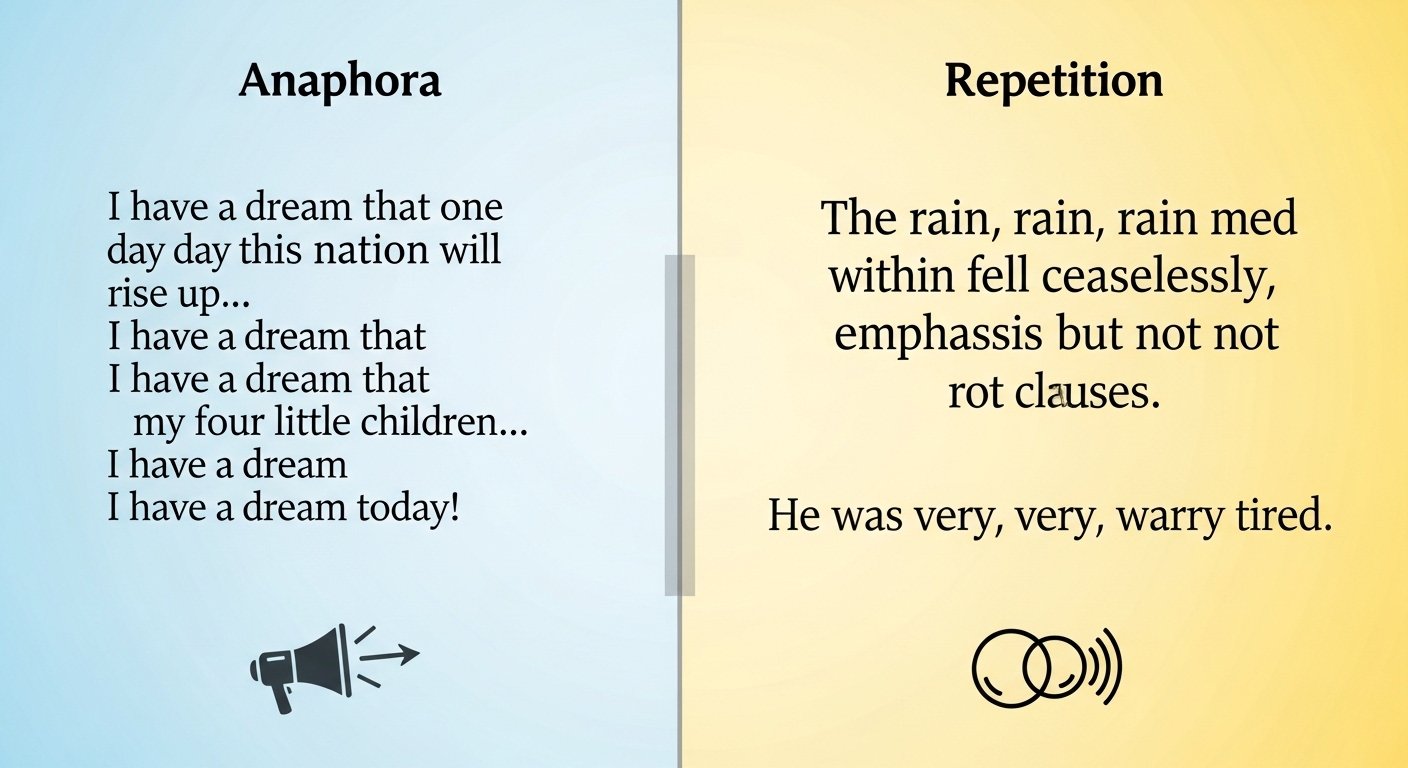
In simple terms, anaphora is a special type of repetition where the same word or phrase appears at the beginning of sentences or clauses. Repetition is a broader technique where a word or phrase is repeated anywhere in the text.
Understanding the difference between anaphora and repetition helps writers make speeches, poems, and stories more powerful and clear.
Key Difference Between the Both
Anaphora repeats a word or phrase at the beginning of sentences or clauses, while repetition repeats a word or phrase anywhere in writing or speech.
Why Their Difference Is Important for Learners and Experts
Knowing this difference helps writers control tone and emphasis. Students learn to write stronger essays and speeches. Poets and speakers use these devices to create rhythm and emotion. Experts in literature use them to analyze style and meaning in texts. These tools help shape memorable language in society, media, and literature.
Pronunciation
Anaphora
- US: /əˈnæfərə/
- UK: /əˈnæfərə/
Repetition
- US: /ˌrepəˈtɪʃən/
- UK: /ˌrepəˈtɪʃən/
Before we explore the deeper details, let us look closely at how anaphora and repetition differ in structure, use, and effect.
Difference Between Anaphora and Repetition
1. Definition
Anaphora: A rhetorical device where the same word or phrase appears at the start of sentences or clauses.
Example 1: We will fight for justice. We will fight for peace.
Example 2: Every day we learn. Every day we improve.
Repetition: The general act of repeating words or phrases anywhere in writing.
Example 1: This is very, very important.
Example 2: He ran and ran and ran.
2. Scope
Anaphora: A specific type of repetition.
Example 1: Many speeches use anaphora.
Example 2: Poets use it for rhythm.
Repetition: A broad literary technique.
Example 1: It appears in poetry and stories.
Example 2: It appears in everyday speech.
3. Position in Sentence
Anaphora: Appears at the beginning.
Example 1: This is our time. This is our hope.
Example 2: Let freedom ring. Let freedom rise.
Repetition: Can appear anywhere.
Example 1: The night was dark, dark, dark.
Example 2: She smiled again and again.
4. Purpose
Anaphora: Builds rhythm and strong emphasis.
Example 1: Used in speeches.
Example 2: Creates emotional power.
Repetition: Emphasizes an idea or feeling.
Example 1: Shows excitement.
Example 2: Shows urgency.
5. Common Use
Anaphora: Often used in speeches and poetry.
Example 1: Political speeches use it.
Example 2: Religious texts use it.
Repetition: Used in everyday language and literature.
Example 1: Stories use repetition for drama.
Example 2: Songs repeat words for rhythm.
6. Structure
Anaphora: Follows a clear pattern.
Example 1: Same phrase at the start.
Example 2: Several sentences begin the same way.
Repetition: Pattern may or may not exist.
Example 1: Words repeat randomly.
Example 2: Words repeat for emphasis.
7. Literary Category
Anaphora: A rhetorical figure.
Example 1: Found in rhetoric.
Example 2: Studied in literary analysis.
Repetition: A stylistic device.
Example 1: Used in storytelling.
Example 2: Used in poetry.
8. Emotional Impact
Anaphora: Creates strong dramatic effect.
Example 1: Speeches become memorable.
Example 2: Readers feel motivation.
Repetition: Reinforces a message.
Example 1: Shows strong emotion.
Example 2: Highlights key ideas.
9. Frequency of Use
Anaphora: Used less frequently and more carefully.
Example 1: Speeches use it for key lines.
Example 2: Poems use it for structure.
Repetition: Very common.
Example 1: Used in daily speech.
Example 2: Used in music and writing.
10. Example Type
Anaphora Example
Hope in the morning.
It is in the struggle.
Hope in the future.
Repetition Example
Hope, hope, hope keeps us alive.
Nature and Behaviour of Both
Anaphora is structured and planned. Writers use it to shape rhythm and persuasive speech.
Repetition is flexible. It may appear naturally in speech or intentionally in writing.
Why People Confuse Anaphora and Repetition
People confuse them because anaphora is actually a form of repetition. Since both repeat words, learners often think they are the same. The key difference is position and structure.
Table Showing Difference and Similarity
| Feature | Anaphora | Repetition | Similarity |
| Meaning | Repetition at sentence start | Repetition anywhere | Both repeat words |
| Scope | Specific rhetorical device | Broad technique | Used in literature |
| Position | Beginning of clauses | Any position | Used for emphasis |
| Pattern | Structured pattern | May be random | Strengthens message |
| Usage | Speeches and poetry | All writing types | Adds rhythm |
Which Is Better in What Situation?
Anaphora works best in speeches and persuasive writing. It creates rhythm and makes ideas memorable. Speakers use it when they want the audience to remember a key message.
Repetition works best in stories, songs, and emotional writing. It helps highlight important ideas or feelings. Writers use it to show excitement, fear, or strong emotion.
How Anaphora and Repetition Are Used in Metaphors and Similes
Examples:
Metaphor with repetition:
Hope is a light, a light that never fades.
Simile with repetition:
His voice echoed like thunder, thunder across the hills.
Anaphora example in imagery:
Like the sun we rise. Like the sun we shine.
Connotative Meaning
Anaphora
- Positive: Powerful, persuasive speech
Example: A speech with anaphora inspires people. - Neutral: A literary device
Example: Writers study anaphora in rhetoric.
Repetition
- Positive: Strong emphasis
Example: Repetition helps readers remember ideas. - Negative: Can feel boring if overused
Example: Too much repetition may annoy readers.
Idioms or Proverbs Related to Repetition
“Practice makes perfect.”
Example: Practice, practice, practice helps you learn.
“Again and again.”
Example: He tried again and again until he succeeded.
Works in Literature Using These Devices
- I Have a Dream — speech, Martin Luther King Jr., 1963
- A Tale of Two Cities — novel, Charles Dickens, 1859
- Leaves of Grass — poetry collection, Walt Whitman, 1855
Movies Related to Speech and Rhetoric
- The Great Debaters — 2007, USA
- The King’s Speech — 2010, UK
Frequently Asked Questions
1. Is anaphora a type of repetition?
Yes. Anaphora is a special form of repetition.
2. Where does anaphora appear in a sentence?
At the beginning of sentences or clauses.
3. Can repetition appear anywhere?
Yes. It can appear at the beginning, middle, or end.
4. Why do writers use these devices?
To emphasize ideas and create rhythm.
5. Are they common in speeches?
Yes. Many famous speeches use them.
How Both Are Useful for Communication
These devices make language stronger and clearer. They help speakers persuade audiences. They also help writers highlight important ideas. In teaching and storytelling, they make messages easier to remember.
Final Words for Both
Anaphora is a structured form of repetition used for powerful openings.
Repetition is a general tool used across all types of language.
Conclusion
The difference between anaphora and repetition is simple but important. Anaphora repeats a word or phrase at the beginning of sentences or clauses, while repetition repeats words anywhere in writing or speech. Both devices add emphasis, rhythm, and emotional impact. Writers, poets, and speakers use them to make language memorable and persuasive. By understanding the difference, learners can recognize these tools in literature and use them effectively in their own writing and speeches.

I’m Zahid Abbas, an educator, researcher, and digital publishing strategist with a passion for linguistics, grammar, and clear communication. As a content creator and SEO specialist, I craft research-driven, reader-focused content that empowers learners and makes knowledge accessible worldwide.