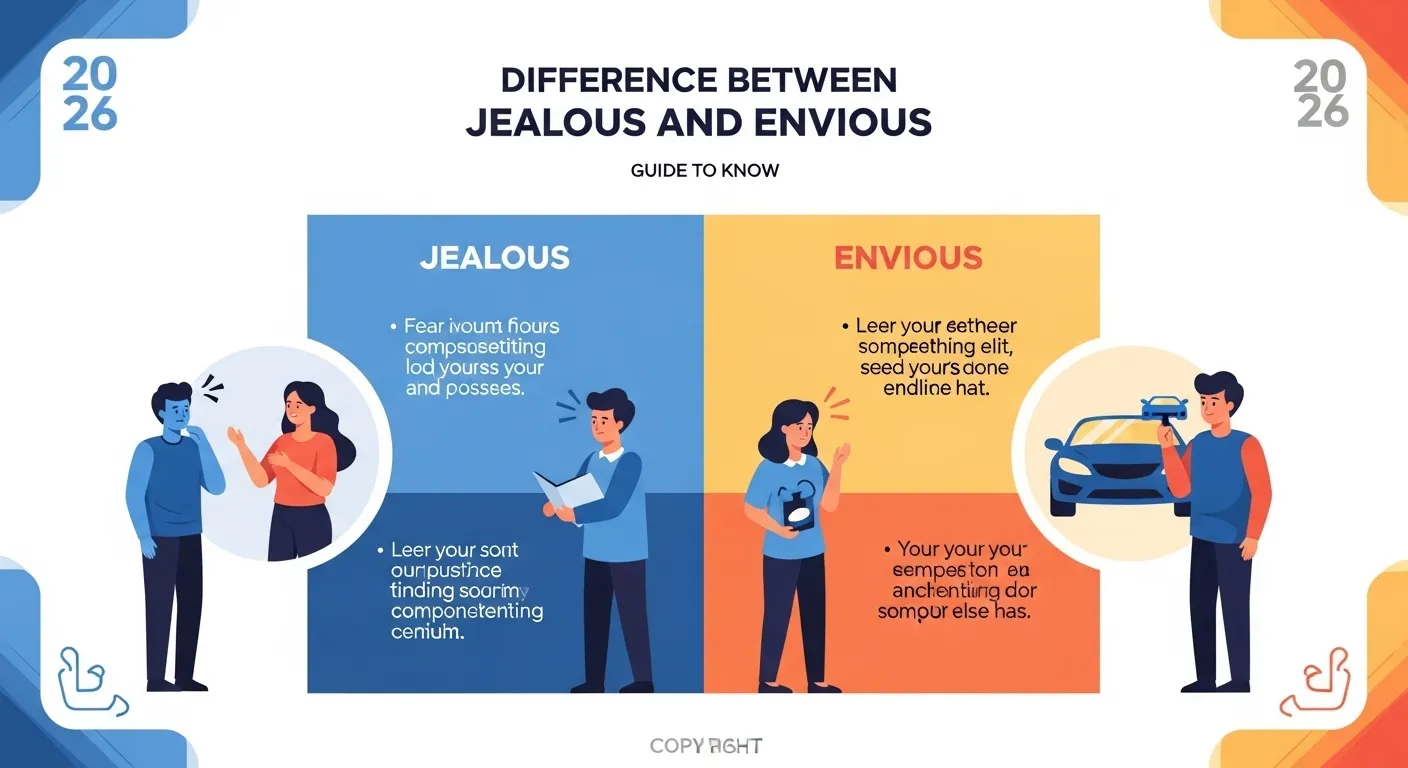
One day, two friends worked in the same office. One friend got a promotion. The other friend felt bad. But the feeling was not simple. He thought, “I wish I had that job.” He also thought, “I hope my friend does not take my place in the team.” These two thoughts show two different emotions. This is where people start asking about the difference between jealous and envious.
Many people use these words in the same way. But the difference between jealous and envious is real and important. When someone feels sad because another person has something good, that feeling may be envy.
When someone fears losing something they already have, that feeling may be jealousy. Understanding the difference between jealous and envious helps people speak clearly.
It also helps us understand human emotions better. In daily life, the difference between jealous and envious appears in friendship, love, work, and success.
Key Difference Between the Both
The main idea in the difference between jealous and envious is simple.
- Envy happens when you want something another person has.
- Jealousy happens when you fear losing something you already have.
Why Their Difference Is Important for Learners and Experts in Society
Knowing the difference between jealous and envious helps people communicate clearly. Students, writers, teachers, and speakers use these words often. When the meaning is correct, the message becomes strong and clear.
In society, emotions guide human actions. If people understand envy and jealousy, they can manage feelings better. It helps in relationships, teamwork, and leadership.
Pronunciation of the Words
Jealous
- US: /ˈdʒeləs/
- UK: /ˈdʒeləs/
Envious
- US: /ˈenviəs/
- UK: /ˈenviəs/
Difference Between the Keywords
1. Basic Meaning
Jealous: fear of losing something you have.
Examples:
- She felt jealous when her friend talked to her boyfriend.
- The child felt jealous of the new baby.
Envious: wanting what someone else has.
Examples:
- He felt envious of his neighbor’s big house.
- She felt envious of her friend’s success.
2. Number of People Involved
Jealous: usually involves three people.
Examples:
- A husband feels jealous of his wife’s new friend.
- A student feels jealous when the teacher praises another student.
Envious: usually involves two people.
Examples:
- He envies his friend’s new car.
- She envies her sister’s talent.
3. Focus of the Feeling
Jealous: focuses on protecting a relationship.
Examples:
- She was jealous of anyone near her partner.
- The dog felt jealous when the owner hugged another pet.
Envious: focuses on desire.
Examples:
- He envies rich people.
- She envies her friend’s beauty.
4. Emotional Nature
Jealous: fear and worry.
Examples:
- He worried someone would take his place.
- She feared losing her best friend.
Envious: longing or desire.
Examples:
- He wanted the same success.
- She wished for the same dress.
5. Social Context
Jealous: common in romantic relationships.
Examples:
- A boyfriend feels jealous.
- A wife feels jealous.
Envious: common in success or wealth.
Examples:
- A worker envies a rich boss.
- A student envies a topper.
6. Emotional Direction
Jealous: defensive feeling.
Examples:
- He protects his friendship.
- She guards her relationship.
Envious: outward desire.
Examples:
- He wants the other person’s job.
- She wants the other person’s house.
7. Intensity
Jealous: often stronger.
Examples:
- Jealous partners argue.
- Jealous friends fight.
Envious: often quiet.
Examples:
- Someone quietly envies success.
- Someone secretly envies beauty.
8. Cause
Jealous: fear of losing something.
Examples:
- Losing love.
- Losing attention.
Envious: desire to gain something.
Examples:
- Wanting money.
- Wanting fame.
9. Reaction
Jealous: may cause anger.
Examples:
- A jealous person argues.
- A jealous friend complains.
Envious: may cause admiration.
Examples:
- An envious student studies harder.
- An envious worker works more.
10. Language Use
Jealous: used for relationships.
Examples:
- “He is jealous of her friend.”
- “She feels jealous in love.”
Envious: used for possessions.
Examples:
- “He envies their house.”
- “She envies their success.”
Nature and Behaviour of Both
Jealous people often show fear and protection. They worry about losing love, friendship, or attention. Their behavior may include anger, suspicion, or insecurity.
Envious people show desire. They want the same success or object another person has. Sometimes envy pushes people to work harder.
Why People Confuse Jealous and Envious
People confuse these words because everyday language mixes them. Many speakers use “jealous” for both feelings. Movies, songs, and daily speech also mix the meanings. Because of this habit, people forget the real difference between jealous and envious.
Which Is Better in What Situation?
Jealousy in some situations
Jealousy can show that someone values a relationship. A small amount of jealousy may protect love or friendship. For example, a partner may feel jealous when someone else shows too much attention. This feeling may help people care more about their relationship.
Envy in some situations
Envy can sometimes motivate people. When someone sees another person succeed, envy may push them to work harder. A student may envy a top student and start studying more. In this way, envy can create growth.
Use of Jealous and Envious in Metaphors and Similes
People often use these emotions in figurative language.
Examples:
- “Green with envy.”
- “Burning with jealousy.”
- “Jealous like a guard dog.”
- “Envy eats the heart.”
Connotative Meaning
Jealous
- Usually negative Example:
- His jealous anger ruined the friendship.
Envious
- Often negative but sometimes neutral Example:
- She felt envious but also inspired.
Idioms and Proverbs
Green with envy
Example:
- He was green with envy when he saw the new car.
The grass is always greener on the other side
Example:
- She envies other jobs, but the grass is always greener on the other side.
Jealous as a cat
Example:
- The child was jealous as a cat when the baby arrived.
Works in Literature
- Othello — tragedy by William Shakespeare (1603)
- The Count of Monte Cristo — adventure novel by Alexandre Dumas (1844)
- The Great Gatsby — novel by F. Scott Fitzgerald (1925)
Movies Related to the Theme
- Envy (2004, USA)
- Jealousy (2013, France)
- The Talented Mr. Ripley (1999, USA)
Frequently Asked Questions
1. Are jealousy and envy the same? No. Jealousy fears loss. Envy wants what others have.
2. Can envy be positive? Sometimes yes. It may motivate people to improve.
3. Is jealousy always bad? Too much jealousy can harm relationships.
4. Why do people mix these words? Daily language often uses them in the same way.
5. Which word is correct when wanting someone’s success? The correct word is envy.
How Jealousy and Envy Affect Our Surroundings
These emotions influence relationships and society. Jealousy can protect bonds but may also cause conflict. Envy may lead to competition and improvement. When people manage these feelings well, they create healthy relationships and positive growth.
Final Words for the Two Feelings
Jealousy protects what we love. Envy shows what we desire. Both emotions are natural parts of human life.
Conclusion
Understanding the difference between jealous and envious helps us use language correctly and understand human emotions more deeply. Jealousy comes from fear of losing something important, such as love or friendship. Envy comes from the desire to have something another person owns. Though people often mix these words, their meanings are different. Knowing this difference improves communication, writing, and emotional awareness. It also helps people manage feelings better in relationships and society. When used correctly, these words describe human emotions clearly and powerfully.

I’m Zahid Abbas, an educator, researcher, and digital publishing strategist with a passion for linguistics, grammar, and clear communication. As a content creator and SEO specialist, I craft research-driven, reader-focused content that empowers learners and makes knowledge accessible worldwide.