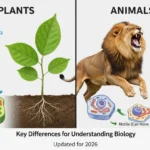
A child visiting Lahore Zoo saw trees, flowers, and animals. The child asked, “What is the difference between plants and animals?” This is a common question.
The difference between plants and animals is about how they live, grow, and get food. When you learn the difference between plants and animals, you understand life better.
The difference between plants and animals helps in science, farming, and daily life.
Key Difference Between the Both
Plants make their own food using sunlight.
Animals cannot make their own food and must eat other things.
The main difference is self-feeding vs dependent feeding.
Why Is Their Difference Necessary to Know for Learners and Experts?
Students learn biology basics. Farmers grow crops and raise animals. Scientists study life systems. In society, this knowledge supports food supply and environment care.
Pronunciation
Plants
- US: /plænts/
- UK: /plɑːnts/
Animals
- US: /ˈæn.ɪ.məlz/
- UK: /ˈæn.ɪ.məlz/
Now let us explore more.
Difference Between Plants and Animals
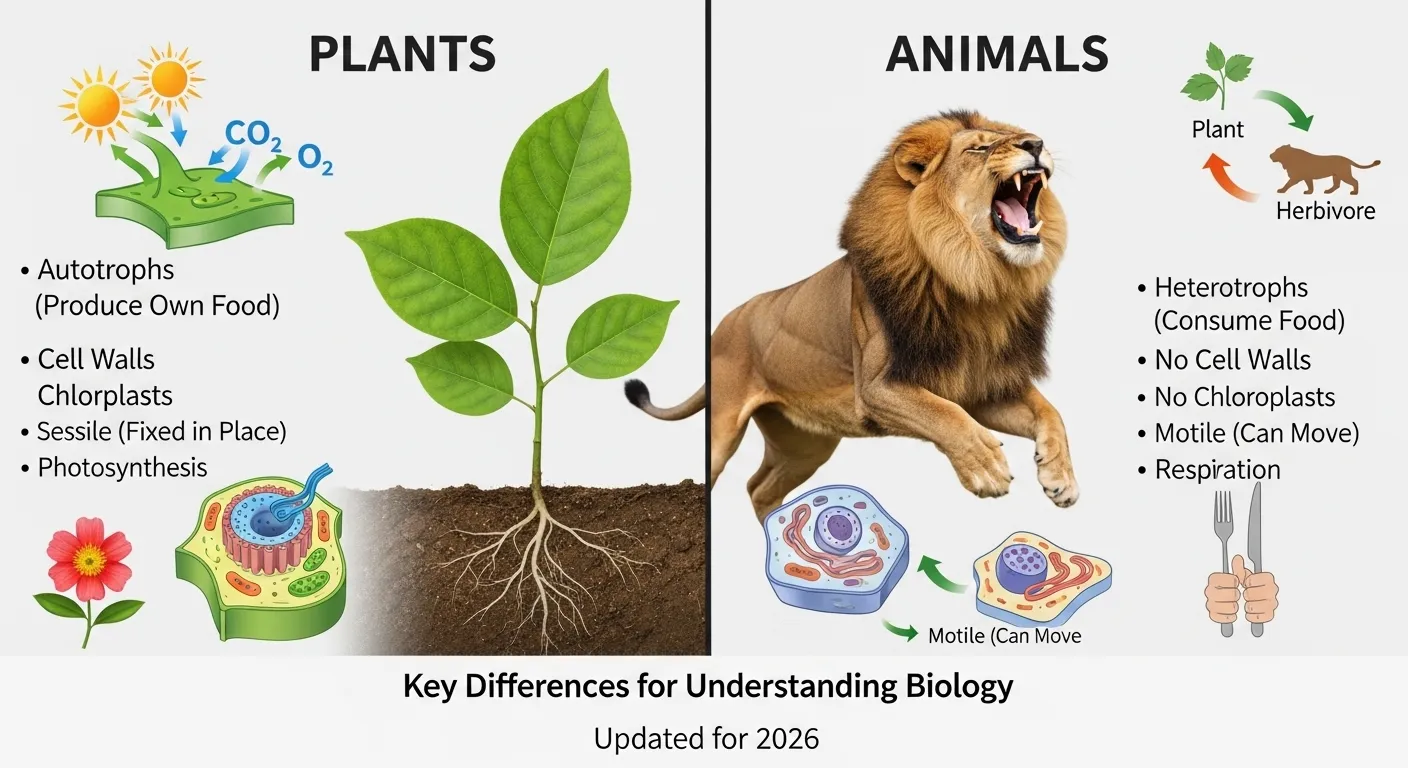
1. Food Making
Plants make food by photosynthesis.
- Example 1: Use sunlight.
- Example 2: Use carbon dioxide.
Animals eat food.
- Example 1: Eat plants.
- Example 2: Eat other animals.
2. Movement
Plants do not move from place to place.
- Example 1: Trees stay in one spot.
- Example 2: Flowers remain fixed.
Animals can move.
- Example 1: Dogs run.
- Example 2: Birds fly.
3. Cells
Plants have cell walls.
- Example 1: Strong structure.
- Example 2: Fixed shape.
Animals do not have cell walls.
- Example 1: Flexible cells.
- Example 2: Different shapes.
4. Energy Source
Plants get energy from sunlight.
- Example 1: Green leaves.
- Example 2: Chlorophyll.
Animals get energy from food.
- Example 1: Eat to survive.
- Example 2: Digest food.
5. Growth
Plants grow throughout life.
- Example 1: Trees grow taller.
- Example 2: Roots spread.
Animals grow to a certain size.
- Example 1: Humans stop growing.
- Example 2: Animals reach maturity.
6. Response
Plants respond slowly.
- Example 1: Turn toward light.
- Example 2: Close leaves slowly.
Animals respond quickly.
- Example 1: Run from danger.
- Example 2: React to sound.
7. Reproduction
Plants reproduce by seeds or spores.
- Example 1: Seed growth.
- Example 2: Flower pollination.
Animals reproduce by giving birth or laying eggs.
- Example 1: Mammals give birth.
- Example 2: Birds lay eggs.
8. Nervous System
Plants do not have nervous system.
- Example 1: No brain.
- Example 2: No nerves.
Animals have nervous system.
- Example 1: Brain control.
- Example 2: Nerve signals.
9. Breathing
Plants exchange gases through leaves.
- Example 1: Take in CO₂.
- Example 2: Release oxygen.
Animals breathe oxygen.
- Example 1: Lungs or gills.
- Example 2: Release CO₂.
10. Habitat Role
Plants produce oxygen and food.
- Example 1: Forests.
- Example 2: Crops.
Animals depend on plants.
- Example 1: Herbivores eat plants.
- Example 2: Carnivores eat animals.
Nature and Behaviour of Both
Plants are stable and self-sufficient. They stay in one place.
Animals are active and dependent. They move and interact.
Why Are People Confused About Their Use?
Both are living things. Both grow and reproduce. This similarity causes confusion, especially for beginners.
Table Showing Difference and Similarity
| Feature | Plants | Animals | Similarity |
| Food | Make own | Eat others | Living things |
| Movement | Fixed | Mobile | Grow |
| Cells | Cell wall | No cell wall | Cells present |
| Energy | Sunlight | Food | Need energy |
| Role | Producers | Consumers | Ecosystem |
Which Is Better in What Situation?
Plants are better for environment support. They give oxygen, food, and shelter. They are essential for life on Earth.
Animals are better for movement and interaction. They help in pollination, food chains, and ecosystem balance.
Use in Metaphors and Similes
Plants may represent calmness.
Example: “He stood like a plant.”
Animals may represent action.
Example: “She ran like an animal.”
Connotative Meaning
Plants – Positive
- Example: “Green plants bring life.”
Animals – Positive
- Example: “Animals add diversity.”
Idioms and Proverbs
Animals
- “A wolf in sheep’s clothing”
- Example: “He looked kind but was a wolf in sheep’s clothing.”
Plants
- “Nip it in the bud”
- Example: “Stop the problem early, nip it in the bud.”
Works in Literature
- The Secret Life of Plants – Non-fiction, Peter Tompkins & Christopher Bird, 1973
Movie Names
- The Jungle Book (1967, USA)
Five Frequently Asked Questions
1. Are plants living things?
Yes.
2. Can animals make their own food?
No.
3. Which produce oxygen?
Plants.
4. Which can move?
Animals.
5. Do both grow?
Yes.
How Are Both Useful for Surroundings?
Plants provide oxygen, food, and shelter. Animals help in pollination and balance ecosystems. Both are essential for life on Earth.
Final Words for Both
Plants make food and stay still.
Animals eat food and move around.
Conclusion
The difference between plants and animals is clear. Plants make their own food and stay in one place. Animals depend on other sources and can move. Both are important for life and the environment. Understanding their difference helps in learning biology and caring for nature.

I’m Zahid Abbas, an educator, researcher, and digital publishing strategist with a passion for linguistics, grammar, and clear communication. As a content creator and SEO specialist, I craft research-driven, reader-focused content that empowers learners and makes knowledge accessible worldwide.