A boy walks into two burger shops in the same city. Both shops have the same logo, same food, and same uniforms. He thinks both shops belong to one company. Later, his father tells him one shop is a franchise and the other is corporate. The boy feels confused. Many people do not understand the difference between franchise and corporate because both businesses may look the same from outside.
The difference between franchise and corporate is mainly about ownership and control. A franchise is owned by a local person who uses a company’s brand and system. A corporate business is fully owned and controlled by the main company. Learning the difference between franchise and corporate is useful for students, workers, and business learners.
It helps people understand shops, restaurants, offices, and modern business systems in daily life.
What is “Franchise”?
A franchise is a business owned by a person or group that uses another company’s name, products, and business system.
History of Franchise
The franchise system started many years ago. Companies wanted to grow into new cities without opening every shop themselves. They allowed local people to use the company name and business methods after paying fees. This system became very popular in food and retail businesses. Over time, many famous brands used franchises to grow quickly around the world. Today, restaurants, gyms, hotels, and stores often use the franchise model because it helps both the company and local business owners.
What is “Corporate”?
A corporate business is a business fully owned and managed by the main company.
History of Corporate
Corporate businesses became more common during the growth of large industries. Big companies needed strong systems to manage workers, factories, and offices. They created company-owned branches with fixed rules and management. Over time, corporate systems became popular in banks, airlines, technology firms, and large stores. Today, many global companies use corporate structures to keep the same quality, branding, and control in every location.
Franchise vs Corporate
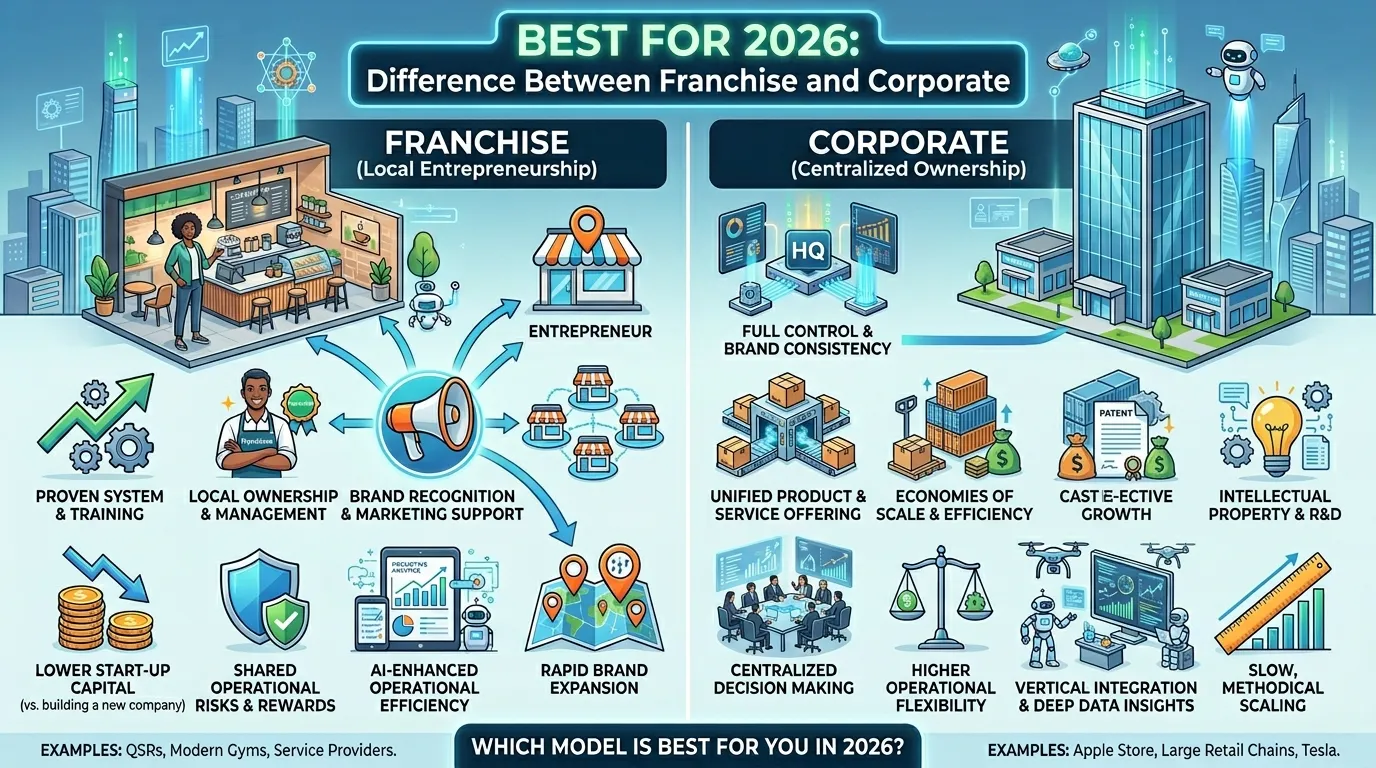
A franchise is locally owned using a company brand, while a corporate business is fully owned by the company itself.
Now let us understand both in a simple and clear way.
How Franchise Works
A franchise owner pays money to use a company’s name, products, and business system.
Key Features
- Owned by a local person
- Uses company brand
- Pays franchise fees
- Follows company rules
- Gets company support
Example Sentences
🔵 My cousin owns a franchise coffee shop.
🔵 The franchise owner followed company rules carefully.
Uses
- Restaurants
- Hotels
- Gyms
- Retail stores
- Education centers
How Corporate Works
A corporate business is directly owned and controlled by the company.
Key Features
- Company-owned
- Controlled by headquarters
- Same system everywhere
- Workers follow company rules
- Company keeps profits
Example Sentences
🟢 She works in a corporate office downtown.
🟢 The corporate branch followed head office instructions.
Uses
- Banks
- Airline companies
- Technology firms
- Big retail chains
- Insurance companies
Which One Should You Use?
Choose a franchise if you want to run your own business with support from a famous brand. Choose a corporate system if the company wants full control over all branches and services.
10 Differences Between Franchise and Corporate
1. Ownership
Franchise: A franchise is owned by a local person or group.
🔴 Ahmed owns a fast-food franchise.
🔴 A family manages the local store.
Corporate: A corporate business is owned by the company itself.
🔴 The company owns the office branch.
🔴 Headquarters controls the business.
2. Control
Franchise: Franchise owners have some freedom in daily work.
🔴 The owner changed store timings.
🔴 He hired local employees.
Corporate: Corporate branches follow strict company control.
🔴 Managers followed company orders.
🔴 The office used company policies.
3. Investment
Franchise: The owner invests personal money.
🔴 She used savings to buy a franchise.
🔴 He paid the startup fee himself.
Corporate: The company invests money in branches.
🔴 The company opened a new office.
🔴 Corporate stores use company funds.
4. Profit
Franchise: Franchise owners share profits through fees.
🔴 The owner paid monthly royalties.
🔴 Part of the income went to the company.
Corporate: The company keeps all profits.
🔴 Corporate sales went to headquarters.
🔴 The company earned all branch income.
5. Risk
Franchise: Franchise owners carry more personal risk.
🔴 He lost money during slow months.
🔴 The owner paid business costs himself.
Corporate: The company carries most financial risk.
🔴 The company handled branch losses.
🔴 Employees did not lose personal money.
6. Flexibility
Franchise: Franchise stores may make local changes.
🔴 The owner added local food items.
🔴 Store hours changed during holidays.
Corporate: Corporate branches stay mostly the same.
🔴 Every branch looked identical.
🔴 Menus followed company standards.
7. Training
Franchise: Franchise owners receive company training.
🔴 Workers learned company methods.
🔴 Owners attended business training.
Corporate: Corporate workers are trained by the company.
🔴 Employees joined company workshops.
🔴 Managers followed corporate programs.
8. Expansion
Franchise: Franchises help brands grow quickly.
🔴 Many franchise stores opened in one year.
🔴 Local owners helped business growth.
Corporate: Corporate growth may take more time.
🔴 The company slowly opened branches.
🔴 Expansion needed large company budgets.
9. Decision-Making
Franchise: Franchise owners make some local decisions.
🔴 The owner planned local sales offers.
🔴 He managed daily store work.
Corporate: Main offices make important decisions.
🔴 Headquarters approved new prices.
🔴 Managers followed company plans.
10. Employees
Franchise: Workers work for the local owner.
🔴 The franchise owner hired staff members.
🔴 Workers reported to the shop owner.
Corporate: Workers work directly for the company.
🔴 Employees followed company managers.
🔴 Staff worked under corporate rules.
Why People Get Confused About Their Use
People often get confused because franchise and corporate businesses may look exactly the same. They may use the same logos, menus, uniforms, and products. Customers usually cannot see the ownership system behind the business. A burger shop may look the same inside and outside whether it is franchise-owned or corporate-owned. The real difference is who owns the business and who controls daily operations.
Table: Difference and Similarity
| Feature | Franchise | Corporate | Similarity |
| Ownership | Local owner | Company-owned | Both use company branding |
| Control | Shared control | Full company control | Both follow business systems |
| Investment | Personal investment | Company investment | Both need money |
| Risk | Owner risk | Company risk | Both face business challenges |
| Expansion | Faster growth | Slower growth | Both expand businesses |
| Training | Company support | Internal training | Both train workers |
| Profit | Shared with company | Goes to company | Both aim for profit |
Which is Better in What Situation?
A franchise is better for people who want business ownership with help from a famous company. It is useful for beginners because the company already provides training, branding, and support. Franchise owners can also understand local customer needs better.
A corporate business is better for companies that want strong control and equal quality everywhere. It helps large companies keep the same products, rules, and customer experience in every branch. Corporate systems also make management easier for big organizations.
How Are “Franchise” and “Corporate” Used in Metaphors and Similes?
🟣 “The shop spread like a franchise.”
Meaning: The business grew very fast.
🟣 “The office felt corporate.”
Meaning: The office felt formal and strict.
🟣 “Their team worked like a corporate machine.”
Meaning: The team worked in a very organized way.
🟣 “His business became a franchise overnight.”
Meaning: His business became successful very quickly.
Connotative Meaning
Franchise
🟣 Positive: “Franchises help small business owners succeed.”
🟣 Neutral: “He owns a franchise restaurant.”
🟣 Negative: “Some people think franchises reduce creativity.”
Corporate
🟣 Positive: “Corporate systems improve organization.”
🟣 Neutral: “She works in a corporate building.”
🟣 Negative: “Some people think corporate offices feel cold.”
Idioms or Proverbs
🟣 “Time is money.”
Meaning: Time is valuable in business.
Example: The franchise owner worked quickly because time is money.
🟣 “Think outside the box.”
Meaning: Use creative ideas.
Example: The corporate team used new ideas to solve the problem.
🟣 “Learn the ropes.”
Meaning: Learn how something works.
Example: The new franchise owner learned the ropes quickly.
Works in Literature
🟣 The Franchise Affair — Josephine Tey, 1948
🟣 Barbarians at the Gate — Bryan Burrough and John Helyar, 1989
Movies Related to the Keywords
🟣 The Founder — 2016, United States
🟣 Office Space — 1999, United States
🟣 Wall Street — 1987, United States
Frequently Asked Questions
1. What is a franchise?
A franchise is a business owned by a local person using another company’s brand and system.
2. What is a corporate business?
A corporate business is fully owned and managed by the company.
3. Which one gives more freedom?
A franchise usually gives more local freedom to the owner.
4. Which one grows faster?
Franchises often grow faster because many local owners invest money.
5. Are employees different in both systems?
Yes. Franchise workers work for local owners, while corporate workers work for the company.
Final Words
Franchise and corporate businesses are important parts of modern life. One system helps local owners start businesses with company support. The other system helps companies keep strong control and equal standards. Learning these business words can improve your English and business knowledge at the same time.
Conclusion
The difference between franchise and corporate is mainly about ownership, control, and business structure. A franchise is owned by a local person who uses a company’s brand and system. A corporate business is fully owned and managed by the company itself. Both systems help businesses grow and serve customers around the world. Understanding the difference between franchise and corporate helps students, workers, and business learners use these terms correctly and confidently.

I’m Zahid Abbas, an educator, researcher, and digital publishing strategist with a passion for linguistics, grammar, and clear communication. As a content creator and SEO specialist, I craft research-driven, reader-focused content that empowers learners and makes knowledge accessible worldwide.