On a calm morning walk in London, a child pointed at a single bird near a pond and said, “Look, a goose!” Moments later, a flock flew overhead, and the child said, “Look at the gooses!” The parent gently corrected, “Those are geese.” This simple scene highlights the difference between goose and geese, a common point of confusion for English learners.
The difference between goose and geese is not just about number; it also shows how English uses irregular plural forms. Understanding the difference between goose and geese improves grammar, speaking, and writing skills.
When you clearly know the difference between goose and geese, you avoid common mistakes and sound more natural in English.
Key Difference Between the Both
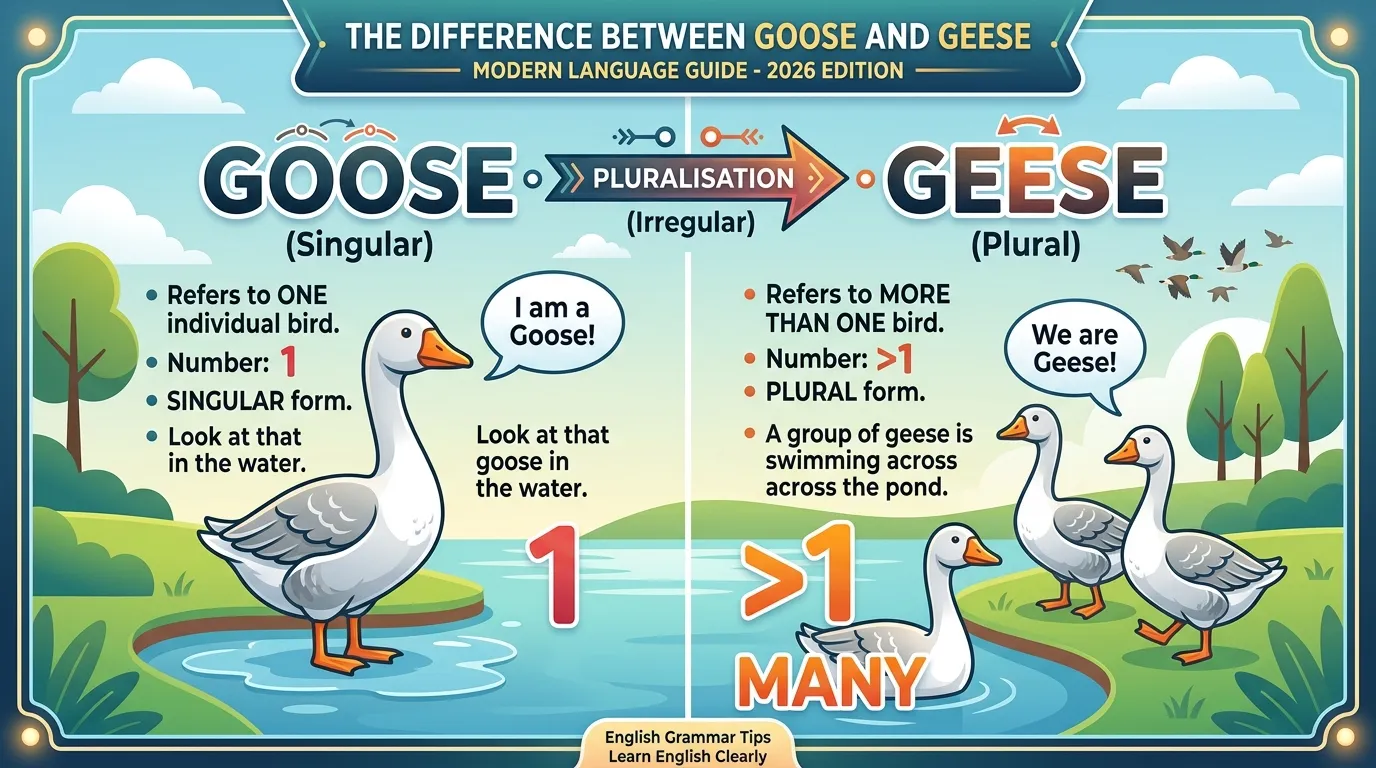
Goose refers to one bird.
Geese refers to more than one bird.
The main difference is singular vs plural form of the same noun.
Why Is Their Difference Necessary to Know for Learners and Experts?
For learners, mastering this difference builds strong grammar foundations. For teachers and writers, it ensures accuracy in communication. In society, correct language helps in education, storytelling, and everyday conversations. It also reflects a good understanding of English patterns.
Pronunciation
Goose
- US: /ɡuːs/
- UK: /ɡuːs/
Geese
- US: /ɡiːs/
- UK: /ɡiːs/
The vowel sound changes from “oo” in goose to “ee” in geese.
Now let us explore the details.
Difference Between Goose and Geese
1. Number and Meaning
Goose refers to a single bird.
- Example 1: A goose is swimming in the lake.
- Example 2: The goose looks calm.
Geese refers to multiple birds.
- Example 1: Geese are flying in formation.
- Example 2: The geese are noisy.
2. Grammatical Form
Goose is a singular noun.
- Example 1: One goose is enough.
- Example 2: The goose walks slowly.
Geese is a plural noun.
- Example 1: Two geese are here.
- Example 2: Many geese gather in winter.
3. Verb Agreement
Goose takes a singular verb.
- Example 1: The goose is eating grass.
- Example 2: A goose honks loudly.
Geese takes a plural verb.
- Example 1: The geese are eating grass.
- Example 2: Geese honk loudly.
4. Spelling Pattern
Goose changes its vowel to form the plural.
- Example 1: Not “gooses.”
- Example 2: Special spelling rule.
Geese shows an irregular plural pattern.
- Example 1: Vowel change from “oo” to “ee.”
- Example 2: Similar to foot → feet.
5. Usage in Sentences
Goose is used when speaking about one animal.
- Example 1: I saw a goose near the river.
- Example 2: The goose crossed the road.
Geese is used for groups.
- Example 1: I saw many geese near the river.
- Example 2: The geese crossed together.
6. Common Mistakes
Goose is often wrongly pluralized.
- Example 1: Incorrect: gooses.
- Example 2: Correct: geese.
Geese is the correct plural form.
- Example 1: Correct in exams.
- Example 2: Correct in daily speech.
7. Word Category
Goose names a single member of the species.
- Example 1: Farm goose.
- Example 2: Wild goose.
Geese refers to a group or flock.
- Example 1: Migrating geese.
- Example 2: A flock of geese.
8. Learning Pattern
Goose belongs to irregular nouns.
- Example 1: Tooth.
- Example 2: Foot.
Geese follows vowel-change plural pattern.
- Example 1: Tooth → teeth.
- Example 2: Foot → feet.
9. Sound Difference
Goose has a long “oo” sound.
- Example 1: Smooth vowel sound.
- Example 2: /uː/ sound.
Geese has a long “ee” sound.
- Example 1: Sharp vowel sound.
- Example 2: /iː/ sound.
10. Contextual Use
Goose is used in single-animal stories or examples.
- Example 1: A goose in a farm story.
- Example 2: One bird description.
Geese is used in group or migration contexts.
- Example 1: Geese flying south in winter.
- Example 2: Group behavior discussion.
Nature and Behaviour of Both
A goose is one bird, often calm but sometimes protective.
Geese are social animals. They live, travel, and migrate in groups, often forming V-shaped patterns in the sky.
Why Are People Confused About Their Use?
The confusion comes from English irregular plurals. Many words add “-s” for plural, but goose changes form completely. Learners expect “gooses,” which is incorrect, so mistakes are common.
Table Showing Difference and Similarity
| Feature | Goose | Geese | Similarity |
| Number | Singular | Plural | Same species |
| Grammar | One noun | Many nouns | Animal name |
| Verb Use | Singular verb | Plural verb | English usage |
| Spelling | Goose | Geese | Irregular pattern |
| Meaning | One bird | Group of birds | Same identity |
Which Is Better in What Situation?
Use goose when referring to a single bird in writing or speech. It is correct for one animal only.
Use geese when referring to two or more birds. It is essential for describing groups, flocks, or migration patterns.
How Are the Keywords Used in Metaphors and Similes?
Goose appears in playful or humorous expressions.
- “You silly goose!”
Geese often appear in descriptive imagery.
- “They moved together like geese in the sky.”
Connotative Meaning
Goose – Neutral or playful
- Example: “He acted like a silly goose.”
Geese – Neutral, sometimes natural imagery
- Example: “Geese flying at sunset look peaceful.”
Idioms and Proverbs
Goose
- “Wild goose chase”
- Example: “We went on a wild goose chase looking for the keys.”
- “Kill the goose that lays the golden eggs”
- Example: “Do not harm a good source of income.”
Geese
- Used more in imagery than fixed idioms.
Five Frequently Asked Questions
1. What is the plural of goose?
Geese.
2. Why is it not gooses?
Because goose is an irregular noun.
3. Is goose singular or plural?
Singular.
4. How do I use geese in a sentence?
Example: The geese are flying south.
5. Are goose and geese different animals?
No, they are the same animal in different numbers.
How Are Both Useful for Surroundings?
Geese play an important role in nature. They help maintain ecosystems, spread seeds, and are part of agriculture and food systems in many cultures.
Final Words for Both
Goose refers to one bird.
Geese refers to many birds.
Conclusion
The difference between goose and geese is a clear example of an irregular plural in English. Goose is the singular form, while geese is the plural form. Although the change may seem unusual at first, it follows a pattern seen in other words like foot and feet. By understanding this difference, learners can improve their grammar, avoid common mistakes, and communicate more confidently in English.

I’m Zahid Abbas, an educator, researcher, and digital publishing strategist with a passion for linguistics, grammar, and clear communication. As a content creator and SEO specialist, I craft research-driven, reader-focused content that empowers learners and makes knowledge accessible worldwide.