When people notice shaking hands, slow walking, muscle weakness, slurred speech, or trouble with movement, they often fear a serious neurological disease. Two conditions that are frequently mentioned are ALS and Parkinson’s disease. Both illnesses affect the nervous system. Both can change movement, independence, and quality of life. Because some symptoms may look similar from the outside, many people search for the difference between ALS and Parkinson’s.
However, these diseases are not the same. The real difference between ALS and Parkinson’s lies in the nerves they damage, the symptoms they cause, how quickly they progress, and the treatments used to manage them. ALS mainly attacks the nerve cells that control muscles.
Parkinson’s mainly affects brain cells that produce dopamine, a chemical needed for smooth movement. Understanding the difference between ALS and Parkinson’s helps patients, caregivers, students, and families make sense of symptoms and seek timely medical help.
Millions of people worldwide live with neurological disorders, and awareness matters. Learning the difference between ALS and Parkinson’s can reduce confusion, build empathy, and support earlier diagnosis. In this expert guide, you will learn symptoms, causes, progression, treatment options, and how these two conditions compare in real life.
Key Difference Between ALS and Parkinson’s
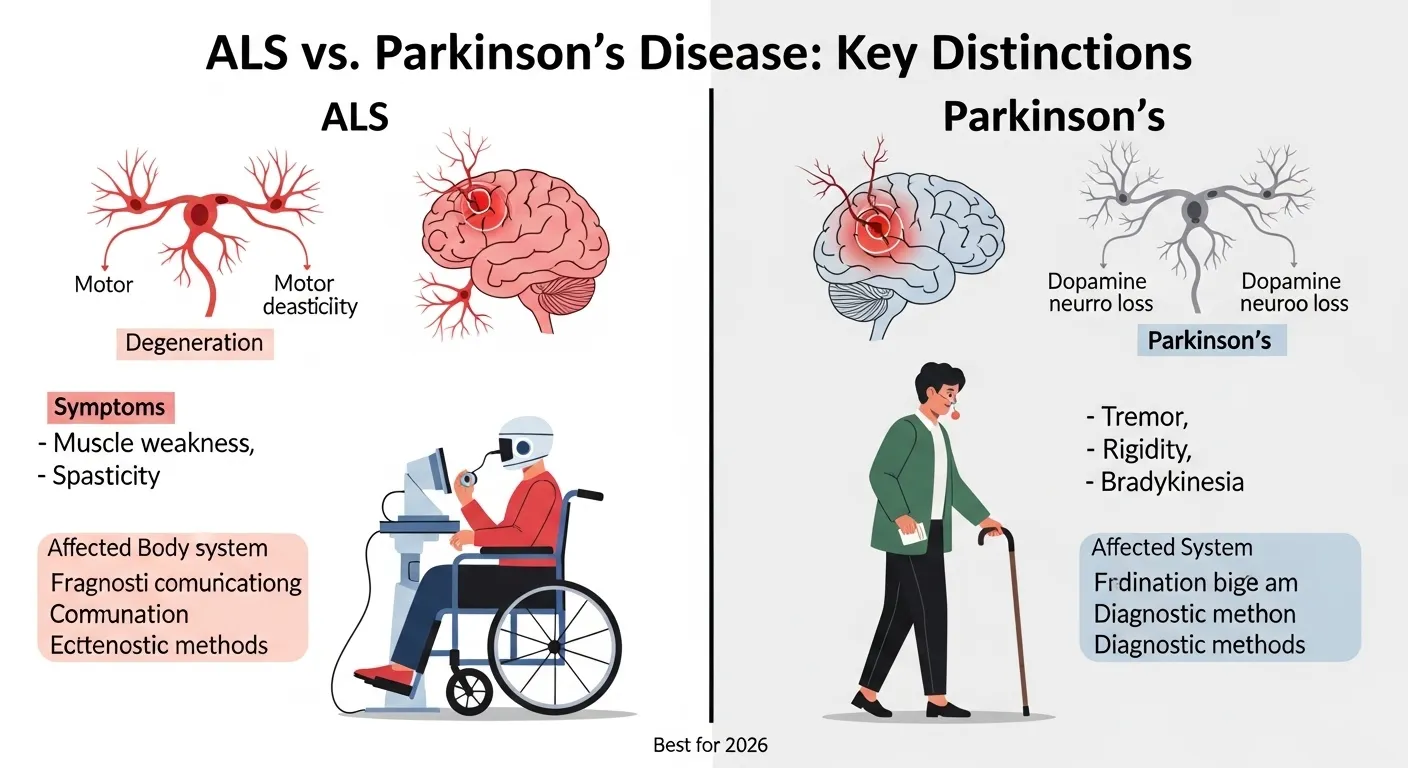
The main difference between ALS and Parkinson’s is the part of the nervous system that is most affected.
- ALS (Amyotrophic Lateral Sclerosis) damages motor neurons, the nerve cells that control voluntary muscles.
- Parkinson’s disease damages dopamine-producing brain cells involved in movement control.
Simple Summary
- ALS = progressive muscle-control nerve disease
- Parkinson’s = movement-control brain disorder
Why Knowing This Difference Matters
Understanding the difference between ALS and Parkinson’s is important for many reasons.
For Patients
Early symptoms may be recognized faster.
For Families
It helps prepare for long-term care needs.
For Caregivers
Different conditions require different support methods.
For Students
It teaches how neurological diseases affect the body in different ways.
For Society
Better awareness reduces fear, myths, and stigma.
Pronunciation of Both
ALS
- US: A-L-S
- UK: A-L-S
Parkinson’s
- US: PAR-kin-sunz
- UK: PAA-kin-sunz
Now let us compare these conditions in depth.
Difference Between ALS and Parkinson’s
1. Full Medical Name
ALS
Amyotrophic Lateral Sclerosis.
Examples:
- Also called Lou Gehrig’s disease in some countries
- Type of motor neuron disease
Parkinson’s
Parkinson’s disease.
Examples:
- Progressive movement disorder
- Common neurological condition in older adults
2. Main Area Affected
ALS
Motor neurons in the brain and spinal cord.
Parkinson’s
Basal ganglia and dopamine pathways in the brain.
3. Common Early Symptoms
ALS
- Muscle weakness
- Hand grip problems
- Foot drop
- Twitching
- Speech changes
Parkinson’s
- Tremor at rest
- Slowness of movement
- Stiff muscles
- Balance changes
- Smaller handwriting
4. Tremor
ALS
Tremor is not usually the classic first sign.
Parkinson’s
Tremor is one of the most recognized symptoms.
Examples:
- Hand shaking while resting
- Finger rolling movement
5. Muscle Weakness
ALS
Major early feature and often progressive.
Examples:
- Trouble lifting objects
- Difficulty climbing stairs
Parkinson’s
Weakness may be felt, but stiffness and slowness are more common than true muscle weakness.
6. Walking and Balance
ALS
Walking becomes difficult because muscles weaken.
Parkinson’s
Walking changes due to slow movement and balance problems.
Examples:
- Shuffling steps
- Reduced arm swing
7. Speech and Swallowing
ALS
Often affected as disease progresses.
Parkinson’s
Can also occur, especially later.
Examples:
- Soft voice
- Slurred speech
- Trouble swallowing
8. Disease Progression
ALS
Often progresses faster.
Parkinson’s
Often progresses more slowly over many years.
9. Treatment Approach
ALS
Focuses on slowing disease progression where possible, symptom control, breathing support, nutrition, mobility aids, and therapy.
Parkinson’s
Focuses on improving dopamine activity, exercise, therapy, and symptom management.
10. Long-Term Impact
ALS
Can affect speaking, swallowing, movement, breathing, and independence.
Parkinson’s
Can affect movement, balance, mood, sleep, and sometimes thinking.
Nature and Behaviour of Both Conditions
ALS
Progressive, muscle weakening, physically disabling, often faster moving.
Parkinson’s
Progressive, movement slowing, tremor-based, often slower moving.
Why People Are Confused About Their Use
Many people confuse these diseases because:
- Both affect movement
- Both are neurological disorders
- Both may affect speech and walking
- Both can worsen over time
- Both are seen in older adults more often
Yet the underlying causes are different.
Quick Comparison Table
| Feature | ALS | Parkinson’s |
| Main Problem | Motor neuron loss | Dopamine cell loss |
| Common Early Sign | Weakness | Tremor/slowness |
| Tremor | Less common early | Very common |
| Progression Speed | Often faster | Often slower |
| Speech Issues | Common later | Can occur |
| Mobility Issues | Due to weakness | Due to stiffness/slowness |
Which Is Better in What Situation?
This is not a better-or-worse comparison because both are serious health conditions.
ALS
Needs early specialist care, respiratory monitoring, nutrition planning, and mobility support.
Parkinson’s
Often benefits greatly from medication, exercise programs, physical therapy, and long-term symptom management.
How These Words Are Used in Metaphors and Public Speech
Sometimes disease names are used metaphorically, though this should be done carefully and respectfully.
ALS
Used to describe rapid decline or loss of function.
Example:
“The company’s systems faced an ALS-like collapse.”
Parkinson’s
Used to describe shaking or unstable movement.
Example:
“The camera had a Parkinson’s-like shake.”
Use of medical terms as metaphors can be insensitive, so it is better to avoid casual misuse.
Connotative Meaning
| Word | Common Tone |
| ALS | Serious, difficult, urgent |
| Parkinson’s | Serious, chronic, challenging |
Both terms carry strong medical and emotional weight.
Literature and Public Awareness
Works Related to ALS
- Tuesdays with Morrie – Memoir, Mitch Albom, 1997
- The Theory of Everything – Memoir adaptation themes of motor neuron disease context, 2014 film
Works Related to Parkinson’s
- Shake, Rattle & Roll With It – Vinnie Jones, memoir themes
- Lucky Man – Michael J. Fox, memoir, 2002
Movies and Documentaries
ALS
- You’re Not You (2014, USA)
- The Theory of Everything (2014, UK/USA, motor neuron disease related story)
Parkinson’s
- Still: A Michael J. Fox Movie (2023, USA)
- Love and Other Drugs (2010, USA, includes Parkinson’s storyline)
Frequently Asked Questions
Is ALS the same as Parkinson’s?
No. They are different neurological diseases.
Which condition progresses faster?
ALS often progresses faster than Parkinson’s, though each case varies.
Does Parkinson’s always cause shaking?
No. Tremor is common, but not everyone has it.
Does ALS mainly cause weakness?
Yes. Progressive muscle weakness is a key sign.
Can both affect speech and walking?
Yes. Both can affect movement and communication in different ways.
How Both Are Important to Society
Awareness of ALS and Parkinson’s helps:
- Increase research funding
- Support caregivers
- Improve early diagnosis
- Build accessible communities
- Reduce stigma around disability
Final Words for Both
ALS and Parkinson’s are different diseases, but both require compassion, awareness, and strong support systems.
Conclusion
The true difference between ALS and Parkinson’s lies in the nerves affected, symptoms shown, speed of progression, and treatment approach. ALS mainly damages motor neurons, leading to worsening muscle weakness and loss of physical function. Parkinson’s mainly affects dopamine pathways, leading to tremor, stiffness, and slow movement. Because both diseases affect mobility and independence, people often confuse them. Understanding the difference between ALS and Parkinson’s helps patients seek care sooner, helps families prepare better, and helps society respond with empathy and support. Knowledge is the first step toward better care and stronger awareness.

I’m Zahid Abbas, an educator, researcher, and digital publishing strategist with a passion for linguistics, grammar, and clear communication. As a content creator and SEO specialist, I craft research-driven, reader-focused content that empowers learners and makes knowledge accessible worldwide.