If you enjoy cars, speed, or smart engine design, you have likely heard two famous words: turbocharger and supercharger. These systems are built to do one exciting job—make an engine stronger. They push extra air into the engine so it can burn more fuel and create more power. That is why many drivers search for the difference between turbocharger and supercharger before buying a car or upgrading one.
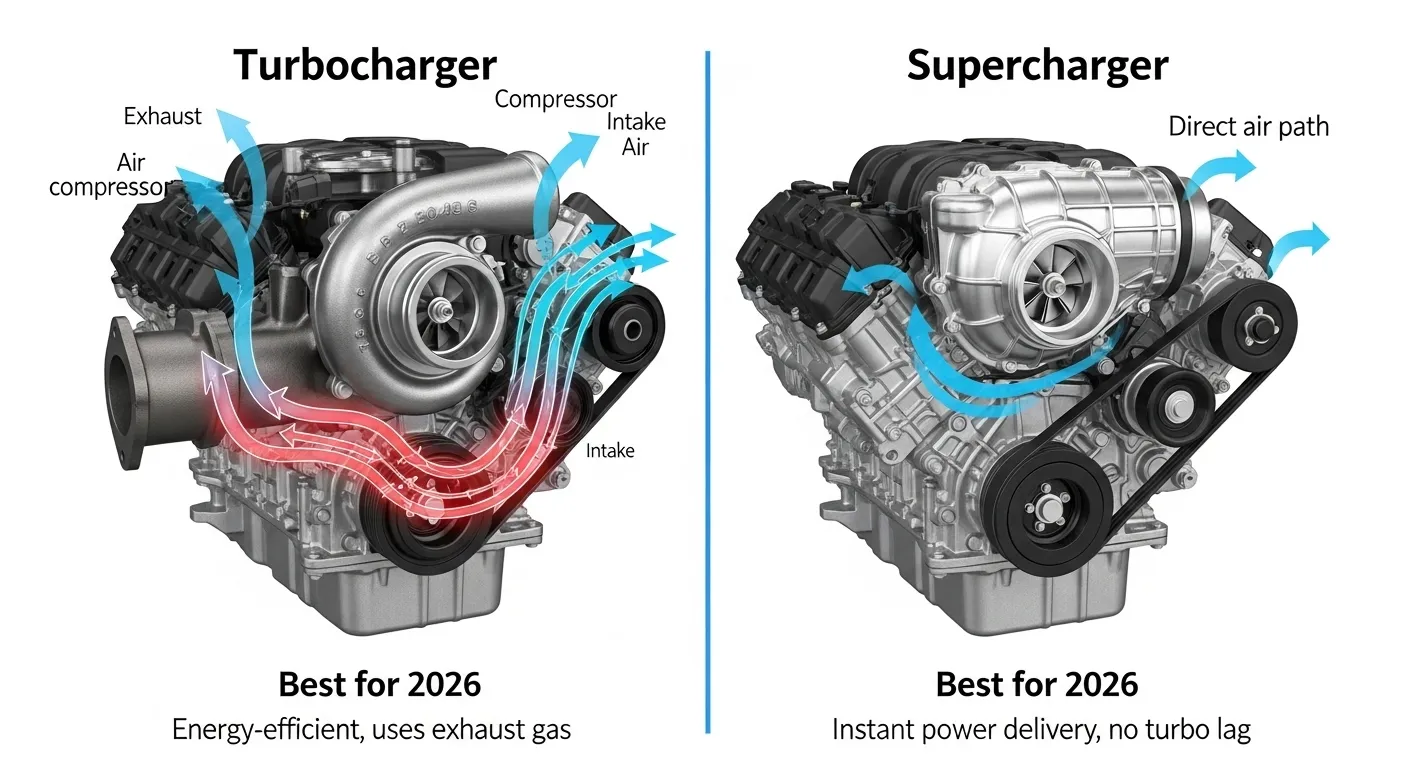
Both systems increase horsepower, improve acceleration, and make driving more fun. Yet they do not work the same way. The true difference between turbocharger and supercharger is found in how they create boost, how the car responds, how much fuel it uses, and how the engine feels on the road. A turbocharger uses exhaust gas that would normally go to waste. A supercharger uses engine power directly through a belt or gears. This single design change creates two very different driving experiences.
Understanding the difference between turbocharger and supercharger helps car buyers choose wisely, helps enthusiasts build better projects, and helps learners understand modern automotive engineering. If you want clear answers, this guide explains the difference between turbocharger and supercharger in a simple and expert way.
Quick Answer: Key Difference Between Turbocharger and Supercharger
- Turbocharger uses exhaust gases to spin a turbine and force air into the engine.
- Supercharger uses direct power from the engine to force air into the engine.
Easy Memory Trick
- Turbo = Exhaust Powered
- Supercharger = Belt Powered
Why This Difference Matters
The difference between turbocharger and supercharger affects:
Performance
How quickly the car accelerates.
Fuel Economy
How much fuel the engine uses.
Driving Feel
Smooth surge vs instant punch.
Maintenance Cost
Different parts need different care.
Buying Decisions
Some drivers want efficiency, others want excitement.
Pronunciation Guide
Turbocharger
- US: TUR-boh-char-jer
- UK: TUR-boh-char-juh
Supercharger
- US: SOO-per-char-jer
- UK: SOO-puh-char-juh
Difference Between Turbocharger and Supercharger
1. How They Get Power
Turbocharger
Powered by hot exhaust gases leaving the engine.
Examples:
- Modern small turbo cars
- Diesel trucks
Supercharger
Powered by the engine crankshaft using a belt.
Examples:
- Muscle cars
- Performance V8 cars
2. Throttle Response
Turbocharger
May have a short delay before power arrives. This is called turbo lag.
Supercharger
Power comes almost instantly when you press the pedal.
Winner
Supercharger for immediate response.
3. Fuel Efficiency
Turbocharger
Usually more efficient because it uses waste exhaust energy.
Supercharger
Usually less efficient because it uses engine power.
Winner
Turbocharger for economy.
4. Power Delivery
Turbocharger
Often gives a strong wave of power once boost builds.
Supercharger
Delivers smooth and steady power across the rev range.
5. Low-Speed Performance
Turbocharger
May feel softer at very low RPM.
Supercharger
Strong pull from low speeds.
Winner
Supercharger.
6. High-Speed Power
Turbocharger
Excellent at mid-range and top-end speeds.
Supercharger
Strong throughout, but often less explosive at top end than some turbo setups.
Winner
Turbocharger in many tuned builds.
7. Sound
Turbocharger
Whistle, spool, and blow-off sounds.
Supercharger
Classic mechanical whine.
Winner
Personal choice.
8. Heat
Turbocharger
Creates more heat due to exhaust connection.
Supercharger
Usually cooler than turbo exhaust systems.
9. Maintenance
Turbocharger
Needs quality oil and cooling care.
Supercharger
Needs belt and pulley inspection.
10. Cost of Ownership
Turbocharger
Can be expensive if major turbo parts fail.
Supercharger
Can also be costly, but design may be simpler depending on system.
Nature and Driving Character
Turbocharger
Efficient, modern, quick once boosted, excellent for smaller engines.
Supercharger
Instant, aggressive, fun, predictable, strong at low speed.
Why People Confuse Them
People mix them up because:
- Both add horsepower
- Both compress air
- Both improve acceleration
- Both are used in sports cars
- Both are called forced induction systems
Side-by-Side Comparison Table
| Feature | Turbocharger | Supercharger |
| Power Source | Exhaust gas | Engine belt |
| Response | Slight lag possible | Instant |
| Fuel Economy | Better | Lower |
| Low-End Power | Good | Excellent |
| High-End Power | Excellent | Strong |
| Sound | Whistle | Whine |
Which Is Better for You?
Choose Turbocharger If You Want:
- Better fuel economy
- Strong highway power
- Smaller engine with big output
- Modern daily driving balance
Choose Supercharger If You Want:
- Instant throttle response
- Strong low-speed pull
- Classic muscle car feel
- Exciting engine sound
Real Car Examples
Turbocharged Cars
- Many modern hatchbacks
- Sports sedans
- Diesel SUVs
Supercharged Cars
- Muscle coupes
- Performance V8 sedans
- Some luxury sports cars
Frequently Asked Questions
Is turbo better than supercharger?
It depends on your goals.
Which is faster?
Either can be faster depending on tuning.
Which is more reliable?
Both can be reliable with proper care.
Does turbo lag still exist?
Yes, but modern systems reduce it greatly.
Which sounds better?
Personal taste decides.
Final Verdict
If you want smart efficiency and big power, choose turbo. If you want instant excitement and raw response, choose supercharger.
Conclusion
The real difference between turbocharger and supercharger is how they make power and how they feel on the road. A turbocharger uses exhaust energy, making it efficient and powerful. A supercharger uses direct engine power, giving instant acceleration and strong low-end torque. Neither is perfect for everyone. Drivers who value economy often prefer turbochargers. Drivers who love sharp response often prefer superchargers. Once you understand the difference between turbocharger and supercharger, choosing the right system becomes easy.

I’m Zahid Abbas, an educator, researcher, and digital publishing strategist with a passion for linguistics, grammar, and clear communication. As a content creator and SEO specialist, I craft research-driven, reader-focused content that empowers learners and makes knowledge accessible worldwide.