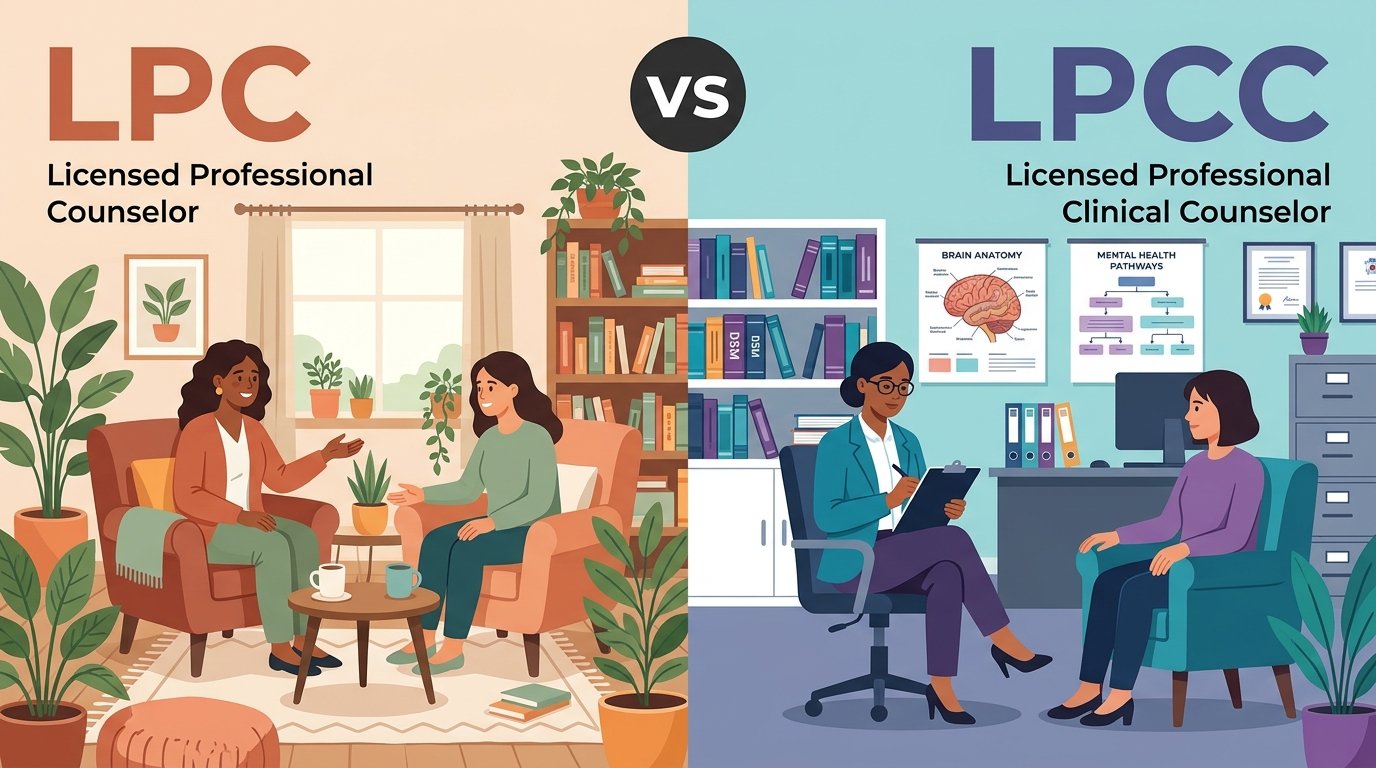
Here is a real situation that happens often in the United States. A counselor in Texas has a license with the letters “LPC” after her name. She moves to California to start a new job. There, the license is called “LPCC.” She learns that she must apply again and follow California’s rules. Every state in the US licenses counselors, but not every state uses the same name. This is why people ask about the difference between LPC and LPCC.
LPC stands for Licensed Professional Counselor. LPCC stands for Licensed Professional Clinical Counselor. Both are licenses for counselors who help people with feelings, stress and mental health. The difference between LPC and LPCC is mostly about the level of clinical training and the name each state uses.
Key difference between LPC and LPCC
The simplest way to remember it: LPCC has the word “clinical” in it, and it often means a more advanced, clinical license. In some states, LPC and LPCC are almost the same thing with two names. In other states, they are two different levels. So always check your own state’s rules.
Why is this difference important for learners and experts?
Students who want to become counselors need the difference between LPC and LPCC to plan their classes and training. Counselors need it to know what work they are allowed to do, and what they can put on a business card. Schools, clinics and hospitals need it to hire the right person. It also matters in society. People who look for help want to know that their counselor is trained and licensed. When the titles are clear, it is easier to find safe and trusted care.
Pronunciation
| Word | US English | UK English |
| LPC | /ˌel.piːˈsiː/ (el-pee-SEE) | /ˌel.piːˈsiː/ (el-pee-SEE) |
| LPCC | /ˌel.piː.siːˈsiː/ (el-pee-see-SEE) | /ˌel.piː.siːˈsiː/ (el-pee-see-SEE) |
| Counselor / Counsellor | /ˈkaʊn.səl.ɚ/ (KOWN-suh-ler) | /ˈkaʊn.səl.ə/ (KOWN-suh-luh) |
Both short forms are said by spelling the letters. The word “counselor” is spelled “counsellor” in the UK.
Note: This blog is for learning. Rules are different in each state, so always check your state’s licensing board. This is not legal or career advice. If you need help with your feelings, talk to a licensed professional or a trusted adult.
Difference Between LPC and LPCC
1. Full Name
LPC means Licensed Professional Counselor. LPCC means Licensed Professional Clinical Counselor.
- LPC example: A card says, “Jane Smith, LPC.”
- LPCC example: A card says, “Ravi Patel, LPCC.”
2. The Word “Clinical”
LPCC includes the word “clinical,” which points to treating mental health problems in a clinic or practice. LPC has no such word.
- LPC example: An LPC counsels students about stress and study habits.
- LPCC example: An LPCC works with patients who have serious mental health needs.
3. Level of License
In some states, LPC is the first or basic level, and LPCC is a higher, clinical level. In other states, they are the same license with a different name.
- LPC example: A new counselor in a state with two levels may start as an LPC.
- LPCC example: After more training, the same counselor may move up to LPCC.
4. Education
Both need a master’s degree or higher in counseling or a close field. An LPCC may need extra clinical courses in some states.
- LPC example: An LPC finished a master’s in school counseling.
- LPCC example: An LPCC finished a master’s with extra classes in mental health care.
5. Supervised Experience
Both must work under a supervisor for a set number of hours before they get the license. The number is different in each state, and LPCC often asks for more clinical hours.
- LPC example: A new LPC works for a few years under a supervisor.
- LPCC example: A new LPCC logs many hours of direct clinical work with clients.
6. Diagnosing and Treating
In some states, an LPCC can diagnose and treat mental health conditions on their own. An LPC in the same state may need to work under supervision for this. In other states, both can do it.
- LPC example: An LPC helps a client build coping skills for stress.
- LPCC example: An LPCC gives a diagnosis and makes a treatment plan, where state law allows it.
7. Supervising Others
In some states, an LPCC can take extra steps to supervise new counselors. An LPC may not be allowed to do this.
- LPC example: An LPC works under a supervisor.
- LPCC example: An experienced LPCC trains and guides a new counselor.
8. Where the Title Is Used
Some states use LPC, such as Texas. Some use LPCC, such as California.Ohio is one state that offers both licenses.
- LPC example: A counselor in Texas writes LPC after her name.
- LPCC example: A counselor in California writes LPCC after his name.
9. Exams
Both must pass a state-approved exam. The exam can be different in each state. For clinical licenses, the exam often focuses on real client cases.
- LPC example: An LPC passes a national counselor exam.
- LPCC example: An LPCC may take a clinical case-based exam, if the state asks for it.
10. Work and Pay
Both work in schools, clinics, hospitals and private offices. A higher clinical license may open more job choices, but this is not guaranteed.
- LPC example: An LPC works in a community center.
- LPCC example: An LPCC opens a private practice and works with insurance companies, where state rules allow it.
Nature and Behaviour of an LPC
An LPC is a caring, trained and licensed helper. An LPC listens, asks good questions and teaches skills to handle stress, grief, school trouble and family problems. and an LPC works in schools, community groups and offices. The word “professional” tells us that the person has studied, trained and passed an exam. In some states, an LPC is a full license that can do almost all of the work. In others, it is a first step that needs more supervision. An LPC follows strict rules to keep clients’ information private.
Nature and Behaviour of an LPCC
An LPCC is a counselor with a clinical focus. An LPCC works with people who have deeper mental health needs, such as anxiety, depression or trauma. In many states, an LPCC has extra training and may diagnose and treat conditions on their own. An LPCC may also supervise new counselors and open a private practice. Like an LPC, an LPCC must keep client information private, follow ethics rules and keep learning to renew the license. The “clinical” part shows more focus on treating mental health conditions.
Also read about more:https://compareact.com/difference-between-jealous-and-envious-2/
Why Are People Confused About LPC and LPCC?
- The names look alike. They differ by just two letters.
- Each state uses different names. Texas uses LPC, California uses LPCC and Ohio has both.
- The rules are not the same everywhere. In one state they are two levels, in another one license.
- Many other titles exist. There are also LMHC, LCPC and LPC-S, which makes it more confusing.
- Job ads mix the words. Some ads say “LPC/LPCC” for the same job.
Difference and Similarity Table
| Feature | LPC | LPCC |
| Full name | Licensed Professional Counselor | Licensed Professional Clinical Counselor |
| Focus | General counseling | Clinical counseling |
| Level | Basic, or the main license in some states | Often more advanced |
| Education | Master’s degree or higher | Master’s degree or higher, with clinical courses |
| Supervised hours | Required | Required, often more clinical hours |
| Diagnosing | Depends on the state | Often allowed |
| Supervising others | Usually no | Sometimes yes |
| Passes an exam | Yes | Yes |
| Helps clients with mental health | Yes | Yes |
| Must renew the license | Yes | Yes |
| Rules depend on the state | Yes | Yes |
Which Is Better in What Situation?
Neither title is “better” in every case. The right one depends on the state and on your goal.
Choose the LPC path when your state uses it as the main license. If you live in a state such as Texas, where the LPC is the main counseling license, then the LPC is the right goal. It lets you counsel people in schools, clinics and offices. If you are just starting out, it is a clear first step. Always read your state board’s rules, because they say what an LPC can and cannot do.
Choose the LPCC path when your state offers it and you want clinical work. If you live in a state such as California, or in a state with two levels, such as Ohio, then the LPCC may open more doors. It may let you diagnose, treat and, in some places, supervise others and open a private practice. It often takes more training and hours. If you want to work with people who have serious mental health needs, check if the LPCC is the better fit.
How the Words Are Used in Metaphors and Similes
These are job titles, so they are not often used in figures of speech. But people sometimes use the ideas.
- LPC as a metaphor: “The LPC was a lighthouse for the lost student.”
- LPC as a simile: “Her counselor listened like a calm river, steady and kind.”
- LPCC as a metaphor: “The LPCC was the guide who helped him through the storm.”
- LPCC as a simile: “Her clinical skills worked like a map in a thick forest.”
Connotative Meaning of LPC and LPCC
A connotation is the feeling a word gives, besides its plain meaning.
LPC is mostly positive to neutral. It suggests a trained, caring and trusted professional. It can feel neutral in a job list.
- Positive: “Everyone at school trusted the LPC.”
- Neutral: “The job asks for an LPC license.”
LPCC is mostly positive to neutral too. It suggests a higher level of clinical skill. Some people find the many letters confusing, and call them “alphabet soup,” which can feel a little negative.
- Positive: “The clinic hired an LPCC with years of experience.”
- Negative: “All these letters, LPC, LPCC, LMHC, are just alphabet soup to me.”
Idioms and Proverbs Related to the Words
There are no old idioms with the words “LPC” or “LPCC.” But these sayings fit the work of counselors.
- “A problem shared is a problem halved”: talking about a problem makes it easier. Example: “He told his counselor about his fear. A problem shared is a problem halved.”
- “Lend an ear”: listen kindly. Example: “The counselor lent an ear to the worried student.”
- “Get it off your chest”: say what is troubling you. Example: “She felt better after she got it off her chest.”
- “Two heads are better than one”: working together helps. Example: “The family and the counselor made a plan. Two heads are better than one.”
- “Rome wasn’t built in a day”: big changes take time. Example: “Healing takes time. Rome wasn’t built in a day.”
Works of Literature on Counseling
Few books have “LPC” or “LPCC” in their titles. These books are about counseling and helping people.
- Counseling and Psychotherapy: Psychology; Carl R. Rogers, 1942
- Man’s Search for Meaning: Psychology memoir; Viktor E. Frankl, 1946
- On Becoming a Person: Psychology; Carl R. Rogers, 1961
- Theory and Practice of Counseling and Psychotherapy: Textbook; Gerald Corey, 1977
- The Gift of Therapy: Guide for therapists; Irvin D. Yalom, 2002
- Maybe You Should Talk to Someone: Memoir by a therapist; Lori Gottlieb, 2019
Movies Related to Counseling
No famous film is named “LPC” or “LPCC.” These films show counselors and therapists at work.
- Ordinary People: Drama; 1980, USA
- The Prince of Tides: Drama; 1991, USA
- Good Will Hunting: Drama; 1997, USA
- Analyze This: Comedy; 1999, USA
- Antwone Fisher: Drama; 2002, USA
Five possible Asked Questions
1. Are LPC and LPCC the same? In some states, yes. They are two names for one license. In other states, they are two different levels.
2. Which is higher, LPC or LPCC? In states with both, the LPCC is often the more advanced, clinical license. But it depends on the state.
3. Can both diagnose mental health problems? Often yes, but it depends on state law and sometimes on supervision. Check with your state licensing board.
4. How can I check if a counselor is licensed? Most states have a free license search on the licensing board’s website. You can type in the counselor’s name and see the type of license.
5. Is a counselor the same as a psychologist or a psychiatrist? No. A counselor has a master’s degree in counseling. A psychologist usually has a doctoral degree in psychology. A psychiatrist is a medical doctor who can prescribe medicine.
How Both Are Useful for Our Surroundings
LPCs and LPCCs help whole communities. They support students who feel stress, families who face loss and workers who feel burned out. They help people learn coping skills and find hope. Clear titles help people choose a safe and trained helper. Schools, clinics and hospitals can hire the right person for the right job. When more people get good help for their feelings, homes are calmer, classrooms are happier and neighbours are kinder.
Final Words for Both
LPC: a licensed counselor who helps people with feelings, stress and life problems. The rules depend on the state.
LPCC: a licensed counselor with a clinical focus, often with more advanced training. The rules depend on the state.
Conclusion
The difference between LPC and LPCC is easy to remember. LPC means Licensed Professional Counselor. LPCC means Licensed Professional Clinical Counselor, with a focus on clinical care. In some states, they are two names for one license. In other states, the LPCC is a higher level, with more training and more things it can do. Because each state has its own rules, the titles can be confusing. If you want to become a counselor, or want to find one, check your state’s licensing board.

I’m Zahid Abbas, an educator, researcher, and digital publishing strategist with a passion for linguistics, grammar, and clear communication. As a content creator and SEO specialist, I craft research-driven, reader-focused content that empowers learners and makes knowledge accessible worldwide.