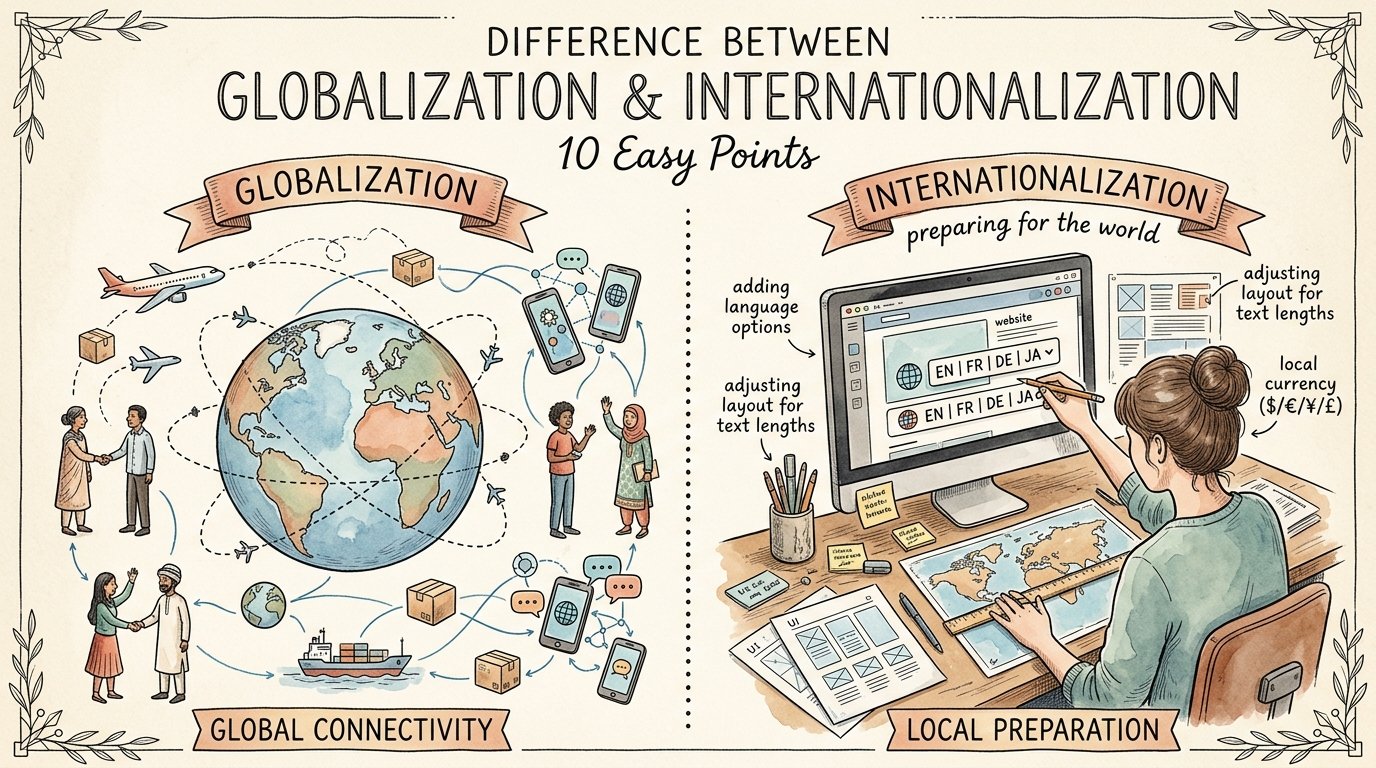
Ali lives in Pakistan. He uses a phone made with parts from other countries. He watches cartoons from other places. And he eats food that people enjoy around the world. And use properly Differences between Globalization and Internationalization.
This shows that countries can be linked.
Globalization means people and countries around the world become more connected.
Internationalization means getting ready to work with people in other countries.
For example, a shop may sell toys to people in another country. It may also add another language to its website.
The Difference between globalization and internationalization is simple. Both words are about countries. But they have different meanings. Globalization connects people around the world. Internationalization helps people work with other countries.
Key Difference Between the Two
- Globalization: It connects people and countries.
- Internationalization: It helps people get ready to work with other countries.
Example: People in many countries buy the same toy. This is linked to globalization.
A shop adds Urdu and English to its website. This is internationalization.
Why Is It Important to Know the Difference?
These words help us learn about the world.
Children can learn about people in other countries. Schools can share ideas. Shops can sell goods to people far away.
For example, one school may share lessons with a school in another country. A shop may sell bags to people in many places.
These ideas help us learn and work together.
How to Say the Words
- Globalization
- US English: gloh-buh-luh-ZAY-shun
- UK English: gloh-buh-lie-ZAY-shun
- Internationalization
- US English: in-ter-NASH-uh-nuh-luh-ZAY-shun
- UK English: in-tuh-NASH-uh-nuh-lie-ZAY-shun
Now, let us learn ten easy differences.
Difference Between Globalization and Internationalization: 10 Easy Points
1. Meaning
Globalization: It connects people and countries.
Examples:
- People in many countries use the same app.
- Countries buy food from one another.
Internationalization: It helps people get ready to work with other countries.
Examples:
- A shop adds a new language to its website.
- Two schools in different countries share ideas.
2. Main Goal
Globalization: It helps people around the world connect.
Examples:
- Children in Pakistan watch shows from Korea.
- People in many countries use the same phone brand.
Internationalization: It helps people work with other countries.
Examples:
- A shop learns the rules of another country.
- A school makes a plan for students from abroad.
3. How Big It Is
Globalization: It can connect many countries.
Examples:
- A toy is sold in many countries.
- People around the world watch a sports game.
Internationalization: It can start with one other country.
Examples:
- A shop sells bags to one new country.
- Two schools in different countries work together.
4. Shops and Businesses
Globalization: It connects shops and buyers around the world.
Examples:
- A shop sells toys made in other countries.
- A car has parts from different places.
Internationalization: It helps a shop get ready to sell goods in another country.
Examples:
- A shop changes its labels for local buyers.
- A shop learns the rules before selling goods abroad.
5. Food and Culture
Globalization: It helps food, songs, and films spread around the world.
Examples:
- People in Pakistan enjoy Korean songs.
- People in many countries eat pizza.
Internationalization: It helps people share things in ways others can understand.
Examples:
- A shop changes an ad for local people.
- A school shares news in different languages.
6. Technology
Globalization: It helps people connect by phone and computer.
Examples:
- A child talks to a friend in another country online.
- Workers share files from far-away places.
Internationalization: It helps apps and websites work for people in different countries.
Examples:
- An app lets people choose a language.
- A website shows money in the right type for each place.
7. Language
Globalization: It helps words and languages spread.
Examples:
- Many people learn English.
- People use words from other languages.
Internationalization: It helps people use things in their own language.
Examples:
- A book is printed in Urdu and English.
- An app gives users many language choices.
8. Time and Steps
Globalization: It grows as countries become more connected.
Examples:
- More countries buy and sell goods.
- People buy things online from other places.
Internationalization: It often means taking steps to work with another country.
Examples:
- A shop learns the rules of a new place.
- A website adds another language.
9. People Involved
Globalization: It can involve people all over the world.
Examples:
- Farmers sell food to other countries.
- People in many places watch the same game.
Internationalization: It can involve people who plan to work with another country.
Examples:
- Teachers work with teachers abroad.
- A shop hires people who know another country.
10. Results
Globalization: It helps people share goods and ideas. But it can make it hard for small shops to compete.
Examples:
- People can buy toys from many countries.
- A small shop competes with a big shop from abroad.
Internationalization: It helps people and groups work with other countries.
Examples:
- A website becomes easier for people in other places to use.
- Two schools make a plan to share ideas.
Nature of Globalization
Globalization connects people and places. It helps food, songs, goods, and ideas move from one country to another.
For example, a child can watch a show from another country. A shop can sell goods to people far away.
But globalization can also bring problems. Small shops may find it hard to compete with big shops. Some local ways may change.
Nature of Internationalization
Internationalization helps people get ready to work with other countries.
A shop may add a new language to its website. A school may welcome children from another country. A company may learn the rules of a new place.
It does not always mean working with the whole world. It may mean working with just one other country.
Also read more about:https://compareact.com/difference-between-reverend-and-pastor-key-differences/
Why Do People Mix Up These Words?
People mix up these words because both are about countries.
Here are three reasons:
- Both involve people in different countries.
- Both can happen at the same time.
- Both are used when people talk about shops, schools, and apps.
Remember:
- Globalization means connecting the world.
- Internationalization means getting ready to work with other countries.
Table of Differences and Similarities
| Point | Globalization | Internationalization |
| Meaning | Connecting the world | Getting ready to work with other countries |
| Main goal | Connect people | Help people work across borders |
| Size | Can link many countries | Can start with one country |
| Shops | Links shops and buyers | Helps shops get ready for new places |
| Culture | Spreads food, songs, and ideas | Helps people share things in ways others can use |
| Technology | Connects people online | Makes apps and websites easier for different users |
| Similarity | Both involve countries | Both involve countries |
How Are They Alike?
- Both are about countries.
- Both help people share ideas.
- Both can help shops and schools.
- Both can bring good and bad changes.
Which Is Better in Each Situation?
When Is Globalization Better?
Globalization helps us learn how the world is connected. It helps explain why we eat food from other places, watch shows from other countries, and use phones with parts from around the world.
For example, a child can learn about another country by watching a video. A shop can sell toys to people far away. Globalization helps people share goods and ideas. But it can also make it hard for small shops to compete with big shops.
When Is Internationalization Better?
Internationalization helps when a person or group wants to work with another country. A shop may add another language to its website. A school may work with a school in another place. An app may let people choose their language.
These steps help people understand and use things more easily. Internationalization is useful when a shop, school, or group wants to reach people in another country.
Globalization and Internationalization in Similes and Metaphors
A simile compares two things using words like as or like. A metaphor says one thing is another thing.
Globalization
- Simile: Globalization is like a big web that links countries.
- Metaphor: Globalization is a bridge between countries.
- Metaphor: The world is a small village.
These words show that people around the world are connected.
Internationalization
- Simile: Internationalization is like opening a door to another country.
- Metaphor: Internationalization is a key to new places.
- Metaphor: Internationalization is a passport for a shop.
These words show how people get ready to work with other countries.
Feelings Linked to the Words
Words can make us think of good things, bad things, or just facts.
Globalization
Neutral: It means countries are more connected.
Example: “Globalization connects shops in many countries.”
Positive: It can mean new chances and shared ideas.
Example: “Globalization helped the shop find more buyers.”
Negative: It can mean more problems for small shops.
Example: “Globalization made it hard for the small shop to compete.”
Internationalization
Neutral: It means getting ready to work with other countries.
Example: “The school began working with a school abroad.”
Positive: It can mean new friends and chances to learn.
Example: “The school met children from another country.”
Negative: It can mean extra work or cost.
Example: “The shop had to spend more money to sell goods abroad.”
Both words can have good or bad meanings. It depends on the situation.
Sayings Related to These Words
These sayings do not mean exactly the same as globalization or internationalization. But they help explain the ideas.
1. “The world is your oyster.”
Meaning: You have many chances.
Example: Globalization helps the shop find buyers in many places. The world is its oyster.
2. “Think globally, act locally.”
Meaning: Think about the world, but help your own town too.
Example: The shop sells goods around the world and also helps local workers. It follows this saying.
3. “When in Rome, do as the Romans do.”
Meaning: Respect the ways of the place you visit.
Example: The shop learns the local rules before selling goods abroad. It follows this saying.
Books Related to These Ideas
These books talk about travel, culture, or links between countries. They are not all about the exact words.
- Around the World in Eighty Days — An adventure story by Jules Verne, published in 1872. It tells of a trip around the world.
- Things Fall Apart — A story by Chinua Achebe, published in 1958. It shows how outside rule changed life in a village in Nigeria.
- The World Is Flat — A non-fiction book by Thomas L. Friedman, published in 2005. It talks about how trade and technology link the world.
- The Lexus and the Olive Tree — A non-fiction book by Thomas L. Friedman, published in 1999. It talks about globalization.
Movies Related to These Ideas
These films show travel, culture, or links between countries. They are not all directly about the two words.
- Around the World in 80 Days — 1956, United States. It is about a trip around the world.
- Gandhi — 1982, United Kingdom and India. It tells the story of Mahatma Gandhi.
- Babel — 2006, United States and other countries. It shows people from different cultures.
- The Terminal — 2004, United States. It is about a traveler stuck at an airport.
- The Big Short — 2015, United States. It tells a story about money and banks.
Five Common Questions
1. What is globalization?
Globalization means people and countries around the world become more connected.
2. What is internationalization?
Internationalization means getting ready to work with people in other countries.
3. Are the two words the same?
No. They are linked, but they have different meanings.
4. Can a small shop use internationalization?
Yes. It can add a new language to its website and sell goods in another country.
5. How does globalization affect our lives?
It helps us buy goods from other places, watch shows from other countries, and learn about new cultures.
How Are They Useful in Our Lives?
Globalization
Globalization helps us learn about other places. We can watch shows, listen to songs, and buy goods from many countries. It also helps shops sell goods to more people.
We should still help local shops and respect our own culture.
Internationalization
Internationalization helps schools, shops, and groups work with people in other countries. A school can share lessons with another school. A shop can add new languages to its website.
These steps help people understand each other and work together.
Final Words
Globalization and internationalization are not the same.
Globalization links people and countries around the world. Internationalization helps people get ready to work with other countries.
Both ideas help people share goods, ideas, and knowledge. They can also bring problems. We should learn about other places and respect our own towns and cultures.
Conclusion
Globalization and internationalization are easy to understand. Globalization links people and countries around the world. Internationalization helps people and groups work with other countries.
For example, a shop may add Urdu and English to its website. This is internationalization. If the shop sells goods to people in many countries, it becomes part of globalization.
Both ideas are useful in schools, shops, and daily life. They help us learn about other people and places. They also show us how the world works together. When we know the difference, we can use both words in the right way.

I’m Zahid Abbas, an educator, researcher, and digital publishing strategist with a passion for linguistics, grammar, and clear communication. As a content creator and SEO specialist, I craft research-driven, reader-focused content that empowers learners and makes knowledge accessible worldwide.