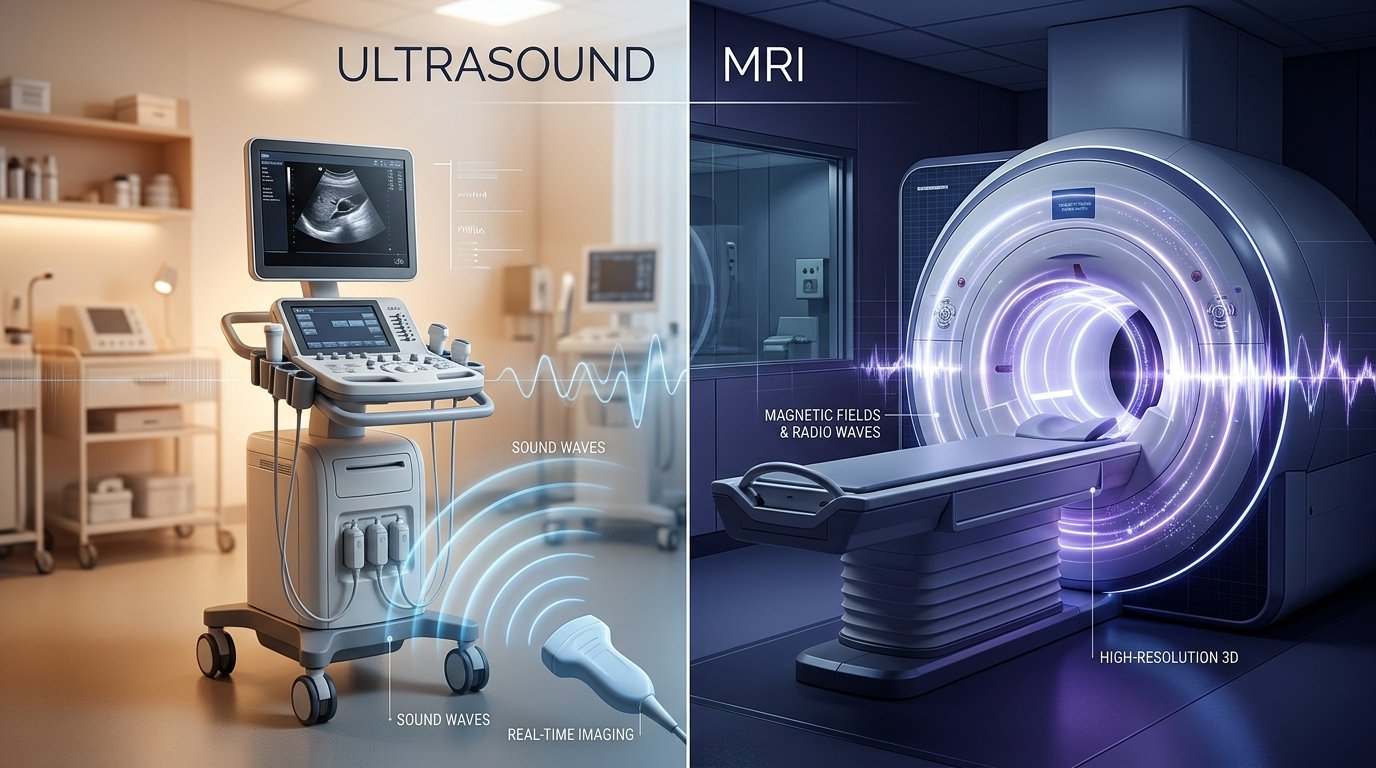
In the 1950s, a doctor named Ian Donald in Glasgow, Scotland, had a bright idea. Shipyard workers used a machine with sound waves to find hidden cracks in metal. Donald wondered if the same kind of machine could look inside the human body. In 1958, he and his team shared the first pictures of an unborn baby made with sound. That was the start of the ultrasound scan we know today. Later, in 2003, two scientists, Paul Lauterbur and Peter Mansfield, won the Nobel Prize in Medicine for their work on MRI. Both tools show the inside of the body, but the difference between ultrasound and MRI is big.
Ultrasound uses high-pitched sound waves to make pictures. MRI, which stands for magnetic resonance imaging, uses a strong magnet and radio waves. Neither one uses X-rays. Learning the difference between ultrasound and MRI helps you understand what happens in a hospital.
Key difference between ultrasound and MRI
The simplest way to remember it: ultrasound uses sound waves and gives quick, live pictures, while MRI uses magnets and gives very detailed pictures. Ultrasound is small, quiet and fast. MRI is a big tube that is loud and takes longer.
Why is this difference important for learners and experts?
Students who know the difference between ultrasound and MRI can understand how doctors find health problems. Nurses, doctors and scan workers need it to pick the right test for the right person. It also matters in society. Good scans help find illness early, keep unborn babies safe and plan the best care. Knowing how they work can also help patients feel less afraid when they go for a scan.
Pronunciation
| Word | US English | UK English |
| Ultrasound | /ˈʌl.trə.saʊnd/ (UL-truh-sound) | /ˈʌl.trə.saʊnd/ (UL-truh-sound) |
| MRI | /ˌɛm.ɑːrˈaɪ/ (em-ar-EYE) | /ˌɛm.ɑːˈraɪ/ (em-ar-EYE) |
| Magnetic resonance imaging | /mægˈnɛt.ɪk ˈrɛz.ən.əns ˈɪm.ɪ.dʒɪŋ/ | /mægˈnɛt.ɪk ˈrɛz.ən.əns ˈɪm.ɪ.dʒɪŋ/ |
Both words are said almost the same in the US and the UK. “MRI” is said by spelling the three letters.
Note: This blog is for learning. It is not medical advice. Your doctor will choose the right test for you.
Now you know what the words mean and how to say them. Let us look at the differences, one by one.
Difference Between Ultrasound and MRI
1. Meaning
Ultrasound makes pictures with sound waves. MRI makes pictures with a magnet and radio waves.
- Ultrasound example: A doctor moves a small probe over a belly to see a baby.
- MRI example: A patient lies in a big tube while a machine scans the brain.
2. How It Works
Ultrasound sends sound waves into the body. The waves bounce back, like an echo, and the machine turns the echoes into a picture. MRI uses a strong magnet to line up tiny parts of the body, and then it uses radio waves to make a picture.
- Ultrasound example: It works like a bat that finds its way by listening to echoes.
- MRI example: The machine reads the signals from the body after the radio waves stop.
3. Size of the Machine
Ultrasound machines are small and can be rolled to a bedside. An MRI machine is very big, and it needs its own room.
- Ultrasound example: A nurse carries a small ultrasound to a village clinic.
- MRI example: A hospital builds a special room with thick walls for the MRI machine.
4. Picture Detail
Ultrasound pictures are good, but they can be grainy. MRI pictures are very sharp and show fine details of soft parts, such as the brain, muscles and joints.
- Ultrasound example: A doctor sees the shape and size of a baby’s face.
- MRI example: A doctor sees a tiny tear in a knee ligament.
5. Live Motion
Ultrasound shows live movement, such as a beating heart, a moving baby or flowing blood. MRI mostly shows still pictures, though special types can show some movement.
- Ultrasound example: A mother sees her baby kick on the screen.
- MRI example: A series of still pictures shows slices of the brain, one by one.
6. Time
An ultrasound is often quick, taking about 15 to 45 minutes. An MRI often takes longer, from about 15 to 90 minutes, depending on the body part.
- Ultrasound example: A quick scan of the belly takes less than an hour.
- MRI example: A scan of the spine can take much longer, and the person must lie very still.
7. Cost
Ultrasound costs less. MRI costs much more.
- Ultrasound example: A clinic can offer ultrasound at a low price.
- MRI example: A hospital charges more for an MRI, because the machine is costly to buy and to run.
8. Comfort and Noise
Ultrasound is quiet. The person lies on a bed and feels a cool gel and a gentle probe. MRI is loud, with banging and knocking sounds, and the person lies inside a tube. Some people feel nervous in the narrow space.
- Ultrasound example: A child sits quietly during a belly scan.
- MRI example: A patient wears earplugs or headphones to block the loud noise.
9. Metal and Safety
Ultrasound has no problem with metal. MRI uses a very strong magnet, so metal in or on the body can be dangerous. Staff always ask questions and check first.
- Ultrasound example: A person with a metal joint can have an ultrasound with no worry.
- MRI example: A person with a pacemaker or certain metal implants needs special checks before an MRI.
10. Best Use
Ultrasound is great for babies before birth, the heart, the belly organs and blood flow. MRI is great for the brain, spine, joints and soft parts that need very fine detail.
- Ultrasound example: Checking the heartbeat of an unborn baby.
- MRI example: Looking at the brain after a head injury.
Nature and Behaviour of Ultrasound
Ultrasound is gentle, quick and friendly. It uses sound waves that we cannot hear, and it does not use X-rays. A trained person puts gel on the skin and moves a probe, and the screen shows pictures right away. It can show movement, such as a beating heart or a baby’s kick. Because it is small and can be moved, it works well in many places, even in small clinics. But sound waves do not pass well through bone or air, so it cannot see everything.
Nature and Behaviour of MRI
MRI is powerful, detailed and noisy. It uses a very strong magnet and radio waves, but it does not use X-rays. The person lies still inside a big tube while the machine makes loud knocking sounds. It can take many pictures from different angles and show fine details of soft parts, such as the brain, spine and joints. Because of the strong magnet, staff must check for metal before the scan. MRI takes more time and costs more, but it can show things that other scans may miss.
Also read more about:https://compareact.com/difference-between-lpc-and-lpcc-2/
Why Are People Confused About Ultrasound and MRI?
- Both look inside the body. They both make pictures of organs and tissues.
- Neither uses X-rays. So people think they work the same way.
- Both are called a “scan.” The same word is used for different tests.
- Both are used in many parts of the body. The areas can overlap.
- People may not know the machines. Most patients only see the room and the screen.
Difference and Similarity Table
| Feature | Ultrasound | MRI |
| Uses | Sound waves | Magnet and radio waves |
| X-rays | No | No |
| Machine | Small and movable | Big tube in its own room |
| Picture detail | Good | Very fine |
| Live motion | Yes | Mostly still |
| Time | Short | Longer |
| Cost | Lower | Higher |
| Noise | Quiet | Loud |
| Metal danger | None | Yes, needs checks |
| Best for | Babies, heart, belly, blood flow | Brain, spine, joints, soft parts |
| Shows inside the body | Yes | Yes |
| Used by doctors | Yes | Yes |
Which Is Better in What Situation?
Neither test is “better” for everyone. Your doctor will choose the one that fits your health need.
Ultrasound is often chosen for quick, live and gentle looks. If a doctor wants to check an unborn baby, a beating heart, a gallbladder or the flow of blood, ultrasound is a great choice. It is quick and does not hurt. It is also helpful in emergency rooms, in small clinics and at the bedside, where a big machine cannot go.This test is often the first choice for checking many health problems.
MRI is often chosen when very fine detail is needed. If a doctor wants to see the brain, the spinal cord, a torn ligament or a small growth in soft tissue, MRI may be the best choice. It gives sharp pictures from many angles.This scan can detect things that ultrasound may miss, especially behind bones. It takes longer and costs more, so doctors choose it when the extra detail will help with the care plan.
How the Words Are Used in Metaphors and Similes
- Ultrasound as a metaphor: “Ultrasound is a flashlight made of sound.”
- Ultrasound as a simile: “The doctor searched the body like a bat that listens for echoes.”
- MRI as a metaphor: “MRI is a camera that sees through skin.”
- MRI as a simile: “The scan looked at the brain like slices of bread, one layer at a time.”
Connotative Meaning of Ultrasound and MRI
A connotation is the feeling a word gives, besides its plain meaning.
Ultrasound is mostly positive to neutral. It makes people think of babies, safety and a first look at a new life. It can feel negative if the scan brings worried news.
- Positive: “The ultrasound showed a healthy, kicking baby.”
- Neutral: “The nurse booked an ultrasound for Monday.”
MRI is mostly neutral. It suggests a serious and careful test. Some people link it with worry, loud noise or a tight space, which feels negative. Others see it as positive, because it can find problems early.
- Neutral: “The doctor asked for an MRI of the knee.”
- Positive: “The MRI helped the doctor find the problem early.”
Idioms and Proverbs Related to the Words
There are no old idioms with the words “ultrasound” or “MRI.” But these sayings fit them well.
- “Seeing is believing”: you trust what you see. Example: “I did not know my baby would be so active until I saw it on the ultrasound. Seeing is believing.”
- “Safe and sound”: not hurt and in good shape. Example: “The scan showed the baby was safe and sound.”
- “Loud and clear”: very easy to hear or understand. Example: “The MRI noise was loud and clear, but the nurse’s kind words were too.”
- “Magnetic personality”: a person who attracts others. Example: “The new teacher has a magnetic personality.”
- “Read between the lines”: find a hidden meaning. Example: “A doctor must read between the lines of a scan to find the cause.”
- “A picture is worth a thousand words”: a picture says a lot. Example: “The scan told us more than a long talk. A picture is worth a thousand words.”
Works of Literature on Ultrasound and MRI
Few books have “ultrasound” or “MRI” in the title. These books are about medicine and the human body.
- Gray’s Anatomy: Anatomy textbook; Henry Gray, 1858
- Callen’s Ultrasonography in Obstetrics and Gynecology: Medical textbook; Peter W. Callen, 1983
- Magnetic Resonance Imaging: Physical Principles and Sequence Design: Science textbook; E. Mark Haacke and others, 1999
- The Emperor of All Maladies: History of cancer; Siddhartha Mukherjee, 2010
- The Body: A Guide for Occupants: Popular science; Bill Bryson, 2019
Movies Related to Ultrasound and MRI
No famous film is named “Ultrasound” or “MRI.” These films show scans, babies or the inside of the body.
- Fantastic Voyage: Science fiction about a trip inside the human body; 1966, USA
- Juno: Comedy-drama with an ultrasound scene; 2007, USA and Canada
- Knocked Up: Comedy with an ultrasound scene; 2007, USA
- Doctor Strange: Superhero film that begins with a doctor and medical scans; 2016, USA
Five possible Asked Questions
1. Does ultrasound use radiation like an X-ray? No. Ultrasound uses sound waves, not X-rays.
2. Does MRI use radiation like an X-ray? No. MRI uses a magnet and radio waves. It does not use X-rays.
3. Is ultrasound safe in pregnancy? Ultrasound is widely used in pregnancy, and doctors consider it safe when done by trained staff for a medical reason. Your doctor can answer questions about your own care.
4. Why is an MRI so loud? The machine’s coils shake very fast to make the pictures. This makes loud knocks and buzzing. Staff usually give earplugs or headphones.
5. Why do I have to tell the staff about metal before an MRI? The magnet is very strong. Metal in the body, such as a pacemaker or some implants, can be unsafe. So staff ask questions and check first.
How Both Are Useful for Our Surroundings
Ultrasound and MRI help people stay healthy. They can find illness early, before it gets worse. That means better care and, often, simpler treatment. Ultrasound is small and moves easily, so it can reach many towns and villages. It helps mothers and babies stay safe. MRI helps doctors plan safe care for the brain, spine and joints. Both give jobs to doctors, nurses and scan workers. Both also help scientists learn more about the human body, so our whole community can be healthier.
Final Words for Both
Ultrasound: a gentle and quick scan that uses sound. It is great for babies, hearts and live movement.
MRI: a powerful scan that uses magnets. It is great for fine detail of the brain, spine and joints.
Conclusion
The difference between ultrasound and MRI is simple once you know the key. Ultrasound uses sound waves, and it is small, quiet, quick and lower in cost. It can show live motion, such as a baby’s kick. MRI uses a strong magnet and radio waves, and it is big, loud and slower. It gives very fine pictures of soft parts, such as the brain and joints. Neither one uses X-rays, and both help doctors see inside the body, which is why people mix them up. Your doctor will pick the one that fits your need. If you ever need a scan, you can ask questions and feel ready.

I’m Zahid Abbas, an educator, researcher, and digital publishing strategist with a passion for linguistics, grammar, and clear communication. As a content creator and SEO specialist, I craft research-driven, reader-focused content that empowers learners and makes knowledge accessible worldwide.