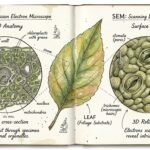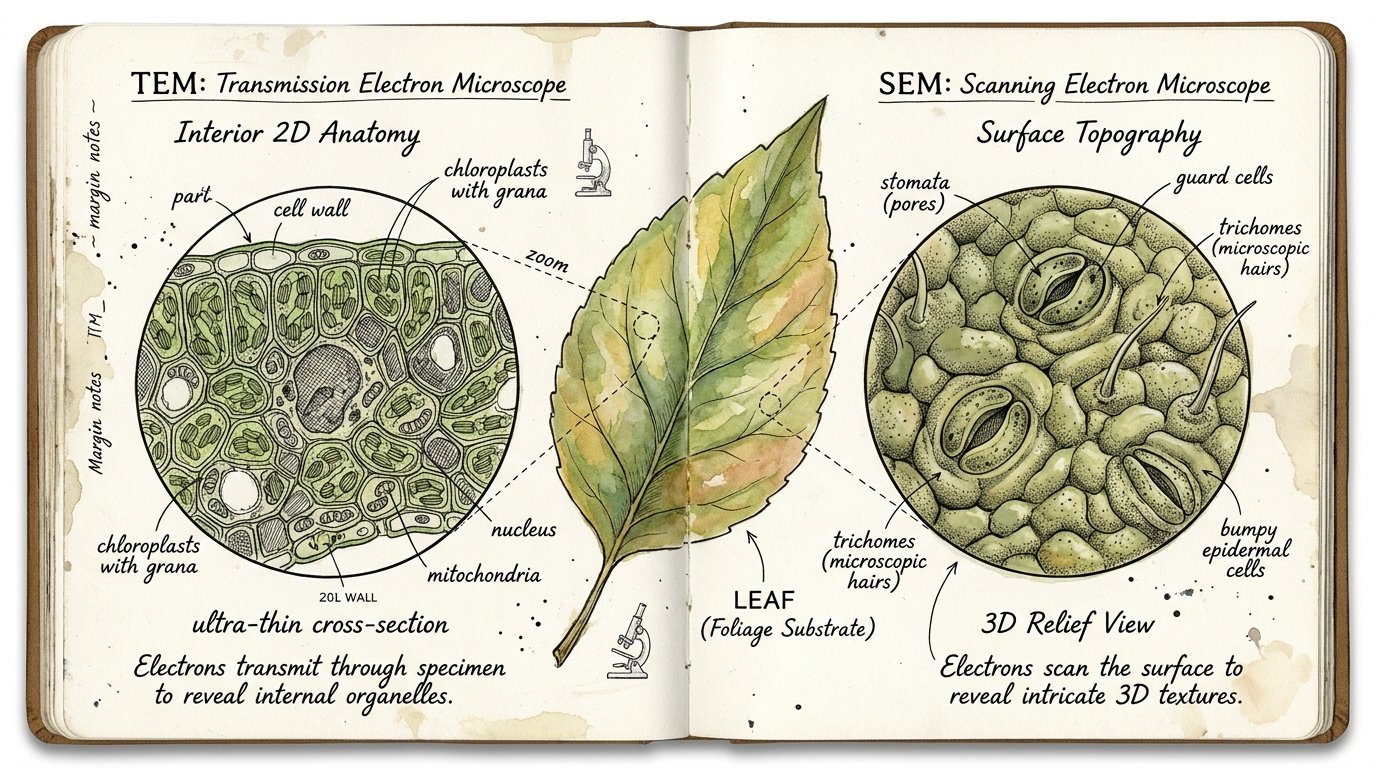
Imagine a scientist wants to look at a tiny piece of a leaf. The leaf has very small parts that we cannot see with our eyes. The scientist can use special tools called TEM and SEM. TEM stands for Transmission Electron Microscope. It lets scientists see tiny parts inside a very thin sample. SEM stands for Scanning Electron Microscope. It helps scientists see the surface of an object.
The difference between TEM and SEM is how they look at tiny things. TEM shows details inside a sample, while SEM shows the shape and surface of a sample. Both tools use electrons instead of normal light to make images. Learning the difference between TEM and SEM helps students and scientists choose the right tool. These tools help us learn about cells, tiny bugs, metals, and many other things.
Key Difference Between TEM and SEM
- TEM: Shows tiny details inside a thin sample.
- SEM: Shows the surface and shape of a sample.
Why Is It Important to Know Their Difference?
Students learn how these tools help us study things that are too small to see. Scientists use TEM to study parts inside cells. They use SEM to study surfaces, such as the surface of a leaf or a metal piece.
Doctors, engineers, and other experts can use information from these tools to learn about health, make better products, and solve problems. Knowing which tool to use can save time and help people get the right information.
Pronunciation of TEM and SEM
- TEM: Say each letter: “T-E-M.”
- SEM: Say each letter: “S-E-M.”
Also read more about:https://compareact.com/difference-between-full-and-queen/
H2: Difference Between TEM and SEM: 10 Easy Points
1. What They Show
TEM: It shows the inside of a tiny object.
- Example 1: TEM can show parts inside a cell.
- Example 2: TEM can show tiny parts inside a virus.
SEM: It shows the outside of an object.
- Example 1: SEM can show the surface of a leaf.
- Example 2: SEM can show tiny hairs on an insect.
2. How They Work
TEM: Electrons pass through a very thin sample.
- Example 1: Electrons pass through a thin slice of plant tissue.
- Example 2: Electrons pass through a thin piece of a material.
SEM: A beam of electrons moves over the surface of a sample.
- Example 1: The beam scans the surface of a small bug.
- Example 2: The beam scans the surface of a metal piece.
3. Type of Image
TEM: It usually makes a flat, two-dimensional image.
- Example 1: A TEM image can show parts inside a cell.
- Example 2: A TEM image can show tiny parts inside a virus.
SEM: It often makes an image that looks three-dimensional.
- Example 1: An SEM image can make a bug look raised.
- Example 2: An SEM image can show bumps on a leaf.
4. Sample Preparation
TEM: The sample must be very thin so electrons can pass through it.
- Example 1: A thin slice of a cell is used.
- Example 2: A very thin piece of a material is used.
SEM: The sample does not need to be cut into very thin slices for normal surface viewing.
- Example 1: A small insect can be prepared for SEM.
- Example 2: A piece of rock can be prepared for SEM.
5. Level of Detail
TEM: It can show very tiny details inside a sample.
- Example 1: It can show small parts inside a cell.
- Example 2: It can help scientists study tiny parts of a material.
SEM: It gives clear details about the surface.
- Example 1: It can show small holes on a leaf.
- Example 2: It can show tiny cracks on metal.
6. Main Use
TEM: It is best when scientists need to see inside a sample.
- Example 1: A scientist studies the inside of a cell.
- Example 2: A scientist studies the inside of a tiny material.
SEM: It is best when scientists need to study a surface.
- Example 1: A scientist studies the outside of an insect.
- Example 2: A scientist checks the surface of a machine part.
7. Image Appearance
TEM: Its images often look flat, with light and dark areas.
- Example 1: A cell image may show dark parts inside it.
- Example 2: A material image may show tiny lines inside it.
SEM: Its images often show shape, bumps, and depth.
- Example 1: A flower’s pollen may look like a tiny ball.
- Example 2: A rough rock may show many small bumps.
8. Magnification
TEM: It can often magnify objects more than SEM can.
- Example 1: It can help scientists study very tiny parts inside a cell.
- Example 2: It can help scientists study very small parts of a material.
SEM: It can magnify objects and show their surface details.
- Example 1: It can show small marks on an insect.
- Example 2: It can show tiny scratches on a metal surface.
Note: The exact magnification depends on the microscope and the sample.
9. Main Question
TEM: It helps answer, “What is inside?”
- Example 1: What parts are inside this cell?
- Example 2: What does the inside of this tiny material look like?
SEM: It helps answer, “What does the outside look like?”
- Example 1: What does this insect’s surface look like?
- Example 2: Does this metal have tiny cracks?
10. Cost and Work
TEM: It often needs careful sample preparation and special skills.
- Example 1: A scientist must make a very thin sample.
- Example 2: A trained worker must set up the microscope.
SEM: It also needs special skills, but preparing samples for surface viewing can be easier in many cases.
- Example 1: A worker prepares a piece of rock.
- Example 2: A scientist prepares a small metal part.
Both tools need special equipment and trained users. The cost depends on the machine, sample, and lab.
Nature and Behaviour of TEM
TEM is a tool for looking inside very small things. It sends electrons through a very thin sample. It can show fine details that a normal light microscope may not show.
TEM is useful when scientists want to learn about the inside of cells, viruses, and materials. Its images often look flat. The sample must be thin enough for electrons to pass through it.
Nature and Behaviour of SEM
SEM is a tool for looking at the surface of very small things. It scans the sample with a beam of electrons. It then uses signals from the sample to make an image.
SEM is useful for looking at shapes, bumps, holes, and cracks. Its images often look three-dimensional. It can study many solid objects without cutting them into very thin slices.
Why Do People Confuse TEM and SEM?
People often confuse TEM and SEM because both are electron microscopes. Both use electrons instead of normal light. Both help us see tiny objects.
Their names also look alike. They are both used in science labs.
But the main difference is simple:
- TEM looks inside.
- SEM looks at the surface.
Remember this easy rule: TEM lets electrons pass through the sample, while SEM scans the surface.
Table: Differences and Similarities Between TEM and SEM
| Feature | TEM | SEM |
| Full name | Transmission Electron Microscope | Scanning Electron Microscope |
| Main job | Shows the inside | Shows the surface |
| How it works | Electrons pass through a thin sample | Electrons scan the surface |
| Image | Usually flat (2D) | Often looks 3D |
| Sample | Must be very thin | Can often be a solid piece |
| Best use | Studying inner parts | Studying outer shape |
| Shared feature | Uses electrons | Uses electrons |
| Main goal | Helps study tiny things | Helps study tiny things |
Which Is Better in What Situation?
When Is TEM Better?
TEM is better when a scientist needs to see inside a tiny object. It can show small parts inside cells and other samples. For example, a scientist may use TEM to study the inside of a cell or the tiny structure of a material. The sample must be very thin so electrons can pass through it. TEM is a good choice when the main question is about the inside of an object. It can show very fine details, but the sample can take time to prepare.
When Is SEM Better?
SEM is better when a scientist needs to see the surface of an object. It can show bumps, holes, cracks, and other small marks. For example, a scientist may use SEM to study the surface of a leaf or a tiny insect. It can also help workers check the surface of metal parts. The sample usually does not need to be as thin as a TEM sample. SEM is a good choice when the main question is about the outside shape or surface of an object.
How Are TEM and SEM Used in Metaphors and Similes?
TEM and SEM are science tools, so they do not have many common metaphors or similes of their own. But we can use them to explain ideas.
TEM Metaphor
A metaphor describes one thing as another thing.
- “TEM is a window into the tiny world.” This means TEM helps us see things inside very small samples.
- “TEM is a key to the hidden world.” This means it helps scientists learn about things they cannot see with their eyes.
SEM Metaphor
- “SEM is a close-up detective.” This means SEM helps scientists find tiny marks on a surface.
- “SEM is a map of the surface.” This means it helps show the shape of an object’s outside.
TEM Simile
A simile compares two things using words such as like or as.
- “A TEM image is like a window into a cell.” It helps us see inside.
- “TEM is like looking through a thin wall.” It helps us study what is inside a thin sample.
SEM Simile
- “An SEM image is like a tiny mountain view.” It can show bumps and depth.
- “SEM is like a magnifying detective.” It helps find tiny details on a surface.
Connotative Meaning of TEM and SEM
Connotation means the feeling or idea a word brings to mind.
TEM and SEM are scientific short forms. They do not usually have a positive or negative feeling. Their meaning is mostly neutral.
TEM: Neutral Meaning
TEM brings to mind careful study of tiny things inside a sample.
– Example: “The scientist used TEM to study the inside of a cell.”
This sentence gives a scientific fact. It does not show a good or bad feeling.
SEM: Neutral Meaning
SEM brings to mind close study of an object’s surface.
– Example: “The scientist used SEM to look at tiny cracks in metal.”
This sentence is also neutral. It tells us what the scientist did.
Both tools can help people solve problems. The results may be used for good or bad purposes, but the names themselves are neutral.
Idioms and Proverbs Related to TEM and SEM
There are no common idioms or proverbs made specifically about TEM or SEM. However, some common sayings can help explain their uses.
– “Look beneath the surface.” This means look deeper to understand something.
- Example: “The scientist used TEM to look beneath the surface of the sample.”
– “Seeing is believing.” This means seeing something can help us believe it is real.
- Example: “The SEM image showed the tiny cracks, so seeing was believing.”
– “The devil is in the details.” This means small details can matter a lot.
- Example: “The SEM showed tiny cracks in the metal, proving that the details mattered.”
These sayings are related to the ideas behind TEM and SEM, but they are not special science terms.
Books and Literature About TEM and SEM
There are science books that explain these tools. They are learning books, not novels about TEM and SEM.
- Transmission Electron Microscopy — Genre: Science textbook; writers: D. B. Williams and C. B. Carter; published in 1996. It explains TEM and how it is used.
ETH Zurich - Analytical Transmission Electron Microscopy: An Introduction for Operators — Genre: Science learning book; writers: J. Thomas and T. Gemming; published in 2014. It helps readers learn about TEM.
ETH Zurich
I could not verify a famous storybook or novel made specifically about TEM and SEM.
Movies About TEM and SEM
I could not verify any well-known feature films made specifically about TEM and SEM. However, educational videos explain how these tools work.
– How Electron Microscopes Work: SEM vs TEM Principles, Electron Beams and Resolution — Educational science video; published in 2016; available on YouTube. It explains how TEM and SEM work.
Five Frequently Asked Questions
1. What is the main difference between TEM and SEM?
TEM shows the inside of a very thin sample. SEM shows the surface of an object.
2. Which microscope shows the surface?
SEM shows the surface. It can show tiny bumps, holes, and cracks.
3. Which microscope shows the inside?
TEM shows the inside. It can help scientists study small parts inside cells.
4. Do TEM and SEM both use electrons?
Yes. Both use electrons to make images of very small things.
5. Which is better, TEM or SEM?
Neither is always better. TEM is better for looking inside a sample. SEM is better for looking at its surface.
How Are TEM and SEM Useful in Our Surroundings?
TEM and SEM help us learn about the small things around us.
- Health: Scientists can study cells and tiny germs.
- Plants: Scientists can look at plant parts and leaf surfaces.
- Insects: SEM can show tiny details on insects.
- Metal: SEM can help find cracks on metal surfaces.
- New materials: TEM and SEM can help scientists learn how materials are made.
These tools help scientists study problems and make new discoveries. They are useful in schools, hospitals, factories, and research labs.
Final Words for TEM and SEM
TEM and SEM are both useful tools for studying tiny things. They use electrons to make images that help scientists see details that are too small for our eyes.
TEM is best for looking inside a very thin sample. SEM is best for looking at the outside surface of an object. Both have special uses, and both help people learn more about the world.
Conclusion
The difference between TEM and SEM is easy to remember. TEM stands for Transmission Electron Microscope. It lets electrons pass through a very thin sample and helps us see what is inside. SEM stands for Scanning Electron Microscope. It scans the surface and helps us see its shape and small details.
Both tools are important in science. TEM can help scientists study parts inside cells and materials. SEM can help them study insects, leaves, rocks, and metal surfaces. Neither tool is best for every job. The right choice depends on what the scientist wants to see. By learning the difference between TEM and SEM, students can better understand how scientists explore the tiny world around us.

I’m Zahid Abbas, an educator, researcher, and digital publishing strategist with a passion for linguistics, grammar, and clear communication. As a content creator and SEO specialist, I craft research-driven, reader-focused content that empowers learners and makes knowledge accessible worldwide.