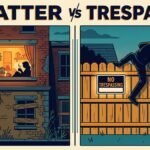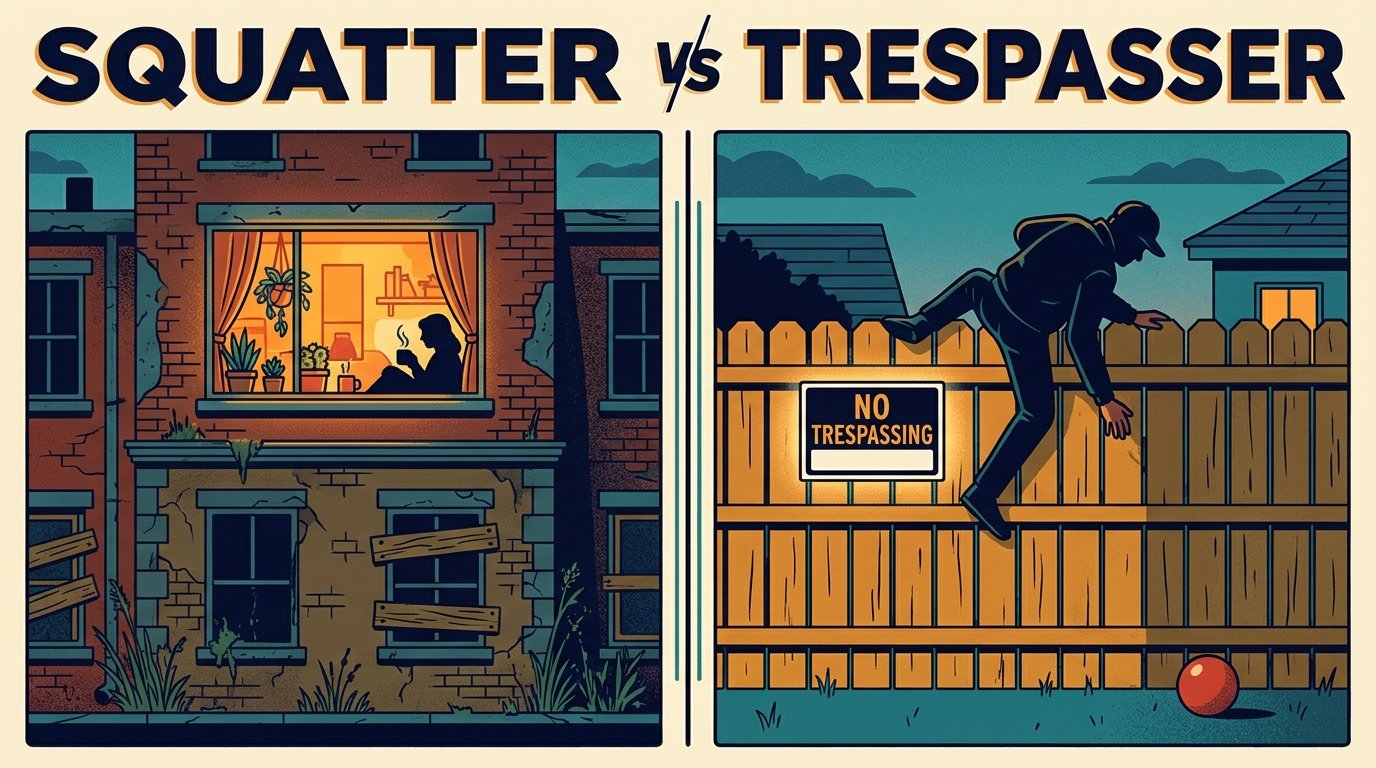
In Caracas, the capital of Venezuela, there is a 45-story tower called Torre David. It was meant to be a bank headquarters, but the work stopped in the 1990s, and the building stood empty and unfinished. In 2007, people with no homes moved in. Over time, about 750 families, or around 3,000 people, lived there. They cooked, slept and even opened small shops inside. They were squatters. Now think of a hiker who climbs over a fence to take a shortcut across a farm. He walks through and leaves in ten minutes. He is a trespasser. This story shows the difference between squatter and trespasser.
A squatter is a person who lives in a building or on land without the owner’s permission. A trespasser is a person who enters someone’s property without permission. Many people mix them up, but the difference between squatter and trespasser is easy to learn.
Key difference between squatter and trespasser
The simplest way to remember it: a squatter stays and lives there, but a trespasser just enters without permission. A squatter makes a place a home. A trespasser may only be passing through. Every squatter starts out as a trespasser, but not every trespasser is a squatter.
Why is this difference important for learners and experts?
Students who know the difference between squatter and trespasser can read the news, write essays and understand property words. Lawyers, police, teachers and property owners need it to use the right word and the right steps. It also matters in society. Cities have empty buildings, and many people need homes. Owners need to keep their property safe. When we understand these words, we can talk about housing and rights in a fair and clear way.
Pronunciation
| Word | US English | UK English |
| Squatter | /ˈskwɑː.t̬ɚ/ (SKWAH-ter) | /ˈskwɒt.ə/ (SKWOT-uh) |
| Trespasser | /ˈtres.pəs.ɚ/ (TRES-puh-ser) | /ˈtres.pə.sə/ (TRES-puh-suh) |
In the US, the “a” in squatter is long and open. In the UK, it is short, like “o.”
Note: This blog teaches the meaning of words. It is not legal advice. Laws are different in each country and state. If you have a property problem, talk to a lawyer or the local authorities.
Difference Between Squatter and Trespasser
1. Meaning
A squatter lives in a property without the owner’s permission. A trespasser enters a property without permission.
- Squatter example: A family moves into an empty house and starts to live there.
- Trespasser example: A boy climbs over a wall to get his ball back from a neighbour’s yard.
2. Main Aim
A squatter wants a place to live or use. A trespasser may want to cross, look around, take something or just explore.
- Squatter example: A man with no home sets up a bed in an empty factory.
- Trespasser example: A teenager sneaks into an old, closed park to take photos.
3. Length of Stay
A squatter stays for days, months or years. A trespasser is usually there for a short time.
- Squatter example: A group lives in an empty building for two years.
- Trespasser example: A person walks across a private field for five minutes.
4. Type of Property
Squatters usually choose empty, unused or abandoned places. Trespassers can enter any kind of property, even a place where people live.
- Squatter example: An old hotel that has been closed for years.
- Trespasser example: A stranger walks into a family’s busy garden.
5. Making a Home
A squatter often sets up a home, with beds, a stove and belongings. A trespasser does not make a home.
- Squatter example: People put up curtains, hang a lamp and cook meals.
- Trespasser example: A person steps over a fence, looks around and leaves.
6. Legal Claim to the Land
In some places, a squatter who stays for a very long time, and follows strict rules, may be able to ask a court for ownership. This is called adverse possession. A trespasser has no such claim.
- Squatter example: In some places, a person who openly uses a plot of land for many years might make a claim in court.
- Trespasser example: A person who crosses a field every week never gets any right to the field.
7. The Law
Trespassing is entering without permission, and it can be a crime or a civil wrong, depending on where you live. Squatting is also against the law in many places, and some places treat it more strictly. For example, in England and Wales, squatting in a home became a crime in 2012.
- Squatter example: A person who moves into someone’s empty home in England may be breaking the law.
- Trespasser example: Walking past a “No Entry” sign onto a private farm may be trespassing.
8. How They Are Removed
A squatter who has been living in a place often has to be removed with a legal process, such as a court order. A trespasser can often be told to leave right away, and may be arrested if he refuses.
- Squatter example: The owner goes to court to get a legal order for the squatters to leave.
- Trespasser example: A guard tells a stranger to leave a building, and he walks out.
9. How They Got In
A squatter may enter through an open door, a broken window or a false story. A trespasser may climb a fence, walk past a sign or enter through a gate.
- Squatter example: A person changes the lock on an empty house and says it is theirs.
- Trespasser example: A man jumps a fence to get into a private pool.
10. Effect on the Owner
Squatters can stop owners from using their property for a long time. Trespassers can disturb the owner, cause damage or put themselves in danger.
- Squatter example: The owner cannot sell or rent the building while people live in it.
- Trespasser example: A person who breaks a gate leaves the owner with a repair bill.
Nature and Behaviour of a Squatter
A squatter is a settler, not a visitor. A squatter picks a place, moves in and tries to stay. Many squatters have no home, little money or no other choice. Some also take over empty buildings on purpose, to make a protest about housing. A squatter often fixes the place up, takes care of it and builds a daily routine. But a squatter still has no permission from the owner, so the stay can be risky, and it may end in a court order. The word “squat” even means to crouch down in a spot, as if setting up camp.
Also read about more:https://compareact.com/difference-between-animatic-and-animation-2/
Nature and Behaviour of a Trespasser
A trespasser is a passer-by, a curious person or a rule-breaker. A trespasser may take a shortcut, explore, take photos, steal or play a prank. Most do not plan to stay. Some do not know that the land is private. Others ignore the signs on purpose. A trespasser is mainly defined by one act: going in without permission. This can be unsafe, because the person may get hurt on a farm, a building site or a railway. It can also scare or harm the owner.
Why Are People Confused About Squatter and Trespasser?
- Both enter without permission. So they look like the same act.
- A squatter starts as a trespasser. The first step is the same.
- News stories mix the words. Reporters sometimes use both for one event.
- Laws use different words. Each country and state has its own rules and names.
- Other words add to the mix. Words like “tenant,” “intruder” and “occupier” sound close.
Difference and Similarity Table
| Feature | Squatter | Trespasser |
| Meaning | Lives in a place without permission | Enters a place without permission |
| Length of stay | Long | Short |
| Aim | To live or use the place | Many aims (cross, look, steal) |
| Property | Often empty or abandoned | Any property |
| Makes a home | Yes | No |
| Possible land claim | Sometimes, after many years, by strict rules | Never |
| Removal | Often needs a legal process | Can often be told to leave at once |
| No permission from the owner | Yes | Yes |
| May break the law | Yes | Yes |
| Can upset the owner | Yes | Yes |
| Starts with entering | Yes | Yes |
Which Word Fits What Situation?
Neither word is “better.” You choose the one that fits what is happening.
Use “squatter” when someone is living in a place without permission. If people have moved into an empty house, set up beds and stayed for days or weeks, the word “squatter” is the right one. It tells us that they are using the place as a home or base, and that they are not just passing through. It also hints at a longer problem, because squatters may need a legal process to leave, and because the matter can involve housing and the law.
Use “trespasser” when someone has entered without permission, even for a short time. If a person steps over a fence, walks onto a private farm or goes into a closed building, the word “trespasser” fits. It is the best word for a short visit, a shortcut or a rule-breaker who does not stay. It focuses on the act of entering. Signs such as “No Trespassing” use this word to warn people to keep out.
How the Words Are Used in Metaphors and Similes
- Squatter as a metaphor: “Worry was a squatter in her mind, living there rent-free.”
- Squatter as a simile: “Like a squatter in an empty house, the fear moved in and stayed.”
- Trespasser as a metaphor: “His rude words were a trespasser in a quiet room.”
- Trespasser as a simile: “The cat crossed the garden like a trespasser in a forbidden land.”
Connotative Meaning of Squatter and Trespasser
A connotation is the feeling a word gives, besides its plain meaning.
Squatter is mostly negative to neutral. It makes people think of someone who has no right to be there. But it can feel sympathetic when people are poor and need a home. In old Australia, “squatter” had a neutral to positive sense, because it meant a settler who took up land to farm sheep.
- Negative: “The owner was angry to find squatters in his shop.”
- Neutral or sympathetic: “Many squatters in the city simply had nowhere else to go.”
Trespasser is mostly negative. It suggests a person who breaks a rule. In old religious writing, “trespass” can also mean a wrong or a sin.
- Negative: “The farmer shouted at the trespassers in his field.”
- Neutral: “The sign said that trespassers would be reported.”
Idioms and Proverbs Related to the Words
There are no old idioms with the exact words “squatter” or “trespasser.” But these sayings fit them well.
- “Possession is nine-tenths of the law”: a person who holds something has a strong claim to it. Example: “The squatters had lived there for years. People said possession is nine-tenths of the law, but the court still said no.”
- “An Englishman’s home is his castle”: your home is your own private place. Example: “He did not want strangers on his land. An Englishman’s home is his castle.”
- “Good fences make good neighbours”: clear borders help people get along. Example: “After a trespassing fight, they built a fence. Good fences make good neighbours.”
- “Overstay your welcome”: stay longer than people want you to. Example: “The visitor overstayed his welcome and would not leave.”
- “Trespassers will be prosecuted”: a sign that warns people to keep out. Example: “We turned back when we saw the sign: trespassers will be prosecuted.”
- “Rent-free”: living somewhere without paying. Example: “That song lives in my head rent-free.”
Works of Literature on Squatters and Trespassers
- The Squatter and the Don: Novel about land and squatters in California; María Amparo Ruiz de Burton, 1885
- The Trespasser: Novel; D. H. Lawrence, 1912
- Mending Wall: Poem about fences and neighbours; Robert Frost, 1914
- Trespass: Novel; Rose Tremain, 2010
- The Trespasser: Crime novel; Tana French, 2016
- Trespasses: Novel; Louise Kennedy, 2022
Movies Related to Squatters and Trespassers
Few famous films have “squatter” in the title. These films are about trespassing, intruders and people who live where they should not.
- Trespass: Action thriller; 1992, USA
- Trespass: Crime thriller; 2011, USA
- Parasite: Dark comedy-thriller about a family that sneaks into a rich home; 2019, South Korea
- The Intruder: Thriller about a man who will not leave his old home; 2019, USA
Five possible Asked Questions
1. Is a squatter a trespasser? Often, yes. A squatter has entered without permission, so he is trespassing. But squatting also means staying and living there.
2. Can a squatter become the owner? In some places, yes, but it is rare. It may take many years and strict rules. This is called adverse possession, and the law is different in each place.
3. Is trespassing a crime? It depends on where you live. In many places, it is a crime, especially after a warning or if there is a sign. In other places, it is a civil wrong.
4. Can an owner remove a squatter by himself? Not always. In many places, owners must follow the legal process, and using force or changing the locks may be against the law. Owners should talk to the police or a lawyer.
5. What about a tenant who stays after the lease ends? That person is often called a holdover tenant. The legal process is different from the one for squatters.
How Both Are Useful for Our Surroundings
Learning these two words helps communities in many ways. People who know the difference can report problems to the right office and use the right steps. Owners learn to look after empty buildings, so they are not left open. Neighbours learn to respect private land and signs. Cities see that empty buildings and a lack of homes are problems that need care and planning. When we understand squatters and trespassers, we can talk about housing, safety and property rights with more fairness and less fear.
Final Words for Both
Squatter: someone who lives in a place without permission. The stay is long, and the matter often needs the law.
Trespasser: someone who enters a place without permission. The visit is short, but it can still break the law.
Conclusion
The difference between squatter and trespasser is simple once you know the key. A squatter lives in a property without permission, and often stays for a long time. A trespasser only enters without permission, and often stays for a short time. Every squatter begins as a trespasser, but not every trespasser becomes a squatter. In some places, a squatter who stays for many years may be able to make a legal claim. A trespasser never can. Laws are different in each place, so always check your local rules. Next time you read a news story, ask two questions. Is the person living there? Or only entering? The answers will tell you which word is right.

I’m Zahid Abbas, an educator, researcher, and digital publishing strategist with a passion for linguistics, grammar, and clear communication. As a content creator and SEO specialist, I craft research-driven, reader-focused content that empowers learners and makes knowledge accessible worldwide.