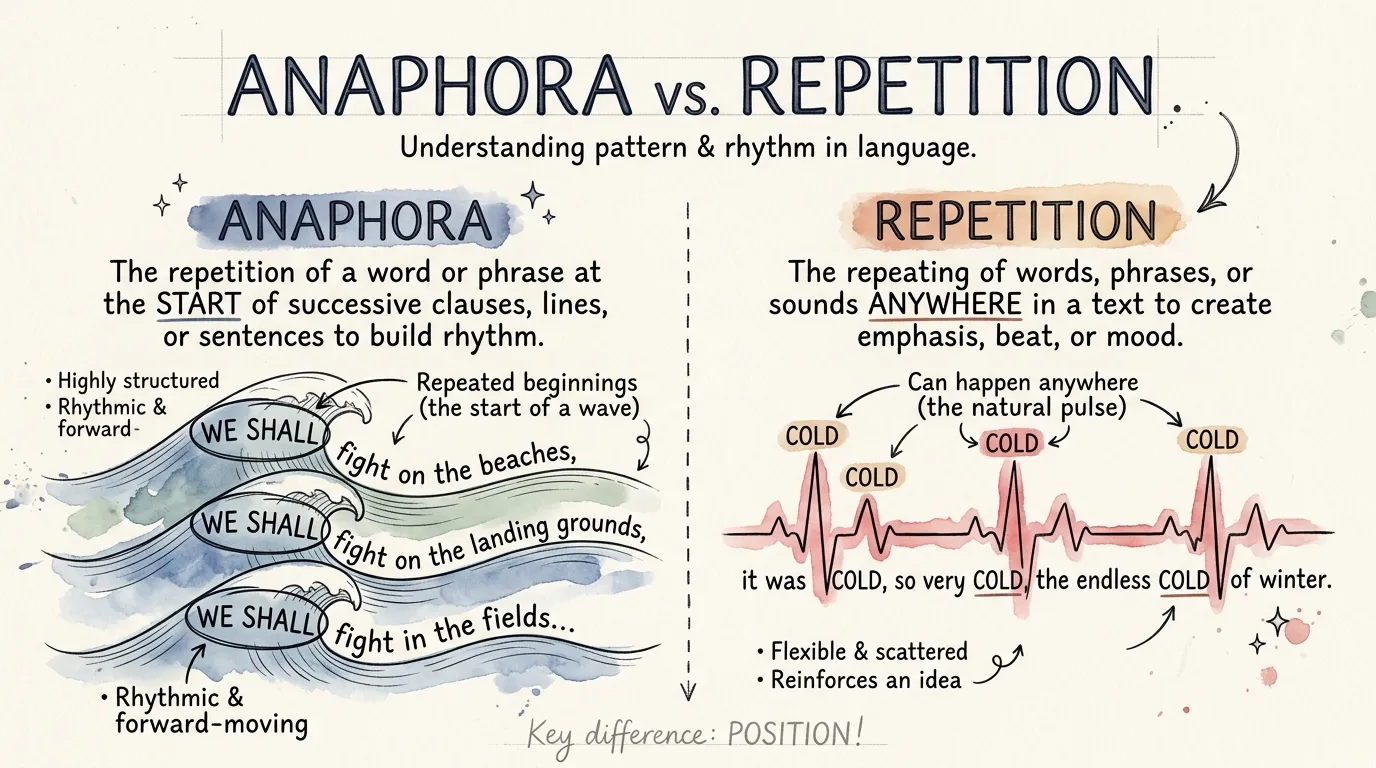
Imagine a teacher standing in front of a class. She says, “We will learn. We will grow. We will succeed.” She repeats the words “We will” at the start of each sentence. This is called anaphora. Now, imagine a student saying, “I love books, books that teach me, books that make me happy.” The word “books” appears more than once. This is an example of repetition.
The difference between anaphora and repetition is important in writing and speaking. Both use words more than once, but they do not always work in the same way. Anaphora repeats words at the start of sentences or lines. Repetition can happen anywhere in a sentence. Learning the difference between anaphora and repetition helps students write better stories, poems, and speeches. It also helps readers understand how writers make their words strong and easy to remember.
Key Difference Between Anaphora and Repetition
- Anaphora: Repeating a word or group of words at the beginning of sentences, phrases, or lines.
- Repetition: Using a word, sound, or group of words more than once.
Example of anaphora: “We need hope. We need love. We need peace.”
Example of repetition: “The rain, rain, rain fell all night.”
Why Is It Important to Know the Difference?
Knowing the difference helps students understand poems, stories, and speeches. Writers use these tools to share ideas and feelings.
For example, a speaker may repeat “We can do it” at the start of several sentences to give people hope. A writer may repeat the word “dark” in a story to create a sad or scary feeling.
These tools are useful in schools, books, songs, and public speeches. They help people remember important ideas and make language more powerful.
Pronunciation of Anaphora and Repetition
- Anaphora: US and UK English: uh-NAF-uh-ruh
- Repetition: US and UK English: rep-uh-TISH-un
10 Differences Between Anaphora and Repetition
1. Meaning
Anaphora: It repeats words at the beginning of phrases, sentences, or lines.
Examples:
- “I will learn. I will try. I will win.”
- “Every day I read. Every day I write.”
Repetition: It repeats a word or phrase more than once.
Examples:
- “The bell rang, rang, rang.”
- “Go, go, go!” shouted the coach.
2. Place of Repeated Words
Anaphora: The repeated words appear at the start.
Examples:
- “We want peace. We want hope.”
- “She likes to sing. She likes to dance.”
Repetition: The repeated words can appear at the start, middle, or end.
Examples:
- “The dog ran and ran.”
- “Happy, happy, happy was the little girl.”
3. Main Purpose
Anaphora: It often makes an idea strong and easy to remember.
Examples:
- “We need care. We need kindness.”
- “I have a dream. I have a plan.”
Repetition: It can show strong feelings or make a word stand out.
Examples:
- “Help, help!” cried the child.
- “No, no, no!” said the boy.
4. Use in Poems
Anaphora: Poets use it to make lines sound connected.
Examples:
- “The sky is blue. The sky is bright.”
- “I see the stars. I see the moon.”
Repetition: Poets use it to create rhythm or feeling.
Examples:
- “Rain, rain, go away.”
- “Alone, alone, all alone.”
5. Use in Speeches
Anaphora: Speakers use it to make their message strong.
Examples:
- “We will work. We will learn. We will grow.”
- “Let us help. Let us care. Let us share.”
Repetition: Speakers may repeat important words anywhere in their message.
Examples:
- “This is our time, our time to shine!”
- “Never give up, never stop trying.”
6. Structure
Anaphora: It follows a clear pattern at the beginning of lines or sentences.
Examples:
- “You can learn. You can grow.”
- “They came to help. They came to care.”
Repetition: It does not need a fixed place or pattern.
Examples:
- “The little bird flew and flew.”
- “Slowly, slowly, the turtle moved.”
7. Feelings
Anaphora: It can build hope, courage, or excitement.
Examples:
- “We can help. We can care.”
- “I believe in peace. I believe in love.”
Repetition: It can show joy, fear, anger, or sadness.
Examples:
- “I am so happy, happy, happy!”
- “Go away, go away!” shouted the frightened child.
8. Use in Daily Speech
Anaphora: People may use it when they repeat the same opening words.
Examples:
- “Today we learn. Today we grow.”
- “I want to help. I want to share.”
Repetition: People use it often to make a point or show feelings.
Examples:
- “Wait, wait for me!”
- “That was very, very good.”
9. Length
Anaphora: It often appears across several phrases, sentences, or lines.
Examples:
- “We need food. We need water. We need shelter.”
- “Every child needs love. Every child needs care.”
Repetition: It can be as short as one repeated word.
Examples:
- “Run, run!”
- “No, no!”
10. Relationship
Anaphora: It is a special kind of repetition because it repeats words at the beginning.
Examples:
- “I can read. I can write.”
- “Here we stand. Here we stay.”
Repetition: It is the wider term for using words or sounds again.
Examples:
- “The wind blew and blew.”
- “The stars were bright, bright, bright.”
Also read more about: https://compareact.com/difference-between-sarcasm-and-irony-2/
Nature and Behaviour of Anaphora
Anaphora follows a pattern. It repeats the same word or words at the start of nearby phrases, sentences, or lines.
It helps readers notice an important idea. And it can also make writing sound smooth and strong.
Examples:
- “We will learn. We will grow. We will shine.”
- “Every day brings hope. Every day brings joy.”
Nature and Behaviour of Repetition
Repetition means using a word, phrase, or sound more than once. It can appear in many places in a sentence or poem.
It can make words stand out, create rhythm, or show strong feelings.
Examples:
- “The baby laughed and laughed.”
- “Stop, stop, stop!” shouted the teacher.
Why Do People Confuse Anaphora and Repetition?
People confuse these terms because both use the same words more than once. Anaphora is also a type of repetition, so the two are closely linked.
The easy way to remember the difference is to look at the place of the repeated words.
- If the same words appear at the beginning of several phrases or lines, it may be anaphora.
- If a word or phrase appears more than once anywhere, it is repetition.
For example, “We need help. We need hope” is anaphora and repetition. The words “We need” appear at the start of both sentences.
Table: Difference and Similarities Between Anaphora and Repetition
| Feature | Anaphora | Repetition |
| Meaning | Repeats words at the beginning | Uses words more than once |
| Place | Beginning of phrases or lines | Anywhere |
| Purpose | Makes an idea strong | Adds feeling or importance |
| Pattern | Has a clear opening pattern | May have any pattern |
| Example | “I can learn. I can grow.” | “I tried and tried.” |
| Relationship | A type of repetition | The wider term |
Similarities
- Both use words more than once.
- Both can make writing stronger.
- Both are used in poems and speeches.
- Both can help readers remember an idea.
- Both can show feelings.
Which Is Better: Anaphora or Repetition?
When Is Anaphora Better?
Anaphora is useful when a writer wants to make an idea strong and easy to remember. It works well in speeches, poems, and stories. For example, “We need kindness. We need care. We need love” makes the message clear. The repeated opening words help connect each sentence. Anaphora is a good choice when the writer wants to build hope, excitement, or a strong message. It can also make a speech sound smooth and powerful. Writers should use it when repeating the same opening words helps readers understand the main idea.
When Is Repetition Better?
Repetition is useful when a writer wants to show a feeling, create a sound, or make one word stand out. For example, “Run, run, run!” shows that someone wants another person to move quickly. Repetition can appear at the start, middle, or end of a sentence. It is common in songs, poems, stories, and everyday speech. Writers can use it to show fear, joy, sadness, or excitement. Repetition is a good choice when a word needs extra attention. It should not be used too much, or the writing may become boring.
Both are useful. The best choice depends on what the writer wants to say.
Anaphora and Repetition in Similes and Metaphors
A simile compares two things using words such as “like” or “as.” A metaphor says one thing is another thing.
Anaphora and repetition can be used with similes and metaphors to make them stronger.
Simile Examples
- Anaphora: “Like a bird, I dream. Like a bird, I hope.” The words “Like a bird” repeat at the beginning.
- Repetition: “Her smile was like sunshine, warm sunshine.” The word “sunshine” is repeated.
Metaphor Examples
- Anaphora: “Hope is a light. Hope is a guide.” The words “Hope is” repeat at the beginning.
- Repetition: “Time is a river, a river that keeps moving.” The phrase “a river” is repeated.
These examples show how repeated words can make comparisons clearer and stronger.
Positive, Negative, and Neutral Meanings
Anaphora and repetition do not have good or bad meanings by themselves. Their effect depends on how a writer uses them.
Anaphora
- Positive: “We can learn. We can grow.” This gives hope.
- Negative: “We lost hope. We lost trust.” This creates a sad feeling.
- Neutral: “The room was large. The room was bright.” This gives information.
Repetition
- Positive: “Happy, happy, happy!” This shows joy.
- Negative: “No, no, no!” This may show fear or anger.
- Neutral: “The train moved slowly, slowly.” This describes how the train moved.
Idioms and Proverbs Related to Anaphora and Repetition
There are no common idioms that directly use the words anaphora and repetition. However, these sayings show how repeating words or ideas can help people remember a message.
1. Practice Makes Perfect
Meaning: Practice helps us improve.
Example: “Read every day. Write every day. Practice makes perfect.” The repeated opening words make the advice stronger.
2. Never Give Up
Meaning: Keep trying, even when something is hard.
Example: “Never give up. Never stop trying.” The repeated opening words show anaphora.
3. Better Late Than Never
Meaning: Doing something late is better than not doing it at all.
Example: “I will finish my homework, even if it is late. Better late than never.” This saying repeats an important idea about trying.
Works in Literature That Use Anaphora and Repetition
Writers have used anaphora and repetition in many famous works. Here are some examples.
- “I Have a Dream” — Genre: Speech; Writer and speaker: Martin Luther King Jr.; Year: 1963. It uses repeated opening words to share a message of hope and fairness.
- A Tale of Two Cities — Genre: Novel; Writer: Charles Dickens; Year: 1859. Its famous opening uses repeated sentence patterns and contrasts.
- The Raven — Genre: Narrative poem; Writer: Edgar Allan Poe; Year: 1845. It uses repeated words and lines to create a strong mood.
- “Do Not Go Gentle into That Good Night” — Genre: Poem; Writer: Dylan Thomas; Year: 1951. It repeats key lines to make its message powerful.
These works use repetition in different ways. Some also use anaphora, depending on the repeated words and their place.
Movies That Use Anaphora and Repetition
Anaphora and repetition are writing tools, not usually the main subject of a movie. However, many films use repeated words and phrases in their dialogue.
- Dead Poets Society — Released: 1989; Country: United States; Genre: Drama. The film uses repeated ideas and phrases to inspire students.
- Rocky — Released: 1976; Country: United States; Genre: Sports drama. Repeated ideas about effort and courage help build the story.
- The King’s Speech — Released: 2010; Country: United Kingdom; Genre: Historical drama. The film focuses on speech, practice, and the power of spoken words.
These films are not specifically about anaphora or repetition, but their dialogue shows how words and ideas can be repeated for effect.
Five Possible Asked Questions About Anaphora and Repetition
1. What is anaphora?
Anaphora is a writing tool that repeats words at the beginning of phrases, sentences, or lines.
2. What is repetition?
Repetition means using a word, sound, or phrase more than once.
3. Is anaphora a type of repetition?
Yes. Anaphora is a special type of repetition because the repeated words appear at the beginning.
4. Can anaphora and repetition appear together?
Yes. For example, “We need peace. We need love.” The words “We need” repeat at the beginning, so the example uses both.
5. Why do writers use anaphora and repetition?
Writers use them to make ideas clear, show feelings, create rhythm, and help readers remember important words.
How Are Anaphora and Repetition Useful in Our Surroundings?
We can find repetition in everyday life. Teachers repeat important lessons to help students remember them. Parents may repeat safety rules so children understand them. Coaches may repeat short words to encourage their teams.
Anaphora can also be useful. A speaker might say, “We can help. We can share. We can care.” The repeated opening words make the message easy to follow.
These tools help people share ideas in schools, homes, meetings, and public speeches. They can make messages clear, strong, and easy to remember.
Final Words on Anaphora and Repetition
Anaphora and repetition are useful tools in English. Repetition means using words or sounds more than once. Anaphora is a special kind of repetition in which words are repeated at the beginning of phrases, sentences, or lines.
Both can make writing stronger and help people remember important ideas. The main thing to remember is where the repeated words appear. If they appear at the start of several phrases or lines, the writing may use anaphora. If they appear more than once anywhere, it uses repetition.
Conclusion
The difference between anaphora and repetition is simple. Anaphora repeats words at the beginning of phrases, sentences, or lines. Repetition uses words or sounds more than once and can happen anywhere. Anaphora is often used to make a message strong and easy to remember. Repetition can create rhythm, show feelings, or make a word stand out. Both tools are common in poems, stories, speeches, and daily talk. They can help writers share ideas clearly and help readers understand important messages. When you read or write, look for repeated words and notice where they appear. This will help you understand and use both tools better.

I’m Zahid Abbas, an educator, researcher, and digital publishing strategist with a passion for linguistics, grammar, and clear communication. As a content creator and SEO specialist, I craft research-driven, reader-focused content that empowers learners and makes knowledge accessible worldwide.