If you visit a Christian church in the United States, you may hear someone called a pastor, Reverend, or even Reverend Pastor. These titles can sound like they mean the same thing, so it is easy to wonder what the actual difference is.
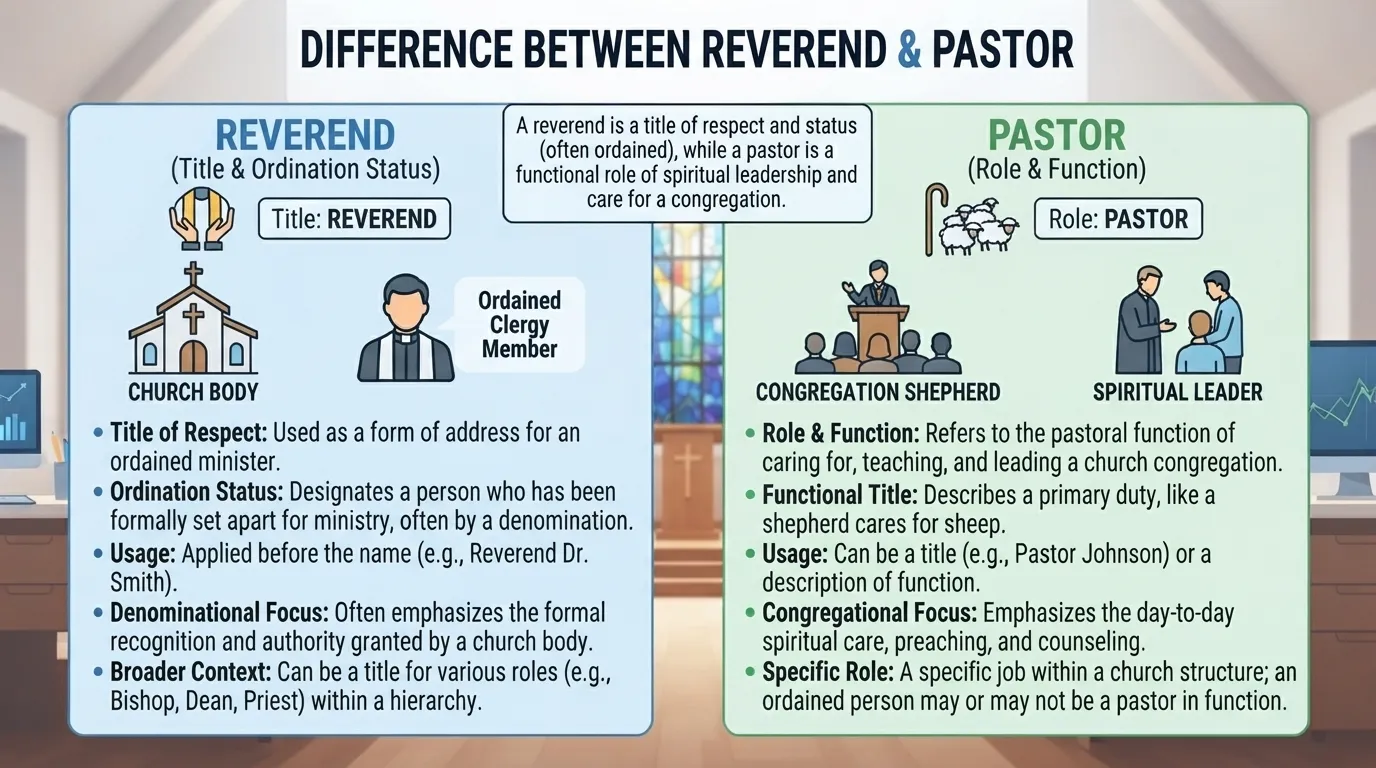
The distinction is mainly about role versus title. A pastor is generally a Christian minister who leads or serves a congregation, while Reverend is a formal title used before the name of an ordained member of the clergy.
However, the exact use of these terms can vary among Christian denominations. Understanding the difference between Reverend and Pastor can help you address clergy members correctly and understand what their titles mean.
Quick Answer
A pastor is usually a Christian minister who has a pastoral role, such as leading and caring for a congregation. Reverend is generally a title of respect used before the name of an ordained Christian clergy member.
In simple terms, pastor describes a role, while Reverend functions mainly as a title. One person can be both a pastor and a Reverend.
What Is a Pastor?
A pastor is a Christian minister who provides spiritual leadership and care, often for a local congregation.
Pastors may preach sermons, lead worship services, teach the Bible, counsel members, perform religious ceremonies, and help guide their church community.
For example, if a minister leads a local Baptist church and provides regular spiritual care to its members, that person may be called the pastor of the church.
The word pastor comes from a Latin word meaning shepherd, which fits its traditional idea of caring for and guiding a group of believers.
What Is a Reverend?
Reverend is generally a title used for an ordained member of the Christian clergy. It is normally placed before a person’s name, as in the Reverend John Smith.
Unlike pastor, the word does not necessarily describe the person’s specific job in a church. An ordained minister may be called Reverend even if they do not serve as the pastor of a particular congregation.
For example, an ordained minister named John Smith might formally be addressed as the Reverend John Smith.
The exact use of the title can vary between denominations and Christian traditions.
Key Differences Between Reverend and Pastor
1. Title vs. Role
The simplest distinction is that Reverend is a title, while pastor usually describes a role.
A person may be called Reverend because they are an ordained member of the clergy. A person is called a pastor when they have a pastoral ministry or leadership role.
This is why the two terms can describe the same person without meaning exactly the same thing.
2. Meaning
Reverend is a formal title associated with ordained Christian clergy.
Pastor refers to someone who provides spiritual leadership and care, often within a particular congregation.
The words therefore focus on different aspects of ministry.
3. Congregational Leadership
A pastor commonly has responsibility for a local church or congregation.
A Reverend may or may not have that responsibility. The person could serve in another form of Christian ministry, depending on their denomination and position.
4. How the Terms Are Used
Reverend is normally used with a person’s name:
- The Reverend James Brown
- Rev. James Brown
Pastor can be used as a person’s ministry title:
- Pastor James Brown
- The pastor of First Church
The exact conventions vary among churches and denominations.
5. Can One Person Have Both Titles?
Yes.
A minister can be both a Reverend and a pastor.
For example, if James Brown is an ordained Christian minister who leads a local congregation, he may be formally called the Reverend James Brown and also be known as Pastor Brown.
These titles are not mutually exclusive.
Reverend vs. Pastor Comparison Table
FeatureReverendPastorBasic meaningA title for an ordained clergy memberA pastoral ministry roleMain functionShows formal clerical status or respectDescribes spiritual leadership and careUsually usedBefore a person’s nameAs a title or description of a roleLeads a congregation?Not necessarilyOften, but not alwaysOrdinationUsually associated with ordained clergyDepends on denomination and church structureCan one person be both?YesYesExampleThe Reverend John SmithPastor John Smith
Similarities Between Reverend and Pastor
The terms are closely related because both are commonly used in Christian settings.
Both may refer to people who:
- Serve Christian communities
- Provide spiritual guidance
- Teach or preach
- Lead religious activities
- Offer pastoral care
- Work within a church or other Christian organization
The biggest source of confusion is that a person who is a pastor may also be formally addressed as Reverend.
Why Are Reverend and Pastor Confused?
The terms are often confused because they can describe the same person.
For example, a minister who leads a church congregation may be both:
the Reverend Michael Jones
and
Pastor Michael Jones.
However, the two titles highlight different things. Reverend is connected mainly with clerical title and status, while pastor describes a ministry role.
Denominational practices also matter. Different Christian traditions may use titles differently, so there is no single rule that applies identically to every church.
When Is “Reverend” Used?
Reverend is generally used when formally referring to or addressing an ordained Christian clergy member.
For example:
- The Reverend Sarah Williams will lead the service.
- I spoke with Reverend Williams after the ceremony.
- Rev. Thomas Brown signed the church document.
In formal writing, the Reverend is traditionally used as a title before the person’s name.
In everyday speech, however, people may use another title, such as Pastor, depending on the person’s role and the customs of the church.
When Is “Pastor” Used?
Pastor is used when referring to a minister who has a pastoral role.
For example:
- Pastor Smith gave the Sunday sermon.
- I spoke with our pastor after the service.
- The pastor visited members of the congregation.
The word is especially common when discussing a minister’s relationship with a local congregation.
Can Reverend and Pastor Be Used Interchangeably?
Sometimes, but not in every situation.
A pastor may also be a Reverend, so the terms can refer to the same person. However, they do not have exactly the same meaning.
Calling someone a pastor emphasizes their pastoral role. Calling someone Reverend emphasizes their formal clerical title.
For example, if someone says, “Our pastor is leading the service,” the focus is on that person’s role in the congregation. If someone writes, “The Reverend John Smith,” the focus is on the person’s formal title.
Because churches have different traditions, it is best to follow the title the individual or their church normally uses.
Common Mistakes With Reverend and Pastor
Mistake 1: Assuming Every Reverend Is a Pastor
Not necessarily. Reverend is a broader clerical title, and an ordained person may serve in a role other than pastor.
Mistake 2: Assuming Every Pastor Uses Reverend
Not necessarily. Churches and denominations differ in their use of clerical titles and forms of address.
Mistake 3: Thinking Reverend Is a Person’s Name
It is a title, not a first or last name.
For example, in the Reverend John Smith, Reverend is the title and John Smith is the person’s name.
Mistake 4: Thinking Pastor and Reverend Are Completely Different People
One person can hold both descriptions.
A local church leader may be both a pastor and a Reverend.
Mistake 5: Assuming All Christian Churches Use These Titles in the Same Way
They do not. Usage can vary by denomination, church tradition, and individual preference.
Linguistic Information
Reverend is commonly shortened to Rev. in writing. It is traditionally used as a title before a clergy member’s name.
Pastor is a noun that refers to a Christian minister who has a pastoral role. It can also be used as a form of address, such as Pastor Johnson.
In American English, both terms are familiar in Christian contexts, but their use depends heavily on denominational and local church conventions.
Frequently Asked Questions
What is the main difference between Reverend and Pastor?
Reverend is generally a formal title for an ordained Christian clergy member, while pastor usually describes someone serving in a pastoral ministry role.
Is a pastor the same as a Reverend?
Not exactly. A pastor can also be a Reverend, but the two terms describe different aspects of the person’s ministry.
Can a woman be called Reverend or Pastor?
Yes. Christian denominations that ordain women may use these titles for women clergy, although specific practices vary between denominations.
Is Reverend a higher rank than Pastor?
Not necessarily. Reverend and pastor are not simply two levels of the same ranking system. Their meanings and uses depend on the church tradition.
Should you call a pastor Reverend?
It depends on the person’s denomination and preference. If you are unsure, using the title the person normally uses is a respectful choice.
Why do some pastors use both Reverend and Pastor?
Because the titles can describe different aspects of the same person’s ministry. A person may be an ordained Reverend who also serves as the pastor of a congregation.
Is Reverend only used in the United States?
No. Reverend is used in various English-speaking Christian contexts, although exact conventions for clergy titles differ by country and denomination.
Conclusion
The main difference between Reverend and Pastor is that Reverend is generally a formal title for an ordained Christian clergy member, while pastor usually describes a person’s role in providing spiritual leadership and care. The terms can overlap because a person who serves as a pastor may also be formally called Reverend. The important point is that they are not simply two names for exactly the same position. Reverend focuses more on clerical title, while pastor focuses more on pastoral ministry. Because Christian denominations use these terms in different ways, the most appropriate title can depend on the church tradition and the individual’s preference.

I’m Zahid Abbas, an educator, researcher, and digital publishing strategist with a passion for linguistics, grammar, and clear communication. As a content creator and SEO specialist, I craft research-driven, reader-focused content that empowers learners and makes knowledge accessible worldwide.