When a business buys a building, vehicle, computer system, patent, or other long-term asset, it usually does not treat the entire cost as an expense right away. Instead, the cost may be spread over the period in which the asset provides value.
This is where depreciation and amortization come in. Both are methods of allocating the cost of an asset over time, but they are generally used for different types of assets.
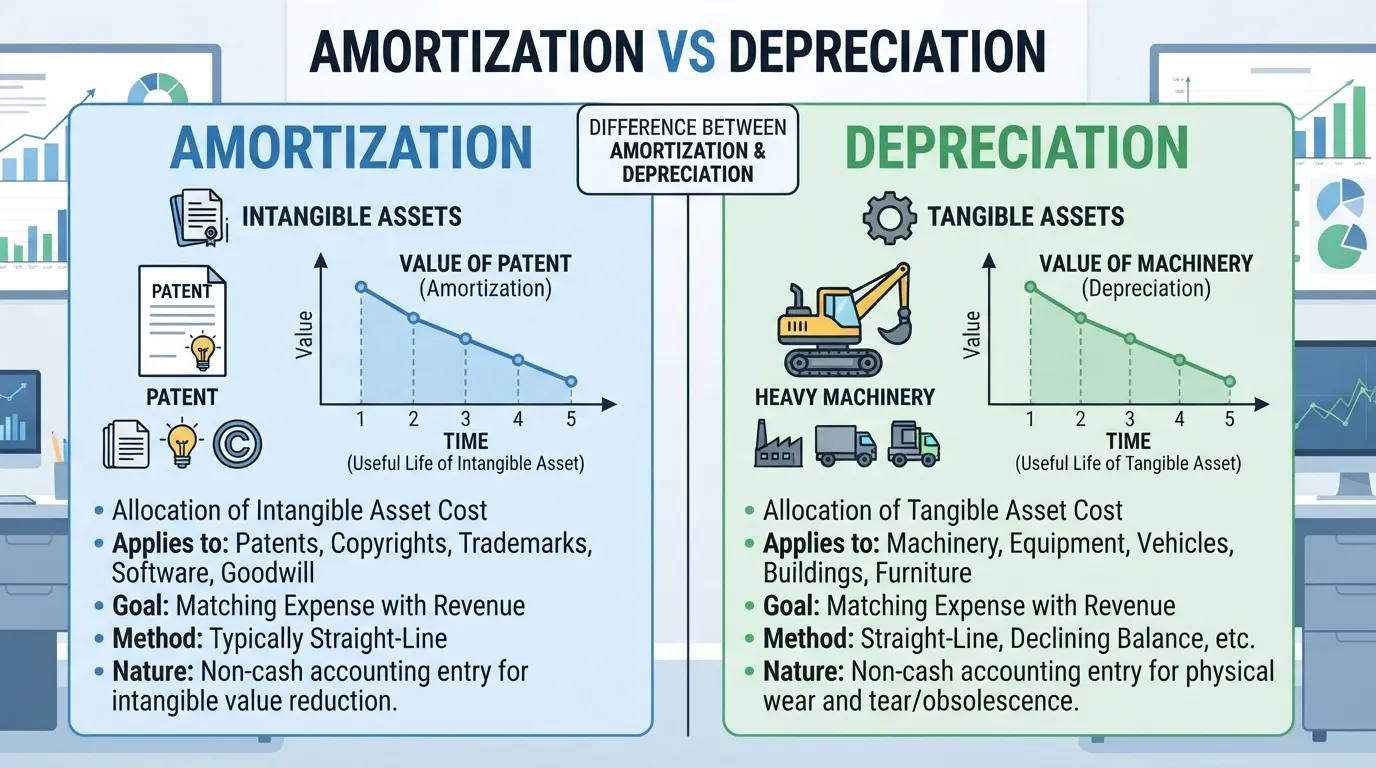
The difference between amortization and depreciation is mainly that depreciation is associated with tangible assets such as equipment and buildings, while amortization commonly applies to intangible assets such as certain intellectual property. (SEC)
Amortization vs. Depreciation: Quick Answer
Depreciation is generally used to allocate the cost of a tangible or fixed asset over its useful life. Examples include buildings, machinery, vehicles, and equipment.
Amortization generally refers to allocating the cost of an intangible asset over its useful life. Examples can include certain patents, copyrights, licenses, and goodwill for tax purposes.
In simple terms: depreciation is usually associated with tangible assets, while amortization is usually associated with intangible assets. (SEC)
you can check also
What Is Depreciation?
Depreciation is an accounting method used to spread the cost of certain tangible assets over the periods in which they are used.
A tangible asset is something physical that a business can use for its operations. Common examples include:
- Buildings
- Machinery
- Vehicles
- Furniture
- Equipment
For example, suppose a business buys a machine for $50,000 and expects to use it for several years.
Example of Depreciation
Imagine a company purchases a delivery vehicle for $40,000.
The vehicle is a physical asset that the company expects to use for several years. Rather than treating the entire purchase price as the cost of using the vehicle in a single period, the business may depreciate the vehicle according to the applicable accounting or tax rules.
What Is Amortization?
Amortization is generally the process of allocating the cost of an intangible asset over its useful life.
An intangible asset does not have a physical form. Examples can include:
- Patents
- Copyrights
- Licenses
- Certain contractual rights
- Certain other forms of intellectual property
The SEC describes amortization as recognizing the loss in value of an intangible asset over its estimated economic life. (SEC)
For U.S. federal tax purposes, the rules can be more specific. For example, the IRS generally requires certain Section 197 intangibles acquired after August 10, 1993, to be amortized over 15 years when the applicable requirements are met. These can include goodwill, patents, copyrights, licenses, franchises, and trademarks. (IRS)
Example of Amortization
Suppose a company acquires certain qualifying intangible assets as part of a business acquisition.
Instead of having a physical asset such as a machine, the company has rights or other intangible value. If the applicable rules require amortization, the company spreads the relevant cost over the prescribed period.
Key Differences Between Amortization and Depreciation
1. Type of Asset
The most basic difference is the type of asset involved.
Depreciation is generally associated with tangible assets such as buildings, equipment, machinery, and vehicles.
Amortization is generally associated with intangible assets such as intellectual property and certain other intangible rights. (SEC)
2. Physical Form
Depreciated assets generally have a physical form.
For example, a company can see and physically use a truck, computer, or piece of machinery.
Amortized assets generally do not have a physical form. A patent or copyright, for example, represents a legal or economic right rather than a physical object.
3. Common Examples
Common examples of depreciated assets include:
- Buildings
- Machinery
- Vehicles
- Furniture
- Equipment
Also Common examples of amortized intangible assets can include:
- Patents
- Copyrights
- Licenses
- Certain franchises
- Goodwill under applicable tax rules (IRS)
4. How the Cost Is Recovered
Depreciation methods can include different approaches depending on the applicable accounting framework or tax rules. For U.S. federal tax purposes, the IRS provides specific depreciation rules and systems, including MACRS for many assets. (IRS)
Amortization may follow a prescribed period or a method based on the asset’s useful life, depending on the circumstances.
5. Treatment of Land
Land is an important exception when discussing depreciation.
The IRS states that most types of tangible property can be depreciated, except land. (IRS)
This is because land is generally not treated as having a determinable useful life in the same way as depreciable property.
6. Effect on Financial Statements
Both depreciation and amortization can appear as expenses and reduce the carrying or book value of applicable assets.
Similarities Between Amortization and Depreciation
Although depreciation and amortization are different, they have several important similarities.
Both:
- Spread an asset’s cost over time.
- Are generally non-cash expenses when recorded in financial statements.
- Can reduce reported income.
- Can reduce the book value of an asset.
- Help match the cost of an asset with the periods benefiting from it.
- Are subject to specific accounting or tax rules.
Why Are Amortization and Depreciation Confused?
The terms are easy to confuse because they describe similar financial concepts.
In both cases, a business spreads the cost of an asset across multiple periods instead of treating the entire cost as an immediate expense in the same way as an ordinary operating expense.
The main distinction is the type of asset involved:
- Depreciation → generally tangible assets
- Amortization → generally intangible assets
When Should You Use Depreciation?
The term depreciation is appropriate when discussing the allocation of the cost of a qualifying tangible asset over time.
Common examples include:
- A company’s building
- Production machinery
- Business vehicles
- Office equipment
- Furniture
When Should You Use Amortization?
Use amortization when discussing the allocation of the cost of a qualifying intangible asset over time or another situation where the applicable rules specifically call for amortization.
Examples can include certain:
- Patents
- Copyrights
- Licenses
- Franchises
- Goodwill
The exact treatment varies. For example, the IRS generally requires qualifying Section 197 intangible costs to be amortized over 15 years for federal tax purposes. (IRS)
Can Amortization and Depreciation Be Used Interchangeably?
Not usually.
In everyday conversation, someone might use the terms loosely to describe spreading an asset’s cost over time. In accounting and taxation, however, the distinction can matter.
Which Is Better: Amortization or Depreciation?
Neither is “better.” They are not competing methods that a business simply chooses between.
The appropriate treatment depends mainly on what the asset is and which accounting or tax rules apply.
Depreciation is generally appropriate for: Tangible assets such as equipment, buildings, and vehicles.
Amortization is generally appropriate for: Intangible assets such as certain patents, copyrights, licenses, and other qualifying intangible assets.
The goal is not to choose whichever produces the better result. The goal is to apply the correct treatment under the relevant rules.
Common Mistakes With Amortization and Depreciation
Mistake 1: Thinking They Are Completely Different Concepts
They are different terms, but they share the same basic idea of allocating an asset’s cost over time.
Mistake 2: Assuming Amortization Always Means Loan Payments
Amortization can refer to the gradual repayment of a loan, but in accounting it can also refer to allocating the cost of an intangible asset over time.
The context matters.
Mistake 3: Thinking Depreciation Means an Asset’s Market Price Fell
Accounting depreciation is not simply a measurement of how much an asset could sell for today. It is a systematic allocation of an asset’s cost under applicable accounting or tax rules.
Mistake 4: Assuming Every Intangible Asset Is Automatically Amortized
Not every intangible asset receives the same treatment. The applicable accounting framework and tax rules determine whether and how an intangible asset is amortized.
Mistake 5: Treating Accounting and Tax Rules as Identical
Financial reporting and U.S. tax accounting can use different rules and methods. A treatment that applies for tax purposes may not necessarily be the same treatment used in a company’s financial statements.
Frequently Asked Questions About Amortization and Depreciation
What is the main difference between amortization and depreciation?
Depreciation generally allocates the cost of tangible assets over time, while amortization generally applies to intangible assets. (SEC)
Is a car depreciated or amortized?
A business vehicle is generally considered a tangible asset, so its cost is generally subject to depreciation rather than amortization, subject to the applicable accounting and tax rules. The IRS specifically includes vehicles among property that may be depreciated when the requirements are met. (IRS)
Is a patent amortized or depreciated?
A patent is an intangible asset. Depending on the applicable accounting or tax rules, its cost may be amortized rather than depreciated. The IRS lists patents among Section 197 intangibles that can generally be amortized over 15 years when the applicable requirements are satisfied. (IRS)
Is land depreciated?
Generally, land itself is not depreciated for U.S. federal tax purposes. The IRS specifically identifies land as an exception to property that can generally be depreciated. (IRS)
Is amortization a non-cash expense?
When amortization is recorded as an expense in financial statements, it generally does not represent a cash payment in the period in which the expense is recognized. It is an allocation of a previously recognized cost.
Can amortization apply to loans?
Yes. In lending, loan amortization refers to gradually paying down a loan through scheduled payments. This is a different use of the term from amortization of an intan
Does depreciation reduce taxable income?
Depreciation deductions can reduce taxable income when the applicable U.S. tax rules allow them. The IRS provides specific rules for recovering the cost of qualifying business or income-producing property through depreciation deductions. (IRS)
Conclusion
The main difference between amortization and depreciation is the type of asset they generally apply to. Depreciation is commonly used to allocate the cost of tangible assets such as buildings, vehicles, machinery, and equipment.Amortization is commonly used for intangible assets such as certain patents, copyrights, licenses, and other qualifying intangible assets. (SEC)Both concepts help spread the cost of an asset over time rather than treating the entire cost as an expense at once. However, the exact calculation and treatment depend on the applicable accounting framework or tax rules. For U.S. businesses, the IRS has detailed rules governing depreciation and amortization, so the accounting treatment should not be assumed to be the same as the tax treatment.

I’m Zahid Abbas, an educator, researcher, and digital publishing strategist with a passion for linguistics, grammar, and clear communication. As a content creator and SEO specialist, I craft research-driven, reader-focused content that empowers learners and makes knowledge accessible worldwide.