Tom looked at his smartwatch one morning. His heart rate was very high. He felt worried. He searched online and found two words: AFib and tachycardia.
At first, he thought they meant the same thing.
Many people think that.
Both can make your heart beat fast. Both can make you feel dizzy or tired. But they are not the same.
Knowing the difference between AFib and tachycardia can help you understand your health better. It can also help you understand what your doctor tells you.
In this guide, you will learn the difference between AFib and tachycardia in simple words with easy examples.
What Is AFib?
AFib stands for Atrial Fibrillation.
It is a heart rhythm problem.
The heart does not beat in a steady way. Instead, it beats in an uneven way.
History of AFib
Doctors have known about AFib for many years. As heart tests improved, doctors learned more about it. Today, AFib is one of the most common heart rhythm problems. It affects millions of people around the world. It is more common in older adults.
What Is Tachycardia?
Tachycardia means a fast heartbeat.
For most adults, a resting heart rate over 100 beats per minute is called tachycardia.
It is not one disease. It is a term that describes a fast heart rate.
History of Tachycardia
The word tachycardia comes from an old Greek word that means “fast heart.” Doctors have used this term for many years. Today, it helps doctors describe a heart that beats faster than normal.
AFib vs Tachycardia
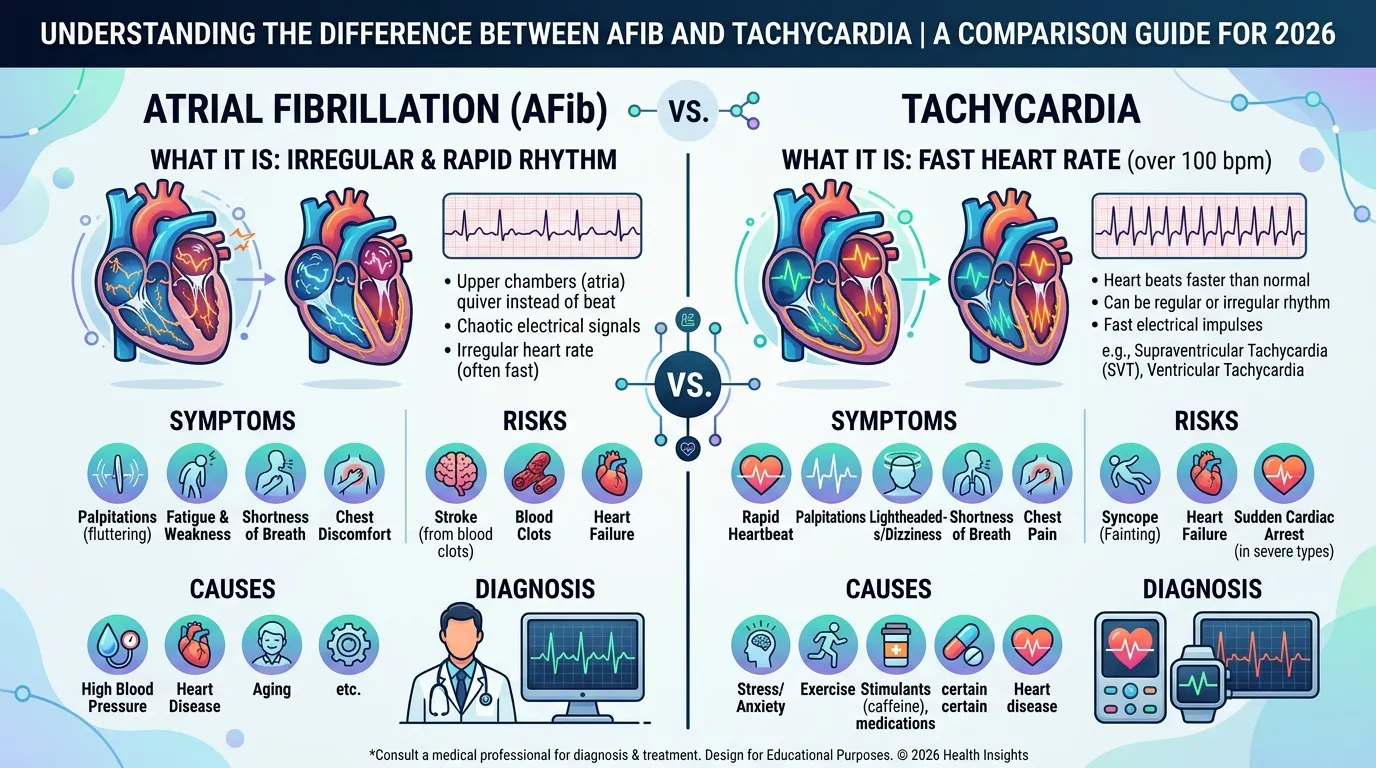
AFib: An uneven heart rhythm.
Tachycardia: A fast heart rate.
This is the main difference.
How AFib Works
Key Features
- Uneven heartbeat
- May cause a fast heartbeat
- Affects the upper part of the heart
- Can raise the risk of stroke
Examples
🔵 My doctor found AFib during a heart test.
🔵 AFib made my heartbeat feel uneven.
Uses
Doctors use the term AFib when they diagnose a specific heart rhythm problem.
How Tachycardia Works
Key Features
- Fast heartbeat
- Heart rate above 100 beats per minute
- Can happen during stress or exercise
- May be short-term or long-term
Examples
🟢 Running caused tachycardia.
🟢 Stress made my heart beat faster.
Uses
Doctors use the term tachycardia to describe a fast heart rate.
Which One Should You Use?
Use AFib when talking about the heart rhythm problem called atrial fibrillation.
Use tachycardia when talking about a fast heartbeat.
10 Differences Between AFib and Tachycardia
1. Meaning
AFib: A heart rhythm problem.
🔴 AFib caused an uneven heartbeat.
🔴 AFib needs medical care.
Tachycardia: A fast heartbeat.
🔴 Exercise caused tachycardia.
🔴 Fever caused tachycardia.
2. Heart Rhythm
AFib: Uneven rhythm.
🔴 The heartbeat was not steady.
🔴 The pulse felt irregular.
Tachycardia: May be steady or uneven.
🔴 The heartbeat was fast but steady.
🔴 The pulse stayed regular.
3. Heart Speed
AFib: Often fast.
🔴 AFib raised the heart rate.
🔴 The heart beat quickly.
Tachycardia: Always fast.
🔴 The heart rate was over 100.
🔴 The pulse was very quick.
4. Stroke Risk
AFib: Higher risk.
🔴 AFib can lead to blood clots.
🔴 Doctors may give blood thinners.
Tachycardia: Risk depends on the cause.
🔴 Some cases are harmless.
🔴 Some need treatment.
5. Cause
AFib: Often linked to heart disease.
🔴 High blood pressure can lead to AFib.
🔴 Heart problems may cause AFib.
Tachycardia: Many causes.
🔴 Stress can cause it.
🔴 Exercise can cause it.
6. Diagnosis
AFib: Needs heart rhythm tests.
🔴 Doctors use an ECG.
🔴 Heart monitors help find AFib.
Tachycardia: Doctors look for the cause.
🔴 They check heart rate.
🔴 More tests may be needed.
7. Treatment
AFib: Often needs long-term care.
🔴 Medicine may help.
🔴 Some people need procedures.
Tachycardia: Treatment depends on the cause.
🔴 Rest may help.
🔴 Treating illness may help.
8. Blood Clots
AFib: Can cause blood clots.
🔴 Clots may form in the heart.
🔴 Stroke risk goes up.
Tachycardia: Usually does not.
🔴 Most cases do not cause clots.
🔴 Risk is often lower.
9. Long-Term Care
AFib: Often needs regular checkups.
🔴 Many people take medicine.
🔴 Doctors monitor the condition.
Tachycardia: May go away.
🔴 Stress-related cases may stop.
🔴 Exercise-related cases are often normal.
10. Type
AFib: A specific condition.
🔴 AFib is a diagnosis.
🔴 Doctors can confirm it.
Tachycardia: A general term.
🔴 It describes a fast heart rate.
🔴 It does not explain the cause.
Why People Get Confused
People get confused because both can make the heart beat fast.
The symptoms can look the same.
Many people see a fast heart rate and think it must be AFib.
That is not always true.
Table: Difference and Similarity
| Feature | AFib | Tachycardia | Similarity |
| Meaning | Heart rhythm problem | Fast heartbeat | Both affect the heart |
| Rhythm | Uneven | Fast | Both may cause symptoms |
| Heart Rate | Often fast | Always fast | Both can feel rapid |
| Risk | Higher stroke risk | Depends on cause | Both need attention |
| Diagnosis | Specific condition | General term | Both need testing |
Which Is Better in What Situation?
Neither one is better.
They are health conditions.
AFib often needs more care because it can raise the risk of stroke.
Tachycardia can be harmless or serious. It depends on the cause.
Possible Questions
Is AFib the same as tachycardia?
No. AFib is a specific heart rhythm problem. Tachycardia means a fast heartbeat.
Can AFib cause tachycardia?
Yes. AFib often makes the heart beat fast.
Is tachycardia always dangerous?
No. Exercise and stress can cause it.
Which one raises stroke risk?
AFib.
How do doctors find them?
Doctors use heart tests such as an ECG.
Conclusion
The difference between AFib and tachycardia is simple. AFib is a specific heart rhythm problem. Tachycardia is a fast heartbeat. AFib can cause tachycardia, but many other things can cause a fast heart rate too. If you have a fast or uneven heartbeat, talk to a doctor. A correct diagnosis can help you get the right care.

I’m Zahid Abbas, an educator, researcher, and digital publishing strategist with a passion for linguistics, grammar, and clear communication. As a content creator and SEO specialist, I craft research-driven, reader-focused content that empowers learners and makes knowledge accessible worldwide.