Last week, Sara was writing a message to her friend. She wanted to say, “I bought this gift especially for you.” But she wrote, “I bought this gift specially for you.” Her teacher later explained that both words are similar, but they are not always used in the same way.
Many English learners face this problem. The difference between especially and specially can seem small at first. However, knowing the difference helps you write and speak more clearly. These two words often appear in daily conversations, school work, emails, and books.
This guide will explain each word in a simple way. You will learn their meanings, uses, examples, and key differences.
What is “Especially”?
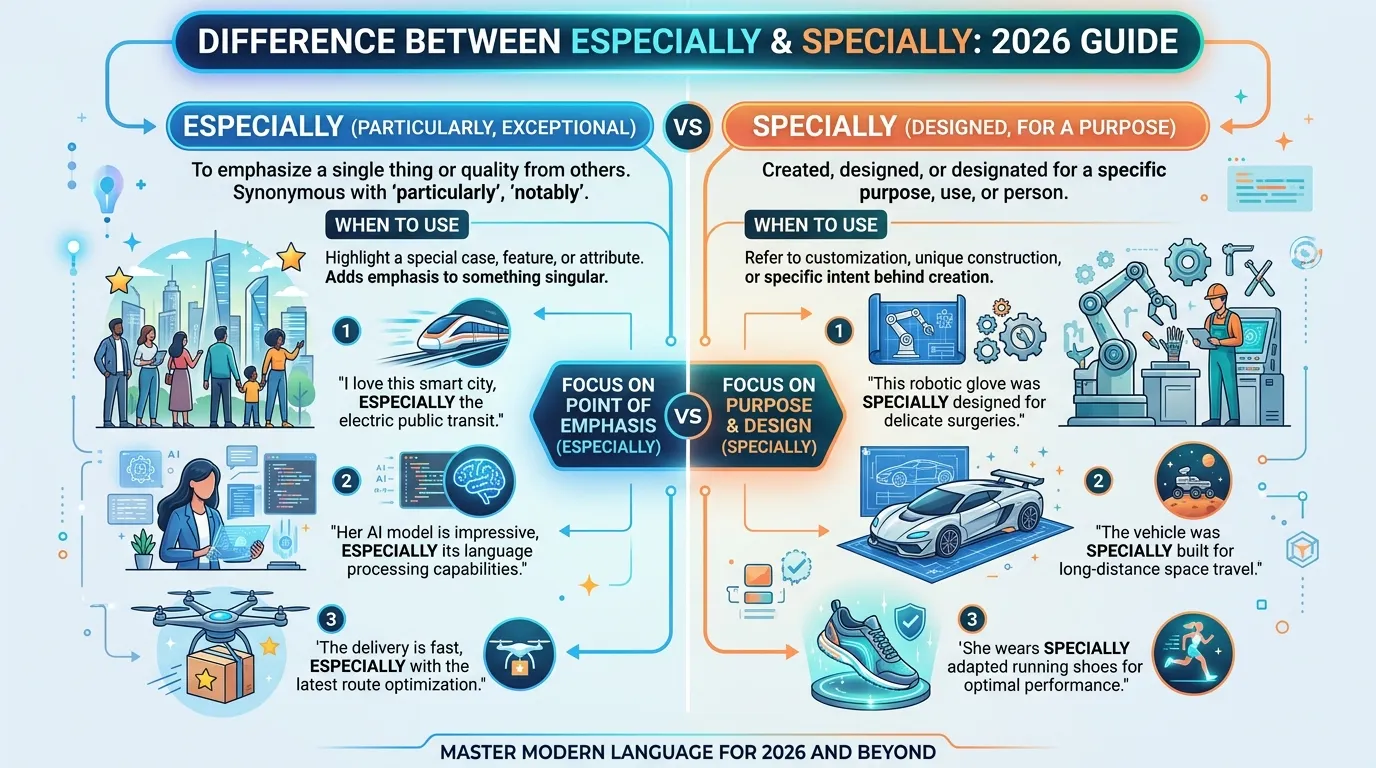
“Especially” means more than others or particularly. It is used when something or someone gets special attention.
Example:
- I like fruit, especially mangoes.
- The park is beautiful, especially in spring.
History of “Especially”
The word “especially” comes from the Latin word specialis, which means “particular” or “specific.” It entered English through Old French many centuries ago. Writers began using it to show that one thing was more important than others. Over time, the word became common in everyday English. Today, people use it to give extra attention to a person, thing, or idea. It is often found in conversations, books, news articles, and school writing. The meaning has stayed almost the same for hundreds of years, which makes it easy to understand and use today.
What is “Specially”?
“Specially” means for a special purpose or in a special way.
Example:
- This chair was specially made for children.
- The room was specially designed for meetings.
History of “Specially”
The word “specially” also comes from the Latin root specialis. It appeared in English around the same period as “especially.” At first, both words were often used in similar ways. As English changed, “specially” became linked to special purposes and special designs. People began using it when talking about things created, arranged, or prepared for a certain reason. Today, “specially” is common in business, education, manufacturing, and daily life. Although it looks very similar to “especially,” its main use is to show that something was done for a particular purpose.
Especially vs Specially
Especially = more than others; particularly.
Specially = for a special purpose; specifically made or done.
Although they look alike, their uses are different. Let’s see how each one works.
How “Especially” Works
Key Features
- Shows extra importance
- Means “particularly”
- Compares one thing with others
- Common in speaking and writing
Examples
🔵 I enjoy all sports, especially football.
🔵 The weather is nice, especially in the morning.
Uses
- Education
- Daily conversations
- Articles and essays
- Presentations
- Storytelling
How “Specially” Works
Key Features
- Shows a special purpose
- Means “made for a reason”
- Often describes design or preparation
- Common in formal writing
Examples
🟢 This cake was specially baked for the event.
🟢 The software was specially developed for teachers.
Uses
- Workplaces
- Manufacturing
- Education
- Product design
- Special events
Which One Should You Use?
Use especially when you want to highlight something as more important than others.
Use specially when something is made, arranged, or done for a particular purpose.
10 Differences Between Especially and Specially
1. Basic Meaning
Especially: Particularly or more than others.
🔴 I love animals, especially dogs.
🔴 She likes fruits, especially apples.
Specially: For a specific purpose.
🔴 The bag was specially made for travel.
🔴 The shoes were specially designed for runners.
2. Main Function
Especially: Gives emphasis.
🔴 He enjoys music, especially jazz.
🔴 I like desserts, especially cake.
Specially: Shows purpose.
🔴 The room was specially prepared.
🔴 The tool was specially created.
3. Use in Comparison
Especially: Compares one thing with others.
🔴 Winter is beautiful, especially after snow.
🔴 Books help students, especially beginners.
Specially: Does not compare.
🔴 The machine was specially built.
🔴 The meal was specially prepared.
4. Common Context
Especially: Daily speech.
🔴 I like tea, especially green tea.
🔴 She enjoys reading, especially novels.
Specially: Design and preparation.
🔴 The chair was specially made.
🔴 The uniform was specially ordered.
5. Focus
Especially: Focuses on importance.
🔴 I miss everyone, especially my family.
🔴 He respects all teachers, especially Mrs. Khan.
Specially: Focuses on purpose.
🔴 The app was specially built for kids.
🔴 The lesson was specially planned.
6. Meaning of “For”
Especially: Usually not followed by purpose.
🔴 I enjoy holidays, especially summer holidays.
🔴 He likes animals, especially cats.
Specially: Often means “for.”
🔴 This gift was specially made for you.
🔴 The desk was specially built for office use.
7. Tone
Especially: Natural and conversational.
🔴 I love movies, especially comedies.
🔴 She likes flowers, especially roses.
Specially: More formal.
🔴 The equipment was specially manufactured.
🔴 The system was specially designed.
8. Writing Style
Especially: Common in essays.
🔴 Exercise helps everyone, especially students.
🔴 Reading is useful, especially for children.
Specially: Common in technical writing.
🔴 The material was specially tested.
🔴 The engine was specially developed.
9. Frequency
Especially: Used more often.
🔴 I enjoy travel, especially beach trips.
🔴 He likes games, especially football.
Specially: Less common.
🔴 The package was specially wrapped.
🔴 The vehicle was specially equipped.
10. Purpose vs Importance
Especially: Importance.
🔴 I love all seasons, especially spring.
🔴 She enjoys music, especially classical music.
Specially: Purpose.
🔴 The book was specially written for beginners.
🔴 The course was specially created for workers.
Why People Get Confused About Their Use
People get confused because both words come from the same root word, “special.” They also look almost the same. In some sentences, both can seem possible. However, “especially” usually means “particularly,” while “specially” usually means “for a special purpose.”
Table: Difference and Similarity
| Feature | Especially | Specially | Similarity |
| Meaning | Particularly | For a special purpose | Both relate to something special |
| Function | Gives emphasis | Shows purpose | Both are adverbs |
| Usage | Common in speech | Common in formal writing | Both modify actions |
| Focus | Importance | Purpose | Both add detail |
| Frequency | More common | Less common | Both are standard English |
Which is Better in What Situation?
Especially is better when you want to point out one thing from a group. It works well in daily conversation, essays, and stories. It helps readers know what is most important.
Specially is better when talking about something made, arranged, or prepared for a reason. It is useful in work settings, product descriptions, and formal writing.
How Are “Especially” and “Specially” Used in Metaphors and Similes?
🟣 She shines especially bright like a star among many stars.
🟣 The jacket was specially crafted like a key made for one lock.
Connotative Meaning
Especially
🟣 Positive: I value all friends, especially you.
🟣 Neutral: Rain falls often, especially in winter.
Specially
🟣 Positive: This gift was specially chosen.
🟣 Neutral: The room was specially arranged.
Idioms or Proverbs
These words are not part of many fixed idioms, but they often appear in common expressions.
🟣 “Made specially for you” — created for one person.
Example: This card was made specially for you.
🟣 “Especially important” — more important than others.
Example: Safety is especially important here.
Works in Literature
🟣 Pride and Prejudice — Jane Austen (1813) uses “especially” to give emphasis.
🟣 Great Expectations — Charles Dickens (1861) contains many examples of “especially.”
Movies Related to the Keywords
🟣 The Special Relationship (2010, UK)
🟣 Special Delivery (2022, South Korea)
Possible Questions
1. Can especially and specially mean the same thing?
Sometimes, but not always.
2. Which word is more common?
Especially is more common.
3. Does specially mean “for a purpose”?
Yes.
4. Does especially mean “particularly”?
Yes.
5. Which word should beginners learn first?
Especially, because it is used more often.
Final Words
Learning small word differences can make your English stronger. Keep reading, writing, and practicing. The more examples you see, the easier these words become. Soon, using “especially” and “specially” will feel natural.
Conclusion
The words “especially” and “specially” are very close in spelling, but their meanings are different. “Especially” means particularly or more than others. “Specially” means for a special purpose. Understanding the difference between especially and specially helps you choose the correct word in speaking and writing. When you want to emphasize importance, use “especially.” When you want to show purpose or design, use “specially.” With practice and simple examples, these two words become easy to understand and use correctly.

I’m Zahid Abbas, an educator, researcher, and digital publishing strategist with a passion for linguistics, grammar, and clear communication. As a content creator and SEO specialist, I craft research-driven, reader-focused content that empowers learners and makes knowledge accessible worldwide.