Sara worked at a small company. One year, a few workers left their jobs. Some retired. Some moved to other companies. During a meeting, her manager talked about attrition and turnover. Sara thought both words meant the same thing.
Many people have the same question.
The difference between attrition and turnover can be confusing because both words deal with employees leaving a company. Yet they are not exactly the same. Knowing the difference between attrition and turnover can help students, job seekers, managers, and business owners understand workplace reports and company news.
In this simple guide, you will learn what these words mean, how they work, and when to use each one. You will also see easy examples that make the meaning clear.
What is “Attrition”?
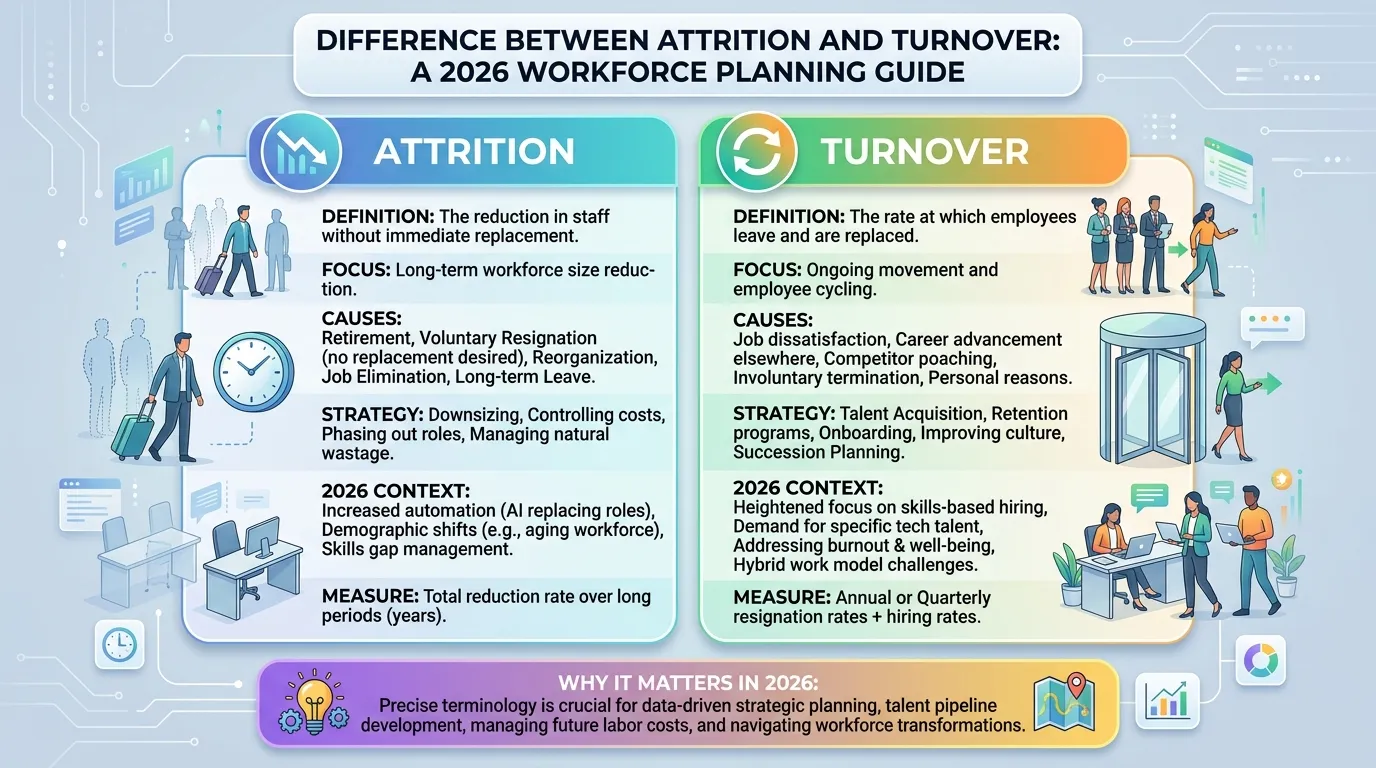
Attrition is when employees leave a company and their jobs are not filled again.
This often happens through:
- Retirement
- Resignation
- Death
- Long-term leave
The company becomes smaller over time because fewer people work there.
What is “Turnover”?
Turnover is the rate at which employees leave a company and are replaced by new workers.
When one worker leaves and another worker takes the job, that is turnover.
Turnover measures employee movement in and out of a company.
History of Attrition
The word “attrition” comes from a Latin word that means “wearing away.” Long ago, it described things becoming smaller through gradual loss. Later, businesses started using the word for workforce reduction. When employees left and companies chose not to replace them, the workforce slowly became smaller. Today, attrition is a common term in human resources and business management. It often appears in reports about company size, labor costs, and workforce planning. The idea is simple: people leave, but the company does not hire new workers for those positions.
History of Turnover
The word “turnover” has been used in English for many years. It originally meant a change from one thing to another. In business, it later became a term for employee replacement. Companies noticed that workers often left jobs and new workers took their place. Human resource departments began tracking this movement. Over time, turnover became an important business measure. Today, companies use turnover rates to study employee satisfaction, workplace culture, hiring success, and staff retention. High turnover can sometimes signal problems inside a company.
Attrition vs Turnover
Attrition means employees leave and are not replaced.
Turnover means employees leave and new employees replace them.
This small difference changes how a company grows or shrinks. Let’s look deeper.
How Attrition Works
Key Features
- Employees leave the company.
- Positions stay empty.
- The workforce becomes smaller.
- Hiring is reduced or stopped.
- Costs may decrease.
Examples
🔵 The company lost five workers through attrition last year.
🔵 Two employees retired, and the company did not replace them.
Uses
- Human resources
- Business planning
- Cost reduction plans
- Company restructuring
- Workforce management
How Turnover Works
Key Features
- Employees leave jobs.
- New employees replace them.
- Workforce size often stays the same.
- Hiring happens regularly.
- Employee movement is tracked.
Examples
🟢 The store had high turnover because many workers quit.
🟢 One employee left, and a new employee started the next week.
Uses
- Human resources
- Employee management
- Hiring plans
- Staff retention studies
- Business reports
Which One Should You Use?
Use attrition when jobs disappear after workers leave.
Use turnover when workers leave and new workers replace them.
10 Differences Between Attrition and Turnover
1. Replacement of Employees
Attrition: Workers leave and are not replaced.
🔴 Three workers retired, and no one replaced them.
🔴 The team became smaller through attrition.
Turnover: Workers leave and are replaced.
🔴 One worker left and another joined.
🔴 The company hired new staff after resignations.
2. Workforce Size
Attrition: Workforce gets smaller.
🔴 The office had 100 workers and now has 90.
🔴 Attrition reduced the team size.
Turnover: Workforce often stays the same.
🔴 Ten workers left and ten joined.
🔴 Staff numbers remained stable.
3. Hiring Activity
Attrition: Little or no hiring.
🔴 Empty positions stayed vacant.
🔴 Hiring was paused.
Turnover: Active hiring.
🔴 The company posted new job ads.
🔴 New workers joined every month.
4. Business Goal
Attrition: Often reduces costs.
🔴 The company saved money.
🔴 Fewer workers meant lower expenses.
Turnover: Keeps operations running.
🔴 New workers filled open jobs.
🔴 Business activities continued normally.
5. Employee Movement
Attrition: One-way movement out.
🔴 Workers left.
🔴 No replacements arrived.
Turnover: Movement in and out.
🔴 Employees left.
🔴 New employees joined.
6. Growth Impact
Attrition: Can slow growth.
🔴 Smaller teams handled more work.
🔴 Fewer workers were available.
Turnover: Growth can continue.
🔴 New staff supported expansion.
🔴 Open positions were filled.
7. Human Resources Focus
Attrition: Focus on workforce reduction.
🔴 HR monitored shrinking teams.
🔴 Fewer employees remained.
Turnover: Focus on retention.
🔴 HR studied why people quit.
🔴 HR improved hiring plans.
8. Cost Impact
Attrition: Often lowers labor costs.
🔴 Payroll expenses dropped.
🔴 The company spent less on salaries.
Turnover: Hiring costs continue.
🔴 New employee training cost money.
🔴 Recruitment expenses increased.
9. Common Causes
Attrition: Retirement and restructuring.
🔴 Older workers retired.
🔴 Departments merged.
Turnover: Job changes and resignations.
🔴 Workers found new jobs.
🔴 Employees changed careers.
10. Business Reports
Attrition: Shows workforce reduction.
🔴 Annual reports mentioned attrition.
🔴 Employee numbers decreased.
Turnover: Shows employee replacement rates.
🔴 HR tracked turnover rates.
🔴 Reports measured staff changes.
Why People Get Confused About Their Use
People often confuse these words because both involve employees leaving a company. They seem similar at first. The main difference is what happens after workers leave. If no one replaces them, it is attrition. If new workers replace them, it is turnover.
Table: Difference and Similarity
| Feature | Attrition | Turnover | Similarity |
|---|---|---|---|
| Meaning | Employees leave and are not replaced | Employees leave and are replaced | Both involve employees leaving |
| Hiring | Little or none | Regular hiring | Both affect staffing |
| Workforce Size | Gets smaller | Usually stays the same | Both change workforce data |
| Cost | Often reduces costs | May increase hiring costs | Both affect budgets |
| HR Use | Workforce reduction | Employee movement | Both are HR terms |
| Business Reports | Tracks shrinkage | Tracks replacement | Both appear in reports |
Which is Better in What Situation?
Attrition may be useful when a company wants to reduce costs without layoffs. It can help businesses become smaller over time. Many companies use attrition during budget cuts.
Turnover is better when a company needs the same number of workers. New employees replace those who leave. This helps businesses continue daily work without major staff shortages.
How Are “Attrition” and “Turnover” Used in Metaphors and Similes?
🟣 Attrition is like water slowly dripping from a bucket.
🟣 Attrition is like leaves falling from a tree over time.
🟣 Turnover is like players changing on a sports team.
🟣 Turnover is like one train leaving while another arrives.
Connotative Meaning
Attrition
🟣 Usually neutral in business reports.
🟣 Sometimes negative when many workers leave.
Turnover
🟣 Neutral in HR discussions.
🟣 Negative when turnover is very high.
Examples:
🟣 “The company faced high attrition.”
🟣 “The company reduced turnover this year.”
Idioms or Proverbs
There are no common English idioms that use these exact words.
Related ideas include:
🟣 “People come and go.”
Meaning: Workers often leave and arrive.
🟣 “Out with the old, in with the new.”
Meaning: Old workers leave and new workers join.
Works in Literature
These terms rarely appear as major themes in literature, but workplace change appears in many books.
🟣 The Jungle — Upton Sinclair — 1906
🟣 Death of a Salesman — Arthur Miller — 1949
🟣 Nickel and Dimed — Barbara Ehrenreich — 2001
Movies Related to the Keywords
🟣 Office Space — 1999 — USA
🟣 The Intern — 2015 — USA
🟣 Up in the Air — 2009 — USA
🟣 The Company Men — 2010 — USA
Possible Questions
1. Is attrition the same as turnover?
No. Attrition means workers leave and are not replaced. Turnover means workers leave and new workers replace them.
2. Which is higher in growing companies?
Turnover is often higher because growing companies hire new workers regularly.
3. Does attrition reduce company size?
Yes. Attrition usually makes the workforce smaller.
4. Is turnover always bad?
No. Some turnover is normal in every company.
5. Which term is used more in HR reports?
Both are common, but turnover appears more often in employee management reports.
Final Words
Learning business terms can seem hard at first. However, small differences can make a big impact. Once you understand these two words, workplace reports become much easier to read. Keep practicing with real examples, and these terms will soon feel natural.
Conclusion
The difference between attrition and turnover is simple when you focus on employee replacement. Attrition happens when employees leave and their jobs remain empty. Turnover happens when employees leave and new employees replace them. Both terms are important in business and human resources. They help companies understand workforce changes and plan for the future. If you are reading HR reports, studying business, or working in an office, knowing this difference will help you communicate more clearly. Remember this easy rule: attrition reduces the workforce, while turnover replaces the workforce. Once you know that, you can use both terms with confidence.

I’m Zahid Abbas, an educator, researcher, and digital publishing strategist with a passion for linguistics, grammar, and clear communication. As a content creator and SEO specialist, I craft research-driven, reader-focused content that empowers learners and makes knowledge accessible worldwide.