Last summer, Ali went on a trip with his family. During the trip, he saw a deep valley between large rocks. His guide called it a canyon. Later, he saw another deep valley with steep sides. This time, the guide called it a gorge.
Ali became confused.
Many people do not know the difference between gorge and canyon. The difference between gorge and canyon can be hard to understand because both are deep landforms with steep sides.
Learning the difference is useful. It can help you in school, travel, reading, and daily conversation. It can also improve your English vocabulary.
In this guide, you will learn the difference between gorge and canyon in a simple way with easy examples.
What is “Gorge”?
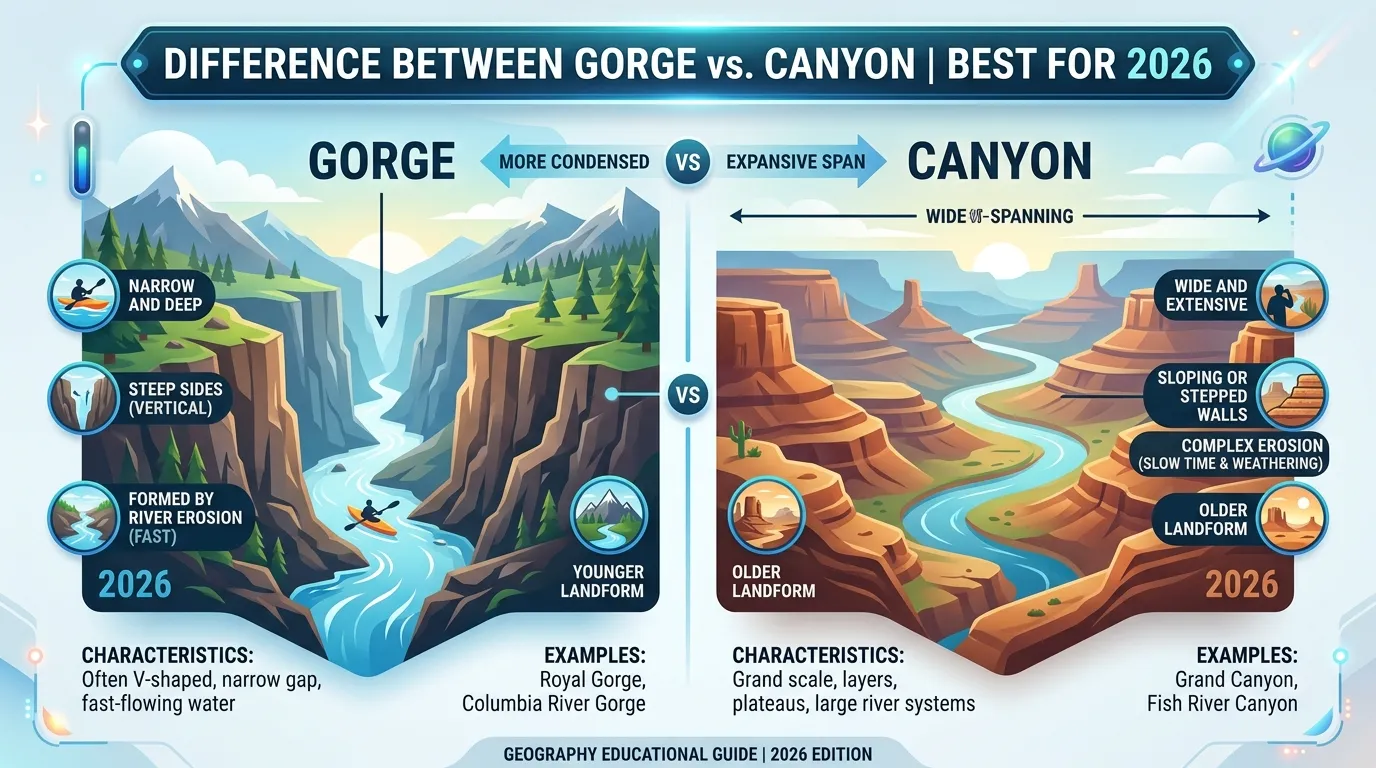
A gorge is a deep and narrow valley with very steep sides. A river often flows through it.
What is “Canyon”?
A canyon is a deep valley with steep sides. It is usually wider than a gorge.
History of Gorge
The word “gorge” comes from an old French word that meant throat. People used this word because a gorge looks narrow, like a throat between two hills or mountains. Over time, the word became common in geography. Today, people use “gorge” to describe a narrow valley with steep walls. Rivers often cut through rock over many years and create gorges. Many famous gorges around the world attract visitors because of their beauty and dramatic views.
History of Canyon
The word “canyon” comes from a Spanish word that means tube or pipe. Spanish explorers used the word to describe deep valleys they saw in North America. Over time, the word became part of English. Today, a canyon usually refers to a large valley with steep rock walls. Wind, water, and time slowly shape canyons. Some canyons are very wide and very deep. They are popular places for tourism, hiking, and photography.
Gorge vs Canyon
A gorge is usually narrow and steep.
A canyon is usually wider and larger.
Now let’s look at the main differences.
How Gorge Works
Key Features
- Deep valley
- Very narrow
- Steep sides
- Often has a river
- Usually found in mountains
Examples
🔵 The river flows through a deep gorge.
🔵 We walked near the steep gorge.
Uses
- Geography lessons
- Travel guides
- Nature studies
- Tourism
How Canyon Works
Key Features
- Deep valley
- Usually wider
- Steep rock walls
- Formed over many years
- Often very large
Examples
🟢 We visited a famous canyon.
🟢 The canyon stretched for many miles.
Uses
- Geography
- Tourism
- Hiking
- Photography
Which One Should You Use?
Use gorge when talking about a narrow valley.
Use canyon when talking about a wider valley with steep sides.
10 Differences Between Gorge and Canyon
1. Width
Gorge: Usually narrow.
🔴 The gorge was very narrow.
🔴 We could see both sides easily.
Canyon: Usually wider.
🔴 The canyon was very wide.
🔴 It stretched far across the land.
2. Size
Gorge: Often smaller.
🔴 The gorge was short.
🔴 It covered a small area.
Canyon: Often larger.
🔴 The canyon covered many miles.
🔴 Tourists explored it for days.
3. Appearance
Gorge: Looks tight and steep.
🔴 The walls stood close together.
🔴 The path looked narrow.
Canyon: Looks open and broad.
🔴 The valley looked wide.
🔴 The walls were far apart.
4. River Presence
Gorge: Often contains a river.
🔴 The river rushed through the gorge.
🔴 Water shaped the rocks.
Canyon: May or may not contain a river.
🔴 A river crossed the canyon.
🔴 Some canyons are dry.
5. Formation
Gorge: Usually formed by fast-moving water.
🔴 The river cut the rock.
🔴 Water made the gorge deeper.
Canyon: Formed by water and erosion.
🔴 Wind shaped the canyon.
🔴 Rain helped form the valley.
6. Location
Gorge: Common in mountain areas.
🔴 The gorge lay between hills.
🔴 It sat in a mountain region.
Canyon: Found in many landscapes.
🔴 The canyon crossed the desert.
🔴 It stretched through dry land.
7. Depth
Gorge: Deep but narrow.
🔴 The gorge dropped sharply.
🔴 Its walls were steep.
Canyon: Deep and wide.
🔴 The canyon looked endless.
🔴 It reached great depths.
8. Tourism
Gorge: Often used for short visits.
🔴 Visitors stopped for photos.
🔴 Hikers explored the gorge.
Canyon: Major tourist attraction.
🔴 Many tourists visited yearly.
🔴 Guided tours were available.
9. Famous Examples
Gorge: Smaller famous sites.
🔴 The Columbia River Gorge attracts visitors.
🔴 Many gorges are local landmarks.
Canyon: Large famous sites.
🔴 The Grand Canyon is world-famous.
🔴 Tourists travel far to see it.
10. Visual Impact
Gorge: Feels enclosed.
🔴 The walls felt close.
🔴 The path felt tight.
Canyon: Feels open.
🔴 The view seemed endless.
🔴 The landscape looked vast.
Why People Get Confused About Their Use
People get confused because both are deep valleys with steep sides. They also form in similar ways. Many books and websites use the terms together. The biggest difference is usually the width.
Table: Difference and Similarity
| Feature | Gorge | Canyon | Similarity |
|---|---|---|---|
| Shape | Narrow | Wide | Deep valley |
| Size | Smaller | Larger | Natural landform |
| River | Usually present | Sometimes present | Formed by erosion |
| Walls | Very steep | Steep | Rock walls |
| Tourism | Local attraction | Major attraction | Popular with visitors |
Which is Better in What Situation?
A gorge is better when you want to describe a narrow valley. It is useful in geography lessons and travel writing about rivers and mountain areas.
A canyon is better when you want to describe a large valley with wide rock walls. It is common in travel guides, books, and discussions about famous natural places.
How Are “Gorge” and “Canyon” Used in Metaphors and Similes?
🟣 His sadness felt as deep as a canyon.
🟣 The gap between them was like a gorge.
🟣 The canyon of time separated the two events.
🟣 Their opinions created a deep gorge.
Connotative Meaning
Positive
🟣 A beautiful canyon view.
🟣 A stunning gorge landscape.
Neutral
🟣 The map showed a canyon.
🟣 The river passed through a gorge.
Idioms or Proverbs
There are no common English idioms that use gorge or canyon directly.
However:
🟣 “A wide gap” means a large difference.
Example: There is a wide gap between their ideas.
Works in Literature
🟣 The Grand Canyon by Stephen J. Pyne (1998)
🟣 The Canyon by Zane Grey (1928)
🟣 River of Darkness by Buddy Levy (2011)
Movies Related to the Keywords
🟣 127 Hours (2010, USA)
🟣 The Canyon (2009, USA)
🟣 Grand Canyon (1991, USA)
Possible Questions
1. What is the main difference between a gorge and a canyon?
A gorge is usually narrower. A canyon is usually wider.
2. Is a gorge deeper than a canyon?
Not always. Both can be very deep.
3. Does a gorge always have a river?
Many gorges have rivers, but not all.
4. What is the most famous canyon?
The Grand Canyon is one of the most famous.
5. Can a canyon become a gorge?
The terms describe shape, so they are usually used differently.
Final Words
Nature has many amazing landforms. Learning their names helps us understand the world better. Keep exploring new words and new places.
Conclusion
The difference between gorge and canyon is mainly about width. A gorge is usually narrow with steep sides, while a canyon is usually wider and larger. Both are beautiful natural landforms formed over many years. Knowing the difference between gorge and canyon can help you use the right word in school, travel, and everyday English. The next time you see a deep valley, you will know whether it is a gorge or a canyon.

I’m Zahid Abbas, an educator, researcher, and digital publishing strategist with a passion for linguistics, grammar, and clear communication. As a content creator and SEO specialist, I craft research-driven, reader-focused content that empowers learners and makes knowledge accessible worldwide.