A boy falls while playing outside. He gets a small cut on his arm. His mother opens the medicine box. She sees Neosporin and Polysporin. She asks, “Which one should I use?” Many people ask this question. The difference between neosporin and polysporin can look hard at first.
The difference between neosporin and polysporin is mostly about ingredients and skin reaction. Both help stop infection in small cuts and burns. Still, one may work better for sensitive skin. Learning the difference between neosporin and polysporin helps students, parents, and English learners understand medicine labels and make better choices at home.
What is “Neosporin”?
Neosporin is a skin ointment. It helps stop germs in small cuts, burns, and scrapes.
History of Neosporin
Neosporin became popular many years ago in the United States. Families used it for small injuries at home. Doctors also used it in clinics and hospitals. The ointment became famous because it helped stop infection. Many people trusted it for daily first aid. Today, Neosporin is still common in homes, schools, and pharmacies around the world.
What is “Polysporin”?
Polysporin is also a skin ointment. It helps protect cuts and burns from germs.
History of Polysporin
Polysporin became popular as another antibiotic ointment for skin care. Many people liked it because it was gentle on sensitive skin. Doctors and pharmacists often suggested it for people who had skin reactions to other ointments. Over time, Polysporin became common in homes and medical stores. Today, many families use it for small cuts and burns.
Neosporin vs Polysporin
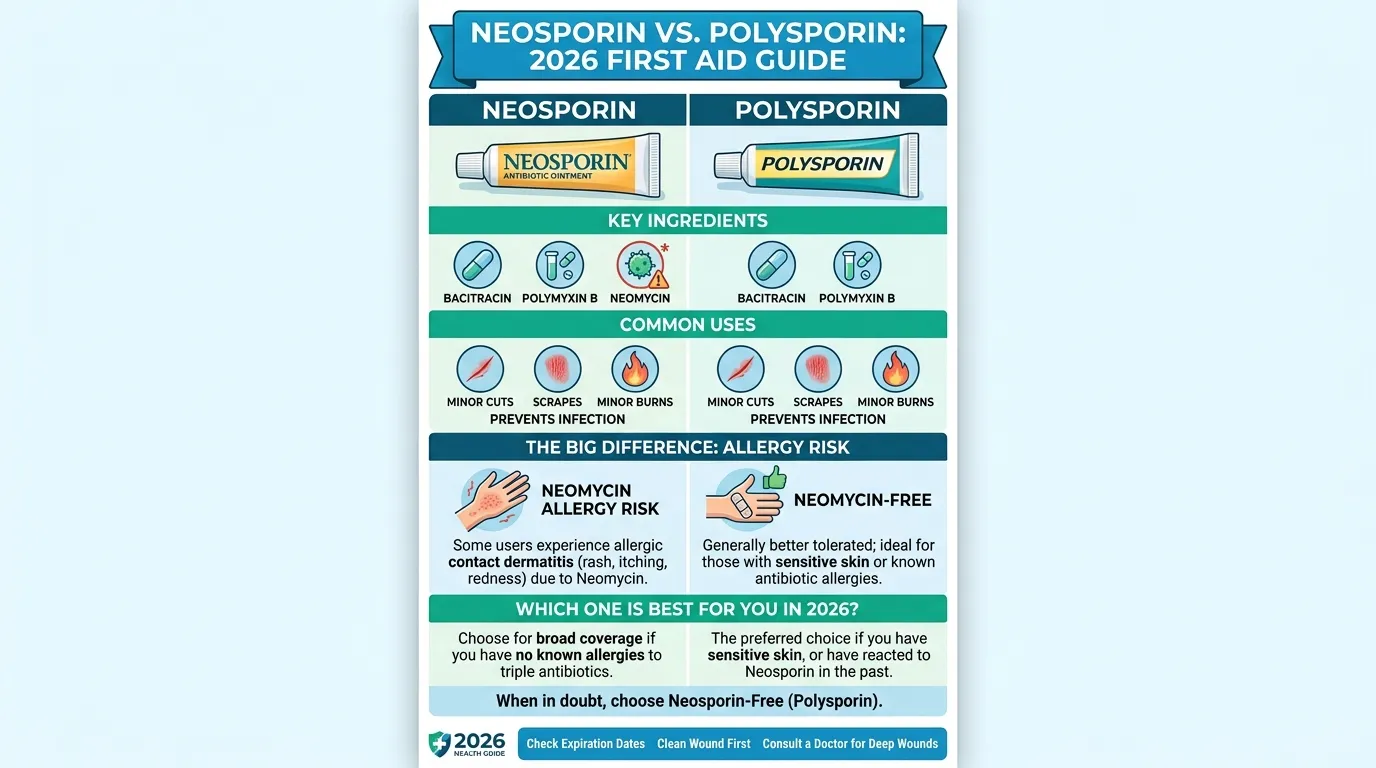
Neosporin has three antibiotics. Polysporin has two antibiotics and may feel gentler on skin.
Now let us learn more about both products.
How Neosporin Works
Neosporin helps stop germs on the skin.
Key Features
- Has three antibiotics
- Used on small cuts
- Easy to use
- Found in first-aid kits
- Helps stop infection
Example Sentences
🔵 I used Neosporin on my cut.
🔵 The nurse gave me Neosporin for my scrape.
Uses
- Small cuts
- Minor burns
- Scrapes
- Home first aid
- Skin care
How Polysporin Works
Polysporin also fights germs on the skin.
Key Features
- Has two antibiotics
- Good for sensitive skin
- Helps stop infection
- Smooth ointment
- Easy to apply
Example Sentences
🟢 She used Polysporin on her burn.
🟢 My doctor suggested Polysporin for my skin.
Uses
- Small cuts
- Minor burns
- Skin care
- Daily first aid
- Sensitive skin
Which One Should You Use?
Use Neosporin if you want stronger germ protection. Use Polysporin if your skin gets irritated easily.
10 Differences Between Neosporin and Polysporin
1. Number of Antibiotics
Neosporin: It has three antibiotics.
🔴 Neosporin has more active ingredients.
🔴 It gives broad protection.
Polysporin: It has two antibiotics.
🔴 Polysporin uses fewer ingredients.
🔴 It has a simpler formula.
2. Sensitive Skin
Neosporin: It may irritate some skin types.
🔴 My skin became itchy after use.
🔴 Some people get redness.
Polysporin: It is often gentler.
🔴 Polysporin felt soft on my skin.
🔴 I had no rash after using it.
3. Ingredient
Neosporin: It contains neomycin.
🔴 The label listed neomycin.
🔴 Some people react to this ingredient.
Polysporin: It does not contain neomycin.
🔴 Polysporin skipped this ingredient.
🔴 The doctor explained the difference.
4. Allergy Risk
Neosporin: It may cause more allergies.
🔴 My arm became red.
🔴 The cut felt itchy.
Polysporin: It may cause fewer allergies.
🔴 My skin stayed calm.
🔴 The ointment felt gentle.
5. Formula
Neosporin: It is a triple-antibiotic ointment.
🔴 The cream fights many germs.
🔴 It protects small wounds.
Polysporin: It is a double-antibiotic ointment.
🔴 It uses two antibiotics together.
🔴 The formula is lighter.
6. Skin Feel
Neosporin: It may feel thick.
🔴 The ointment stayed heavy on my skin.
🔴 The cut stayed covered.
Polysporin: It may feel lighter.
🔴 The cream spread easily.
🔴 My skin felt comfortable.
7. Common Users
Neosporin: Many families use it daily.
🔴 My mother keeps Neosporin at home.
🔴 Schools often use it.
Polysporin: People with sensitive skin prefer it.
🔴 My friend uses Polysporin only.
🔴 Doctors suggest it for some patients.
8. Protection
Neosporin: It gives strong protection.
🔴 The wound healed well.
🔴 It helped stop infection.
Polysporin: It gives gentle protection.
🔴 My cut healed without irritation.
🔴 It worked well on my skin.
9. Popular Choice
Neosporin: It is very common in first-aid kits.
🔴 I found it in the medicine box.
🔴 Most stores sell it.
Polysporin: It is common for skin-sensitive users.
🔴 The pharmacist recommended it.
🔴 Many parents buy it for children.
10. Main Concern
Neosporin: People worry about allergies.
🔴 I checked the warning label.
🔴 My doctor asked about skin reactions.
Polysporin: People like its gentle use.
🔴 It felt mild on the cut.
🔴 The cream caused no itching.
Why People Get Confused About Their Use
People get confused because both ointments treat cuts and burns. They also look alike in stores. Both stop germs and help protect the skin. The biggest difference is the ingredients and skin reaction.
Table: Difference and Similarity
| Feature | Neosporin | Polysporin | Similarity |
| Antibiotics | Three | Two | Both fight germs |
| Neomycin | Yes | No | Both help cuts |
| Skin Reaction | More irritation | Gentler | Both are ointments |
| Main Use | Small wounds | Small wounds | Both stop infection |
| Users | General users | Sensitive skin users | Both sold in pharmacies |
Which is Better in What Situation?
Neosporin is better for people who want strong germ protection for cuts and scrapes. Many families keep it at home for daily first aid.
Polysporin is better for people with sensitive skin. It may feel softer and cause fewer skin problems. Many doctors suggest it for gentle skin care.
How Are “Neosporin” and “Polysporin” Used in Metaphors and Similes?
🟣 “Like Neosporin on a wound” means quick help.
🟣 “Gentle as Polysporin” means soft and calm.
🟣 “Her words worked like Neosporin” means her words helped emotionally.
🟣 “The cream spread like Polysporin” means it worked smoothly.
Connotative Meaning
Neosporin
🟣 Positive: “Neosporin gives strong protection.”
🟣 Neutral: “I bought Neosporin today.”
🟣 Negative: “Some people get skin irritation.”
Polysporin
🟣 Positive: “Polysporin feels gentle.”
🟣 Neutral: “The store sells Polysporin.”
🟣 Negative: “Some people think it feels too mild.”
Idioms or Proverbs
🟣 “Better safe than sorry.”
Meaning: It is smart to be careful.
Example: I used ointment because better safe than sorry.
🟣 “Time heals all wounds.”
Meaning: Pain improves with time.
Example: My cut healed because time heals all wounds.
Works in Literature
🟣 Being Mortal — Atul Gawande, 2014
🟣 The Body — Stephen King, 1982
Movies Related to the Keywords
🟣 Patch Adams — 1998, United States
🟣 The Doctor — 1991, United States
Frequently Asked Questions
1. What is the main difference between Neosporin and Polysporin?
Neosporin has three antibiotics. Polysporin has two.
2. Which one is better for sensitive skin?
Polysporin is often better for sensitive skin.
3. Can both treat cuts and burns?
Yes. Both help small cuts and burns.
4. Does Neosporin contain neomycin?
Yes. Neosporin contains neomycin.
5. Are both antibiotic ointments?
Yes. Both are antibiotic skin ointments.
Final Words
Neosporin and Polysporin both help protect small cuts and burns. Learning their differences can help you choose the right ointment for your skin and daily care.
Conclusion
The difference between neosporin and polysporin is simple. Neosporin has three antibiotics and gives strong germ protection. Polysporin has two antibiotics and may feel gentler on sensitive skin. Both help stop infection in small cuts, burns, and scrapes. Learning the difference between neosporin and polysporin helps students, parents, and English learners make smart and safe choices.

I’m Zahid Abbas, an educator, researcher, and digital publishing strategist with a passion for linguistics, grammar, and clear communication. As a content creator and SEO specialist, I craft research-driven, reader-focused content that empowers learners and makes knowledge accessible worldwide.