Imagine walking through a quiet park and seeing a large black bird sitting on a tree. You may call it a crow, but it could be a raven. This is why the difference between raven and crow can be confusing, even for people who enjoy watching birds.
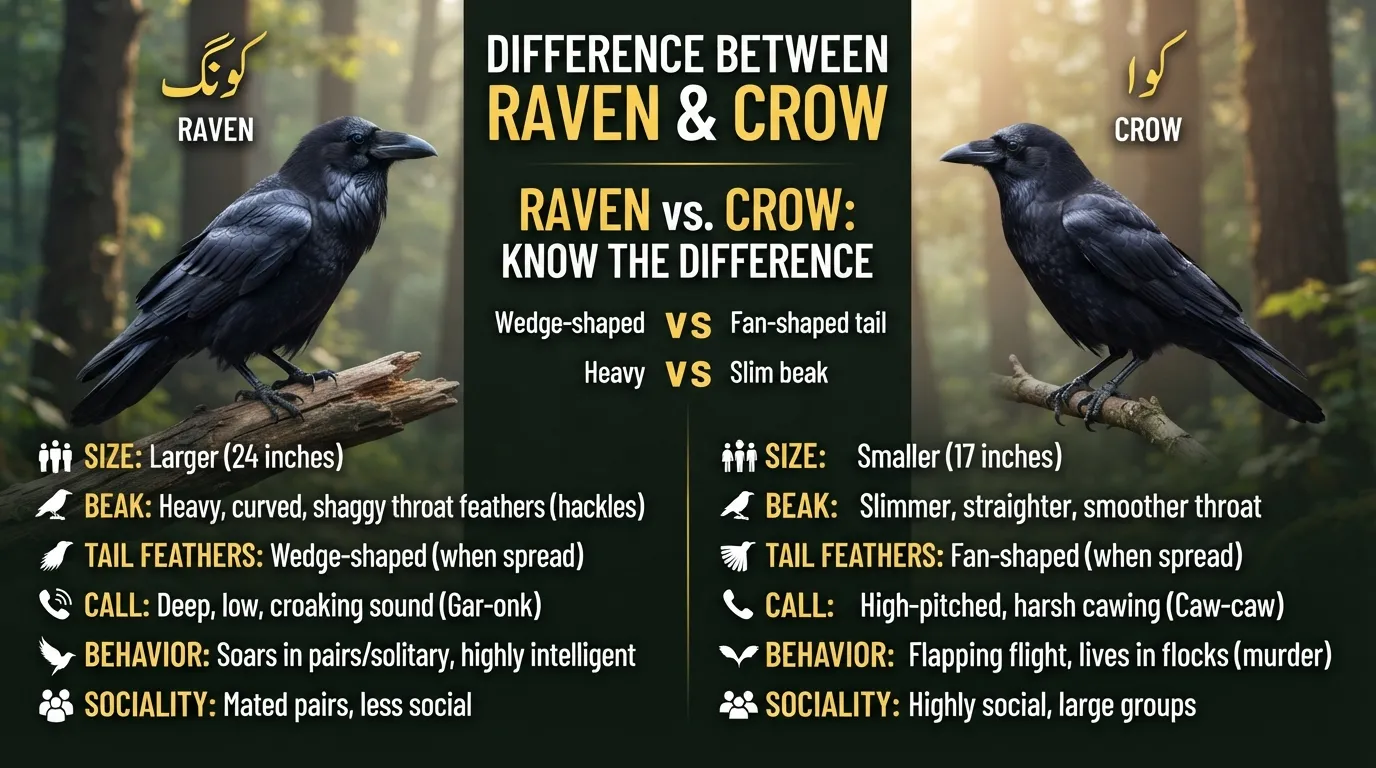
However, the difference between raven and crow becomes easier to see when you look at their size, tail shape, voice, habitat, and behavior.
Understanding the difference between raven and crow is useful for students, bird watchers, writers, and nature lovers. Once you learn the difference between raven and crow, you can identify these fascinating birds with much greater confidence.
Key Difference Between Raven and Crow
The simplest difference is size and shape. A raven is generally larger, with a heavier bill, longer wings, and a wedge-shaped tail. A crow is usually smaller, with a lighter bill and a more rounded tail.
For example:
- Raven: Usually larger and heavier, with a deep, powerful voice.
- Crow: Usually smaller and more social, with the familiar “caw” sound.
Why Is Their Difference Necessary to Know for Learners and Experts?
Knowing the difference between these birds is more than a vocabulary exercise. For learners, it develops observation skills and helps them understand animal classification and ecosystems. For bird watchers and researchers, correct identification is important when recording species, studying populations, or describing wildlife.
They are often connected with intelligence, mystery, death, survival, or cleverness. Confusing the two can therefore change the meaning of a scientific description or a literary reference.
Pronunciation of Raven and Crow
WordUS pronunciationUK pronunciationRaven/ˈreɪ.vən//ˈreɪ.vən/Crow/kroʊ//krəʊ/
Raven sounds like “RAY-vuhn.” Crow sounds like “kroh.”
Now that we know what the two words mean, let us look beyond their names and compare the birds themselves.
Difference Between Raven and Crow
Here are ten important differences that make identification easier.
1. Size
The most obvious difference is size. Ravens are generally much larger than crows. A Common Raven can reach around 27 inches in length, while an American Crow is usually around 20 inches.
Raven examples:
- The raven looked almost as large as a hawk from a distance.
- A raven can appear especially big when it spreads its wings.
Crow examples:
- The crow looked noticeably smaller beside the raven.
- Several crows gathered on the fence.
2. Bill Shape
A raven has a larger, heavier bill. Its bill often looks longer and more powerful than its head. A crow has a more moderate bill.
Raven examples:
- The raven used its strong bill to tear apart food.
- Its large bill helped the bird break tough material.
Crow examples:
- The crow picked up a small piece of food with its bill.
- The crow’s bill looked slimmer than the raven’s.
3. Tail Shape
Tail shape is one of the best clues when the bird is flying. A raven’s tail usually forms a pointed or diamond-like shape. A crow’s tail is more rounded.
Raven examples:
- The flying raven showed a pointed tail.
- Its tail looked like a small diamond in the sky.
Crow examples:
- The crow had a more rounded tail.
- Its tail shape was easier to see during flight.
4. Neck Feathers
Ravens often have longer, shaggy feathers around the throat. Crows usually have a smoother-looking throat.
Raven examples:
- The raven’s throat feathers looked loose and shaggy.
- The bird puffed up its neck feathers while calling.
Crow examples:
- The crow’s neck looked relatively smooth.
- The crow kept its throat feathers close to its body.
5. Voice
Their calls are also different. Crows are famous for their familiar “caw” sound. Ravens often produce deeper, rougher sounds that may resemble a croak or a low “gronk.” Sound can be especially useful when visual identification is difficult.
Raven examples:
- A deep croaking sound came from the trees.
- The raven made a low, rough call.
Crow examples:
- The crow gave a loud “caw.”
- Several crows called to one another from the rooftops.
6. Flight Style
Ravens often combine wingbeats with soaring and gliding. Crows usually show more regular wingbeats during flight. The difference becomes easier to notice when both birds are flying in open space.
Raven examples:
- The raven soared above the valley.
- It glided for several seconds without many wingbeats.
Crow examples:
- The crow flew steadily across the field.
- Several crows flapped toward the trees.
7. Social Behavior
Crows are often highly social and can gather in large groups. Ravens are generally less social outside feeding situations and are often seen alone or in pairs.
Raven examples:
- A single raven searched the open land for food.
- Two ravens moved together across the hillside.
Crow examples:
- A group of crows gathered around a food source.
- Many crows rested together in the trees.
8. Habitat
Both birds can live around people, but their preferred habitats can differ by species. Ravens are commonly associated with forests, mountains, open country, deserts, coasts, and other broad landscapes. Crows are highly adaptable and are common in farms, towns, cities, parks, and other human-influenced areas.
Raven examples:
- The raven flew across a mountain valley.
- A raven rested on a cliff above the forest.
Crow examples:
- A crow searched for food near a city park.
- Crows often visit farms and suburban areas.
9. Intelligence and Problem-Solving
Both birds are highly intelligent. They can learn, remember locations, investigate objects, and adapt to changing situations.
Raven examples:
- The raven investigated a strange object before approaching it.
- It changed its behavior after learning that the object was harmless.
Crow examples:
- The crow learned where people left food.
- A crow may remember a person or place associated with danger.
10. Overall Appearance
A raven usually looks heavier and more powerful. A crow generally has a slimmer appearance.
Raven examples:
- The bird looked large, heavy, and broad-winged.
- Its thick bill and shaggy throat suggested a raven.
Crow examples:
- The smaller bird had a lighter-looking body.
- Its rounded tail and moderate bill suggested a crow.
Nature and Behavior of Ravens
Ravens are curious, confident, and intelligent birds. They often investigate their surroundings and can adapt to different environments. Common Ravens are usually seen alone or in pairs, although they may gather around rich food sources..
Ravens can be cautious around unfamiliar situations, but they are also excellent explorers. Their intelligence has made them important symbols in many cultures and literary works.
Nature and Behavior of Crows
Crows are adaptable, social, and highly observant birds. They can live successfully around people and make use of many different food sources.
They often communicate with one another through calls and body movements. Their social nature can make them easier to notice in groups.
Crows are also famous for learning from experience. They can recognize patterns and remember useful or dangerous situations. Their intelligence is one reason they have fascinated humans for centuries.
Why Are People Confused About Their Use?
People confuse raven and crow mainly because both birds belong to the same family and share many features. Both are black, intelligent, noisy, adaptable, and commonly associated with mysterious imagery.
There is also a language problem. In everyday conversation, people sometimes use crow as a general word for a black corvid. A large black bird may therefore be casually called a crow even when it is actually a raven.
The easiest solution is to consider several clues together: size, bill, tail, throat feathers, sound, flight, and behavior. Do not depend on color alone.
Raven vs. Crow: Difference and Similarity
Raven
A raven is the better word when you are describing a large, powerful black bird, especially when its size, heavy bill, pointed tail, deep call, or soaring flight is noticeable. For example, a nature writer describing a large bird flying over a mountain should choose raven if the evidence supports that identification. In literature, raven may also be the better word when the intended mood is dark, mysterious, symbolic, or supernatural. Edgar Allan Poe’s famous poem is a classic example of the powerful cultural meaning attached to the word.
Crow
Crow is the better word when you are talking about a smaller black corvid, especially one commonly seen around towns, farms, parks, and other human environments. It is also the natural word in expressions such as “as the crow flies” and “eat crow.” If you are writing for children, general readers, or people describing common urban birds, crow is often the more familiar term. Still, careful identification matters because not every black corvid is a crow.
Raven and Crow in Metaphors and Similes
Both words have strong figurative meanings.
Raven in Metaphors
The raven often represents mystery, darkness, loneliness, death, or foreboding.
- The raven of grief sat silently on his shoulder.
- Her thoughts were a raven flying through the darkness.
Raven in Similes
- He was as silent as a raven at midnight.
- The clouds moved like dark ravens across the sky.
Crow in Metaphors
The crow can represent cleverness, survival, observation, noise, or mischief.
- The old man was a crow among the city streets, always watching.
- Her mind was a clever crow searching for an answer.
Crow in Similes
- He was as noisy as a group of crows.
- The children scattered like crows when the bell rang.
Connotative Meaning of Raven and Crow
Raven: Usually Negative or Mysterious
The word raven often has a dark or mysterious connotation. This association comes partly from folklore and literature.
Example: The raven appeared in the story as a symbol of grief and mystery.
However, raven does not always have a negative meaning. It can also suggest intelligence, beauty, strength, or wisdom.
Crow: Neutral, Negative, or Positive
The word crow can have several connotations.
Positive: cleverness and adaptability The crow was praised for its clever solution.
Negative: noise, mischief, or unwanted behavior The noisy crows disturbed the quiet morning.
Neutral: simply the name of a bird A crow landed on the fence.
Idioms and Expressions Related to Raven and Crow
Common Crow Expressions
1. As the crow flies Meaning: the shortest distance between two places in a straight line.
The village is only five miles away as the crow flies.
He had to eat crow after his prediction proved completely wrong.
3. Crow about something Meaning: to boast about something.
He kept crowing about his victory.
Raven Expressions
There are fewer common English idioms built directly around raven. The word is much more common in poetry, mythology, symbolism, and descriptive phrases.
Raven-black means extremely black or glossy black.
She had raven-black hair.
Because “raven” has a strong literary and symbolic tradition, writers often use it for imagery rather than everyday idioms.
Ravens and Crows in Literature
- The Raven — Edgar Allan Poe — Poetry — 1845. Poe’s famous poem uses a raven as a mysterious visitor associated with grief and the repeated word “Nevermore.” It was published in The Raven and Other Poems in 1845.
- Crow: From the Life and Songs of the Crow — Ted Hughes — Poetry — 1970. Hughes created a striking mythic crow figure in this major poetry collection. The Ted Hughes Society identifies it as one of his most important and ambitious works.
- “The Raven” — Edgar Allan Poe — Gothic narrative poetry — 1845. The poem remains one of the best-known literary uses of the raven as a symbol of sorrow and psychological darkness.
Movies Featuring Ravens and Crows
- The Crow — 1994 — United States. Directed by Alex Proyas and starring Brandon Lee, this dark fantasy film uses the crow as an important supernatural symbol.
- The Raven — 2012 — United States, Spain, and Hungary. Directed by James McTeigue, the crime thriller fictionalizes the final period of Edgar Allan Poe’s life and connects its story to Poe’s writings.
- The Crow — 2024 — United States/United Kingdom release. This later adaptation is based on James O’Barr’s comic-book property and continues the franchise’s dark supernatural theme.
Frequently Asked Questions
1. What is the main difference between a raven and a crow?
A raven is generally larger, has a heavier bill, a more pointed or wedge-shaped tail, and a deeper call. A crow is usually smaller and has a more rounded tail.
2. Are ravens and crows the same bird?
No. They are different birds, although both belong to the Corvidae family.
3. Which is smarter, a raven or a crow?
Both are highly intelligent. Ravens are especially known for flexible problem-solving, while crows are also excellent learners and problem-solvers. It is better to say that both have remarkable intelligence rather than treating one as universally “smarter.”
4. How can I tell a raven from a crow when it is flying?
Look at the tail and wing shape. A raven usually has a more pointed, wedge-shaped tail and can soar or glide. A crow usually has a more rounded tail and more regular wingbeats.
5. Why do people call ravens crows?
Because they look very similar. Both are black members of the same bird family, and casual speakers may use crow as a general term for a black corvid.
How Are Ravens and Crows Useful for Their Surroundings?
Ravens and crows play useful roles in ecosystems. As omnivorous birds and opportunistic feeders, they consume a wide variety of foods. They can help remove animal remains and waste from the environment, which contributes to nutrient cycling.
They also interact with many other species. Their feeding behavior can influence the movement and availability of food for other animals.
Their intelligence is another ecological advantage. Both birds can adapt to changing environments, including areas influenced by humans. This adaptability helps them survive in landscapes that are changing over time.
Final Words for Raven and Crow
Ravens and crows may look similar at first, but they are not difficult to distinguish once you know what to observe. Ravens are generally larger, heavier, deeper-voiced, and more likely to show a pointed tail and shaggy throat. Crows are generally smaller, more social, and have a rounded tail and familiar caw.
Both are intelligent, adaptable, and ecologically valuable. They also have a rich place in human language and culture.
Conclusion
The difference between raven and crow becomes much clearer when you look beyond their shared black feathers. Ravens are generally larger and heavier, with bigger bills, pointed tails, shaggy throat feathers, and deeper calls. Crows are usually smaller, more social, and have rounded tails and the familiar “caw.” Both birds, however, are intelligent members of the Corvidae family and play useful roles in their surroundings. It also helps readers understand why these birds appear so often in literature, films, idioms, and symbolism.

I’m Zahid Abbas, an educator, researcher, and digital publishing strategist with a passion for linguistics, grammar, and clear communication. As a content creator and SEO specialist, I craft research-driven, reader-focused content that empowers learners and makes knowledge accessible worldwide.