Imagine moving into a new home and standing in a furniture store with your partner. You need a comfortable bed, but the salesperson asks, “Do you want a full or a queen?” Both sound familiar, yet they are not the same size.
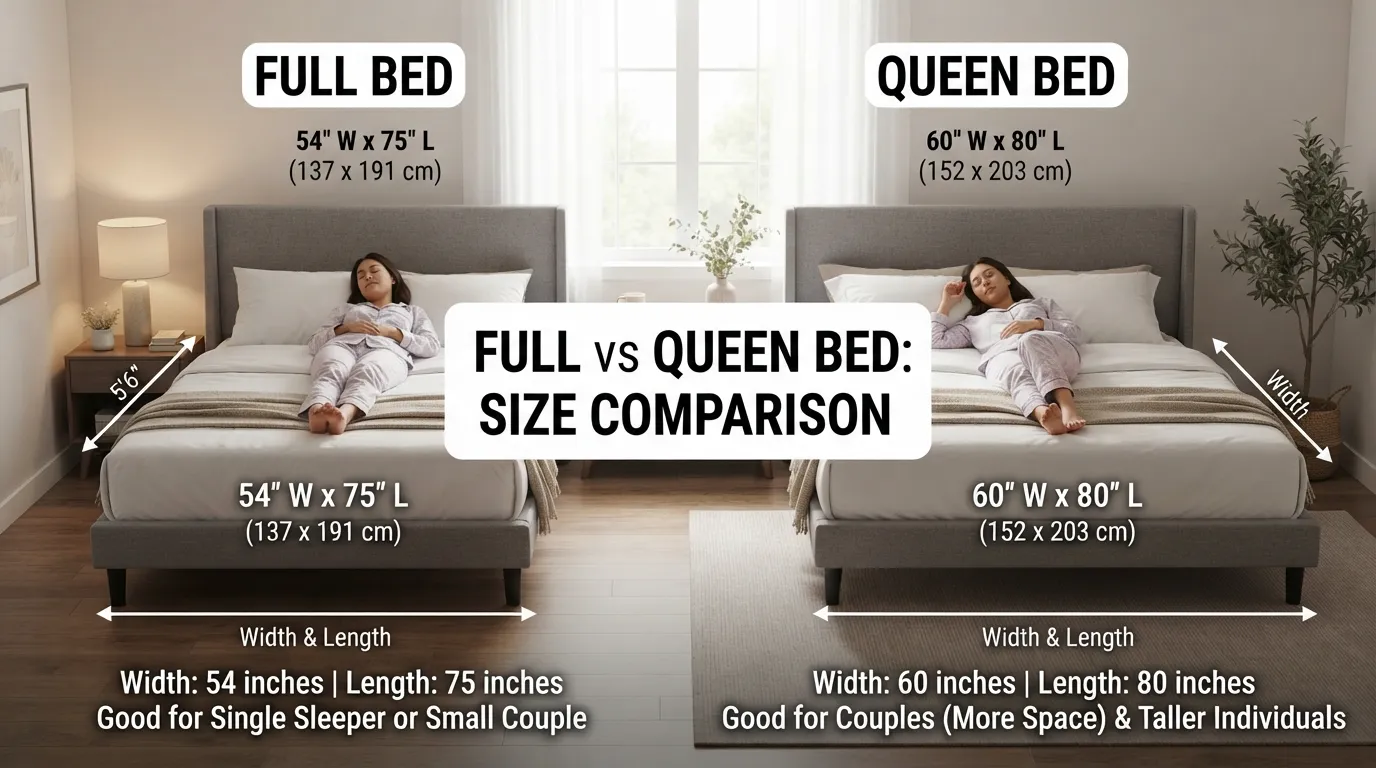
A full bed, also called a double bed, is smaller, while a queen bed gives you more sleeping space. In the United States, a standard full mattress is about 54 × 75 inches, while a queen mattress is about 60 × 80 inches.
Understanding the difference between full and queen can help you choose the right bed for your room, budget, and sleeping needs. The difference between full and queen also matters when buying sheets, frames, and other bedding. Knowing the difference between full and queen makes shopping much easier.
Key Difference Between Full and Queen
The main difference is size. A full mattress is 54 inches wide and 75 inches long. A queen mattress is 60 inches wide and 80 inches long. Therefore, a queen gives you 6 extra inches of width and 5 extra inches of length. It also provides about 750 more square inches of sleeping surface.
Why Is Their Difference Necessary to Know for Learners and Experts?
Knowing the difference between full and queen is useful because bed sizes affect comfort, room design, furniture selection, and spending. Learners can understand how words such as full-size and queen-size work in everyday English. Experts in interior design, hospitality, furniture sales, and home planning need accurate knowledge to recommend the right option.
This knowledge also has a practical social value. A comfortable sleeping space can support better rest, while choosing the wrong size can make a room crowded or make sleeping uncomfortable. A full can be useful where space is limited, whereas a queen often gives couples and taller sleepers more room.
Pronunciation of Full and Queen
WordUS PronunciationUK PronunciationSimple SoundFull/fʊl//fʊl/“fool” but with a shorter vowelQueen/kwiːn//kwiːn/“kween”
The pronunciation of both words is essentially the same in standard American and British English.
Now that the basic meaning is clear, let us look at the differences that actually matter when choosing between these two bed sizes.
you can also check:https://compareact.com/difference-between-invisalign-and-braces/
Difference Between Full and Queen
1. Overall Dimensions
A full mattress measures approximately 54 × 75 inches. A queen mattress measures approximately 60 × 80 inches.
Examples:
- A single adult may find a 54 × 75-inch full bed comfortable.
- A couple may prefer the extra space of a 60 × 80-inch queen bed.
2. Width
A queen is 6 inches wider than a full.
That extra width may not sound huge, but it becomes noticeable when two people share the bed. A full gives about 27 inches of width per person if two people divide it equally, while a queen gives about 30 inches per person.
Examples:
- A person sleeping alone may not need the extra width.
- Two partners can benefit from the additional side-to-side space.
3. Length
A full is 75 inches long, while a queen is 80 inches long.
This makes a queen more suitable for taller sleepers.
Examples:
- A shorter adult may sleep comfortably on a full.
- A person over six feet may find a queen more comfortable.
4. Sleeping Capacity
A full is generally better suited to one person. A queen is generally more suitable for two people.
Examples:
- A teenager can use a full bed alone.
- A married couple can choose a queen for more personal sleeping space.
5. Bedroom Space
A full occupies less floor space than a queen. This makes it useful for smaller bedrooms, guest rooms, and apartments.
Examples:
- A full may leave more walking space in a small bedroom.
- A queen may work better in a larger master bedroom.
6. Sleeping Comfort
A queen generally provides greater freedom to move, stretch, and change sleeping positions.
Examples:
- A restless sleeper may appreciate a queen.
- A person who stays mostly in one position may be satisfied with a full.
7. Cost
Full mattresses are generally less expensive than comparable queen mattresses. Bedding and frames can also cost less, although prices vary by brand and material.
Examples:
- A student furnishing a small room may choose a full to save money.
- A couple may spend more on a queen for additional comfort.
8. Furniture and Bedding
A full mattress requires full-size sheets and accessories. A queen requires queen-size sheets and accessories.
They are not interchangeable.
Examples:
- Full sheets may be too small for a queen mattress.
- Queen sheets can be loose or poorly fitted on a full mattress.
9. Moving and Installation
A full mattress is smaller and usually easier to carry through narrow spaces. A queen is larger and can be more difficult to move around corners or upstairs.
Examples:
- A full may be easier to move into a small apartment.
- A queen may require more care when moving through a narrow staircase.
10. Future Flexibility
A queen can be a more flexible long-term choice because it works well for single sleepers and couples.
Examples:
- A single person may buy a queen because they may share the bed later.
- Someone who plans to remain a solo sleeper may prefer the lower cost and smaller footprint of a full.
Nature and Behavior of Full
The word full suggests completeness, fullness, or having a substantial amount. When used as a bed-size term, however, it does not mean that the bed is completely filled or that it is the largest size.
As a bed, a full is compact and practical. It offers more space than a twin but less than a queen. It is particularly useful for single sleepers and smaller rooms.
Examples:
- “The guest room has a full bed.”
- “I chose a full because my bedroom is small.”
Nature and Behavior of Queen
The word queen traditionally refers to a female monarch. In the context of beds, however, it is simply a standard mattress-size name.
As a bed size, a queen is larger and more spacious than a full. It is commonly chosen by couples, taller sleepers, and people who like extra room.
Examples:
- “We bought a queen for our main bedroom.”
- “She prefers a queen because she likes to stretch out.”
Why Are People Confused About Their Use?
The confusion comes partly from the everyday meanings of the words.
Full sounds as if something is complete or large. A person may therefore assume that a “full” bed is very large. In reality, a full is smaller than a queen.
Queen sounds like a title rather than a measurement. People may also assume that the difference is only a name. However, the two sizes have different dimensions.
Another reason is that both can work for one adult, so their practical uses can overlap. The important point is that full and queen are separate mattress sizes.
Full vs. Queen: Difference and Similarity.
Which Is Better in What Situation?
When Is a Full Better?
A full is better when you sleep alone, have a small bedroom, or want to keep your furniture and mattress costs lower. It is also a practical choice for teenagers, guest rooms, apartments, and people who do not need much sleeping space. Because it is smaller, it leaves more floor area for desks, wardrobes, chairs, and walking space. A full can also be easier to move through tight hallways and stairs. If your room is limited in size and you are a single sleeper, choosing a full can be a sensible and economical decision.
When Is a Queen Better?
A queen is better when two people regularly share the bed or when a single sleeper wants extra room. Its additional width and length provide more space for movement and can be especially helpful for taller people. It is also a versatile choice if your sleeping arrangements may change in the future. Although it costs more and takes up more room, many people consider the extra comfort worthwhile. A queen is especially suitable for master bedrooms, couples, restless sleepers, and people who enjoy having plenty of room while sleeping.
Full and Queen in Metaphors and Similes
Full
- Metaphor: “Her heart was a full cup of kindness.”
- Simile: “The room was full like a crowded theater.”
- Metaphor: “His mind was a full library of ideas.”
Here, full suggests abundance, completeness, or having a lot of something.
Queen
- Metaphor: “She was the queen of the classroom.”
- Simile: “She walked into the room like a queen.”
- Metaphor: “The rose was the queen of the garden.”
Here, queen can suggest leadership, beauty, confidence, or importance.
Connotative Meaning of Full and Queen
Positive Meaning of Full
“Her schedule was full of exciting opportunities.”
Here, full suggests abundance.
Negative Meaning of Full
“The bus was so full that we could hardly move.”
Here, full suggests overcrowding.
Positive Meaning of Queen
“She is the queen of her profession.”
Here, queen suggests excellence and leadership.
Negative or Critical Use of Queen
“He behaves as if he were a queen.”
Depending on context, this may suggest someone expects special treatment. The meaning depends strongly on tone.
Idioms and Proverbs Related to Full and Queen
Expressions with Full
- “Full of beans” — full of energy. Example: “The children were full of beans after breakfast.”
- “Full of life” — energetic and lively. Example: “The little girl is full of life.”
- “Full steam ahead” — move forward with great energy. Example: “The team is moving full steam ahead with the project.”
- “Full circle” — returning to an earlier situation or point. Example: “After ten years, his career came full circle.”
Expressions with Queen
- “Queen bee” — the dominant or most influential woman in a group. Example: “She became the queen bee of the social club.”
- “Queen of hearts” — a woman who is admired or loved. Example: “Everyone treated her as the queen of hearts.”
Works in Literature Containing “Full” or “Queen”
- The Full Moon at the Nanking Hotel — poetry, Francisco X. Alarcón, 2000.
- The Queen of Spades — short story, Alexander Pushkin, 1834.
- The Queen of Hearts — novel, Wilkie Collins, 1859.
- The Queen of Air and Darkness — novel, T. H. White, 1939.
- The Queen of the Damned — novel, Anne Rice, 1988.
Movies With “Full” or “Queen” in the Title
- Full Metal Jacket — war drama film, 1987, United States/United Kingdom.
- The Full Monty — comedy-drama film, 1997, United Kingdom.
- Queen — comedy-drama film, 2013, India.
- The Queen — historical drama film, 2006, United Kingdom/France/Italy.
- Queen of Katwe — biographical sports drama, 2016, United States.
Again, these titles use full and queen in their ordinary or symbolic senses rather than referring to bed dimensions.
Frequently Asked Questions
1. Is a full bed bigger than a queen?
No. A full bed is smaller. A standard full is about 54 × 75 inches, while a queen is about 60 × 80 inches.
2. Can two people sleep on a full bed?
Yes, two people can sleep on a full bed, but it provides less personal space than a queen. A queen is generally more comfortable for couples.
3. Is a full bed the same as a double bed?
In U.S. mattress terminology, yes. Full and double commonly refer to the same standard mattress size.
4. Is a queen better for tall people?
Usually, yes. A queen is 80 inches long compared with 75 inches for a full, giving taller sleepers more length.
How Full and Queen Are Useful for Their Surroundings
The choice between a full and a queen affects more than the mattress itself. It influences how much floor space remains for furniture and movement. A full can help preserve space in a compact bedroom, while a queen can provide greater comfort in a larger room.
The choice also affects bedding, bed frames, transportation, and room organization. Choosing the correct size prevents wasted money on unsuitable sheets or furniture.
Final Words for Full and Queen
Full and queen are both useful bed sizes, but they serve different needs. A full is smaller, more space-efficient, and generally more affordable. A queen is wider, longer, and more comfortable for couples or people who prefer additional sleeping space.
The best choice is not simply the larger one. It depends on the sleeper, bedroom size, budget, and future needs.
Conclusion
Understanding the difference between full and queen is important when buying a mattress, planning a bedroom, or choosing bedding. A full mattress is normally 54 × 75 inches, while a queen is 60 × 80 inches, making the queen both wider and longer. A full is often a smart choice for a single sleeper, smaller bedroom, guest room, or limited budget. A queen is generally better for couples, taller sleepers, and people who want more room to move. Neither size is universally better. The right choice depends on your personal circumstances.