A young girl looked in the mirror and noticed a small dark spot on her arm. Her brother had a red patch on his neck since birth. They both asked their mother, “Are these the same?” Many people ask this question because the difference between mole and birthmark can seem confusing at first.
The difference between mole and birthmark is important in daily life and health discussions. A mole is usually a small dark skin spot that may appear later in life. A birthmark is a colored mark present at birth or soon after. Learning the difference between mole and birthmark helps students, parents, and English learners use these words correctly. It also helps people understand simple skin terms in medical talks and daily conversations.
What is “Mole”?
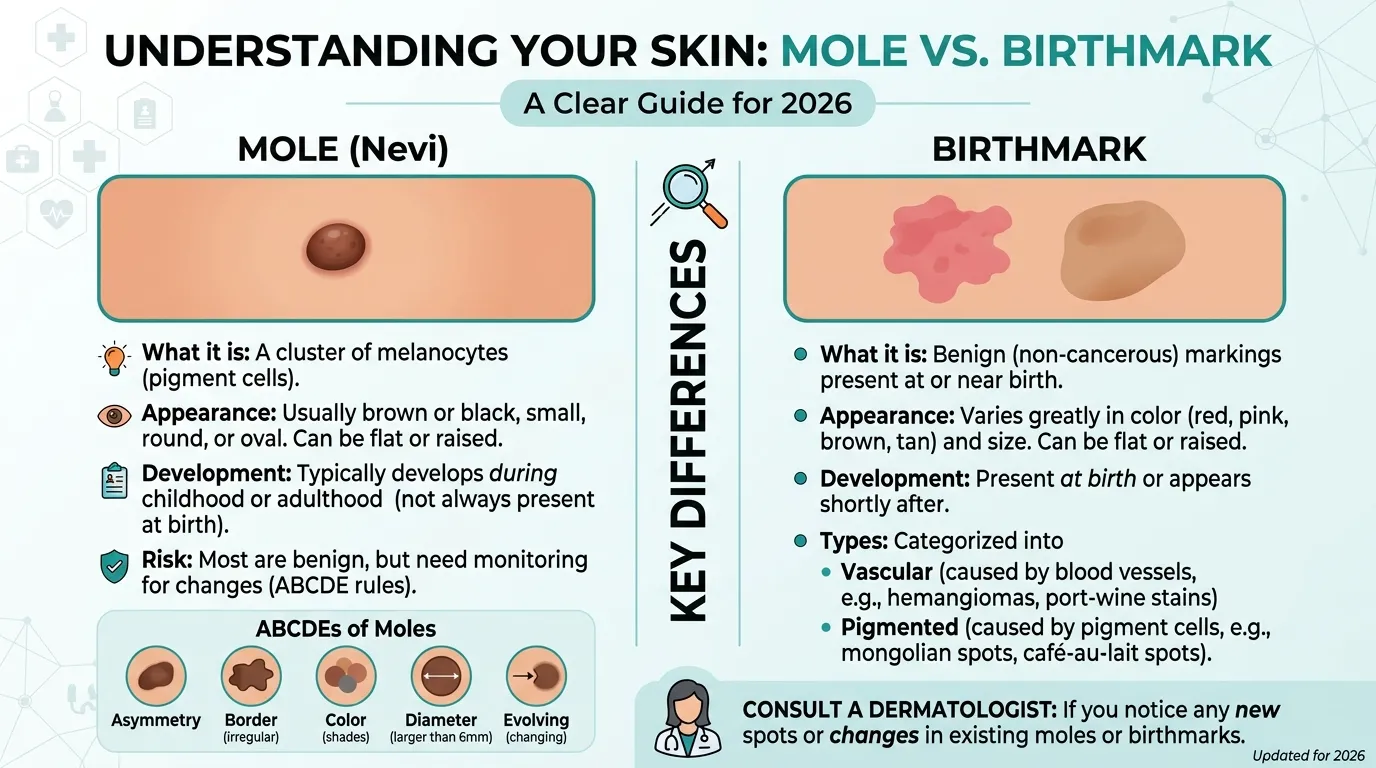
A mole is a small dark spot on the skin. It forms when skin cells called melanocytes grow together in one area.
History of Mole
People have noticed moles on the human body for thousands of years. In ancient times, some cultures believed moles showed beauty, luck, or personality traits. During the Middle Ages, people sometimes feared unusual skin marks because of superstitions. Later, doctors and scientists studied moles more carefully and learned that they are caused by groups of pigment cells in the skin. Today, most moles are harmless, but doctors still check some moles for health reasons. Modern medicine now understands how moles grow, change, and appear on different skin types.
What is “Birthmark”?
A birthmark is a colored mark on the skin that appears at birth or shortly after birth. It can be red, brown, pink, or blue.
History of Birthmark
Birthmarks have been part of human stories and beliefs for centuries. In many cultures, people once believed birthmarks carried special meanings or signs from nature. Some old traditions linked birthmarks to family history or future events. Over time, medical science explained that birthmarks form because of extra pigment or blood vessels under the skin. Doctors now know that many birthmarks are harmless and common in babies. Some birthmarks fade with age, while others remain for life. Today, birthmarks are understood as natural skin conditions rather than mysterious signs.
Mole vs Birthmark
A mole is usually a small dark skin growth, while a birthmark is a skin mark present from birth.
Now let us look at their features and differences in a simple way.
How Mole Works
Moles form when pigment cells group together on the skin.
Key Features
- Usually brown or black
- Can appear later in life
- Often small and round
- May be flat or raised
- Common on face, arms, and back
Example Sentences
🔵 She has a tiny mole near her nose.
🔵 His mole became darker with age.
Uses
- Skin identification
- Beauty marks
- Medical skin checks
- Personal appearance
- Health observation
How Birthmark Works
Birthmarks appear because of pigment or blood vessel changes in the skin.
Key Features
- Present at birth or soon after
- Different colors and sizes
- May fade over time
- Can be flat or raised
- Common in babies
Example Sentences
🟢 The baby had a pink birthmark on her hand.
🟢 His birthmark became lighter with age.
Uses
- Personal identity
- Medical observation
- Skin studies
- Family recognition
- Baby health records
Which One Should You Use?
Use “mole” when talking about a small dark skin spot that may appear later. Use “birthmark” when talking about a skin mark present from birth or early baby life.
10 Differences Between Mole and Birthmark
1. Time of Appearance
Mole: A mole often appears later in life.
🔴 My mole appeared during my teenage years.
🔴 She noticed a new mole last year.
Birthmark: A birthmark appears at birth or soon after.
🔴 The baby was born with a birthmark.
🔴 His birthmark appeared during infancy.
2. Color
Mole: Moles are usually brown or black.
🔴 The mole looked dark brown.
🔴 She covered the black mole with makeup.
Birthmark: Birthmarks can be red, pink, blue, or brown.
🔴 Her birthmark looked pink.
🔴 The child had a red birthmark.
3. Cause
Mole: Moles form from grouped pigment cells.
🔴 Doctors checked the pigment mole.
🔴 The mole grew from skin cells.
Birthmark: Birthmarks form from pigment or blood vessels.
🔴 The birthmark came from blood vessels.
🔴 Pigment caused the skin mark.
4. Shape
Mole: Moles are often small and round.
🔴 His mole looked circular.
🔴 The tiny mole sat near her eye.
Birthmark: Birthmarks can have many shapes.
🔴 Her birthmark spread across the arm.
🔴 The mark looked uneven.
5. Texture
Mole: A mole may be raised.
🔴 I touched the raised mole carefully.
🔴 The mole felt smooth.
Birthmark: Birthmarks are often flat.
🔴 The birthmark felt flat on the skin.
🔴 The patch looked smooth.
6. Size
Mole: Moles are usually small.
🔴 The mole was tiny.
🔴 He had several small moles.
Birthmark: Birthmarks can be large.
🔴 The birthmark covered her shoulder.
🔴 The baby had a large mark.
7. Change Over Time
Mole: Moles may change in size or color.
🔴 The mole became darker.
🔴 Her mole slowly grew larger.
Birthmark: Some birthmarks fade with age.
🔴 The mark became lighter over time.
🔴 His birthmark almost disappeared.
8. Medical Attention
Mole: Doctors sometimes check moles for skin problems.
🔴 The doctor examined the mole.
🔴 She visited a skin clinic for her mole.
Birthmark: Birthmarks are usually harmless.
🔴 The doctor said the birthmark was safe.
🔴 Most birthmarks need no treatment.
9. Common Age Group
Mole: Moles are common in teens and adults.
🔴 Teenagers often get new moles.
🔴 Adults may have many moles.
Birthmark: Birthmarks are common in babies.
🔴 The newborn had a birthmark.
🔴 Babies often have skin marks.
10. Appearance Style
Mole: Moles often look like dots.
🔴 The mole looked like a tiny dot.
🔴 A dark dot appeared on his neck.
Birthmark: Birthmarks often look like patches.
🔴 The patch spread across her skin.
🔴 The birthmark looked wide and soft.
Why People Get Confused About Their Use
People get confused because both moles and birthmarks are skin marks. They may also look similar in color or shape. Some birthmarks are dark like moles, and some moles appear early in life. Still, their causes and timing are different.
Table: Difference and Similarity
| Feature | Mole | Birthmark | Similarity |
| Time of Appearance | Later in life | At birth or soon after | Both appear on skin |
| Color | Brown or black | Many colors | Both may be dark |
| Size | Usually small | Can be large | Both vary in shape |
| Cause | Pigment cells | Pigment or blood vessels | Both are natural |
| Medical Concern | Sometimes checked | Usually harmless | Both may need observation |
Which is Better in What Situation?
Moles are useful in skin studies and medical checks because doctors can watch changes in color or size. Some people also see moles as beauty marks on the face or body.
Birthmarks are useful for identity and medical records. They help parents and doctors notice natural skin features from birth. Many birthmarks are harmless and become part of a person’s unique appearance.
How Are “Mole” and “Birthmark” Used in Metaphors and Similes?
🟣 “A mole on the plan” means a hidden problem.
🟣 “Like a birthmark” means something permanent or natural.
🟣 “The stain stayed like a birthmark” means it remained for a long time.
🟣 “His secret spread like a mole under the skin” means it slowly became noticeable.
Connotative Meaning
Mole
🟣 Positive: “Her mole looked beautiful.”
🟣 Neutral: “He has a mole on his arm.”
🟣 Negative: “Some people worry about changing moles.”
Birthmark
🟣 Positive: “The birthmark made the child unique.”
🟣 Neutral: “The baby has a birthmark.”
🟣 Negative: “Some people feel shy about visible birthmarks.”
Idioms or Proverbs
🟣 “Beauty is in the eye of the beholder.”
Meaning: People see beauty differently.
Example: Some people find facial moles attractive.
🟣 “Wear your marks proudly.”
Meaning: Accept your natural appearance with confidence.
Example: She wore her birthmark proudly.
Works in Literature
🟣 The Birthmark — Nathaniel Hawthorne, 1843
🟣 The Mole — Tadeusz Dołęga-Mostowicz, 1933
Movies Related to the Keywords
🟣 Birthmarked — 2018, Canada
🟣 Austin Powers: International Man of Mystery — 1997, United States
Frequently Asked Questions
1. Is a mole the same as a birthmark?
No. A mole usually appears later, while a birthmark appears at birth or soon after.
2. Can birthmarks disappear?
Yes. Some birthmarks fade with age.
3. Are moles dangerous?
Most moles are harmless, but doctors may check changing moles.
4. Can adults get birthmarks?
Birthmarks usually appear in babies, not adults.
5. Are both natural skin marks?
Yes. Both are natural skin conditions.
Final Words
Moles and birthmarks are common skin features that make every person unique. Learning their differences can help people speak clearly and understand basic health words with confidence.
Conclusion
The difference between mole and birthmark is mainly about appearance, timing, and cause. Moles usually develop later and are often dark spots. Birthmarks appear at birth or soon after and may have different colors and sizes. Both are natural skin marks, but they are not the same. Understanding the difference between mole and birthmark helps students, parents, and English learners use these words correctly in daily life and health discussions.

I’m Zahid Abbas, an educator, researcher, and digital publishing strategist with a passion for linguistics, grammar, and clear communication. As a content creator and SEO specialist, I craft research-driven, reader-focused content that empowers learners and makes knowledge accessible worldwide.