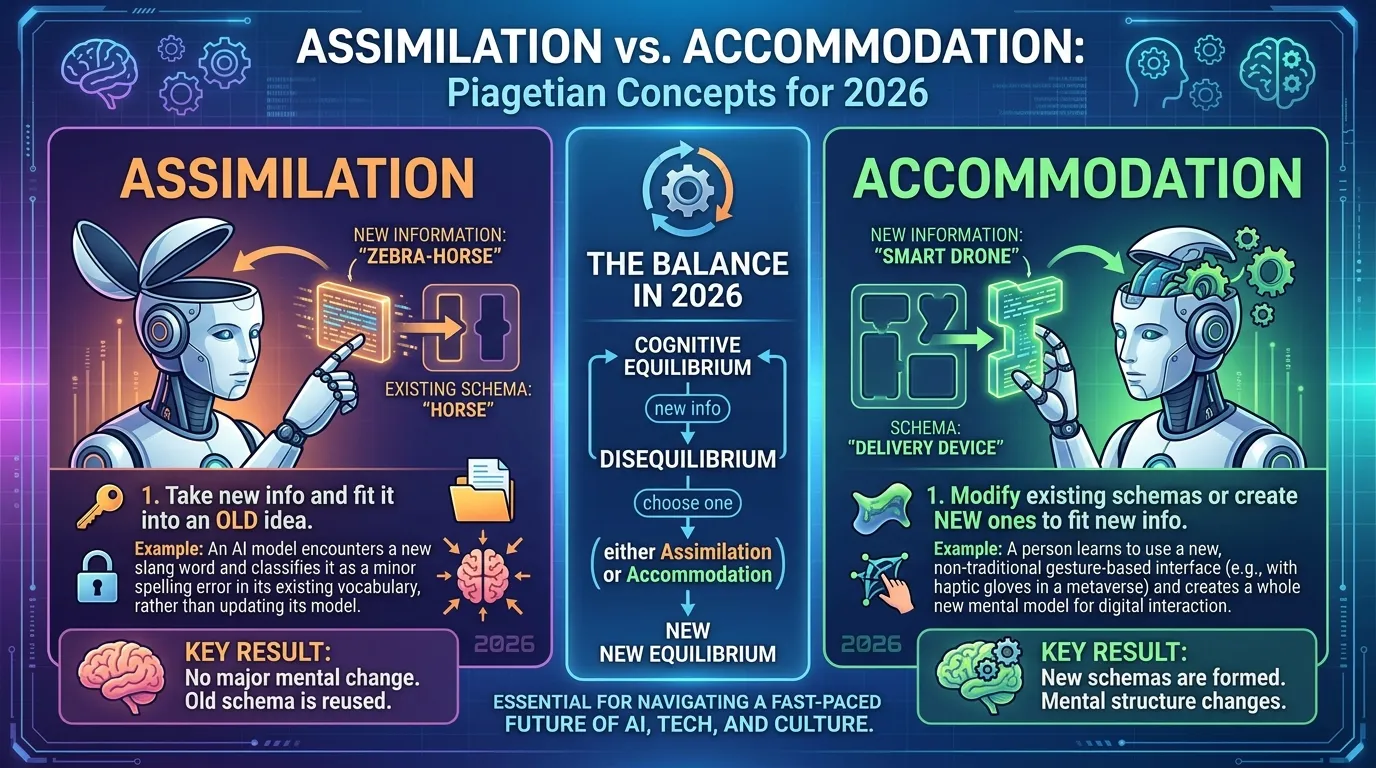
A little boy saw a zebra at the zoo. He said, “Look! A horse!” The zebra looked like a horse to him. Later, his mother told him, “No, this is a zebra.” The boy then learned something new. This is the difference between assimilation and accommodation.
The difference between assimilation and accommodation is about learning new things. Assimilation means using old ideas to understand something new. Accommodation means changing old ideas after learning new facts. Many students find the difference between assimilation and accommodation hard at first. But with simple examples, it becomes easy. These ideas help children learn at school and in daily life.
What is “Assimilation”?
Assimilation means adding new ideas to what you already know.
History of Assimilation
Jean Piaget made this idea famous. He studied how children learn. He saw that children use old ideas to understand new things. For example, a child may think a zebra is a horse because both have four legs. Piaget called this assimilation. Today, teachers still use this idea to help children learn better.
What is “Accommodation”?
Accommodation means changing old ideas when new facts do not match.
History of Accommodation
Jean Piaget also explained accommodation. He saw that children sometimes need to change their thinking. A child may first think all animals with four legs are dogs. Later, the child learns that cats and cows are different animals. This change in thinking is called accommodation. It helps children grow smarter and understand the world better.
Assimilation vs Accommodation
Assimilation means adding new ideas to old thinking. Accommodation means changing old thinking.
Now let us learn more with easy examples.
How Assimilation Works
Assimilation helps people learn with old ideas.
Key Features
- Uses old knowledge
- Easy to understand
- Helps quick learning
- Common in children
- Adds new ideas
Example Sentences
🔵 The boy called the zebra a horse.
🔵 I learned a new game like football.
Uses
- School learning
- Child growth
- Daily life
- Reading
- Language learning
How Accommodation Works
Accommodation changes old ideas into new ones.
Key Features
- Changes thinking
- Helps deeper learning
- Fixes wrong ideas
- Builds new understanding
- Helps mental growth
Example Sentences
🟢 The boy learned the zebra was not a horse.
🟢 She changed her answer after the lesson.
Uses
- School lessons
- Problem solving
- Personal growth
- Science learning
- New experiences
Which One Should You Use?
Use assimilation when new things look familiar. Use accommodation when you learn something very different.
10 Differences Between Assimilation and Accommodation
1. Main Meaning
Assimilation: Adds new ideas to old thinking.
🔴 The child thought the zebra was a horse.
🔴 He linked the new game to football.
Accommodation: Changes old thinking.
🔴 The child learned a zebra is different.
🔴 She changed her wrong idea.
2. Thinking
Assimilation: Keeps old ideas.
🔴 He used old knowledge.
🔴 The lesson felt easy.
Accommodation: Changes old ideas.
🔴 The student learned a new fact.
🔴 Her thinking changed.
3. Learning Style
Assimilation: Easy and fast learning.
🔴 The child understood quickly.
🔴 The game felt familiar.
Accommodation: Slower learning.
🔴 The student needed more time.
🔴 The idea felt new.
4. Mental Change
Assimilation: Small change in thinking.
🔴 He added new facts.
🔴 She used old ideas.
Accommodation: Big change in thinking.
🔴 He learned a new rule.
🔴 She changed her belief.
5. Old Knowledge
Assimilation: Uses old knowledge.
🔴 The learner remembered old lessons.
🔴 The child used familiar ideas.
Accommodation: Builds new knowledge.
🔴 The learner fixed mistakes.
🔴 The child learned new facts.
6. Common Use
Assimilation: Common in easy learning.
🔴 The student linked ideas together.
🔴 The child guessed quickly.
Accommodation: Common in hard learning.
🔴 The lesson changed her mind.
🔴 The student learned a new truth.
7. Flexibility
Assimilation: Less flexible.
🔴 He stayed with old ideas.
🔴 The child repeated old thinking.
Accommodation: More flexible.
🔴 She accepted a new answer.
🔴 The class changed opinions.
8. Result
Assimilation: Adds information.
🔴 He learned more facts.
🔴 She added ideas to memory.
Accommodation: Creates new understanding.
🔴 The child learned the real answer.
🔴 The lesson changed her thinking.
9. In School
Assimilation: Helps simple lessons.
🔴 The teacher used easy examples.
🔴 Students connected old lessons.
Accommodation: Helps deep learning.
🔴 Science changed student ideas.
🔴 New facts improved learning.
10. Example
Assimilation: Zebra = horse idea.
🔴 The child guessed wrong.
🔴 He used old thinking.
Accommodation: Zebra is different from horse.
🔴 The child learned the truth.
🔴 She corrected her mistake.
Why People Get Confused About Their Use
People get confused because both words are about learning. Both happen in the brain. Also, they can happen together while learning something new.
Table: Difference and Similarity
| Feature | Assimilation | Accommodation | Similarity |
| Meaning | Adds ideas | Changes ideas | Both help learning |
| Thinking | Uses old ideas | Makes new ideas | Both use the brain |
| Learning | Easy | Harder | Both improve knowledge |
| Change | Small | Big | Both help growth |
| Use | Quick learning | Deep learning | Both happen in school |
Which is Better in What Situation?
Assimilation is better when new things are similar to old ideas. It helps children learn quickly and feel comfortable.
Accommodation is better when old ideas are wrong. It helps people understand new facts and become smarter.
How Are “Assimilation” and “Accommodation” Used in Metaphors and Similes?
🟣 “Assimilation is like adding books to a shelf.”
🟣 “Accommodation is like building a new shelf.”
🟣 “His brain worked like assimilation.”
🟣 “Her mind changed like accommodation.”
Connotative Meaning
Assimilation
🟣 Positive: “Assimilation helps easy learning.”
🟣 Neutral: “The class used assimilation.”
🟣 Negative: “Too much old thinking can stop new ideas.”
Accommodation
🟣 Positive: “Accommodation helps growth.”
🟣 Neutral: “The student used accommodation.”
🟣 Negative: “Changing ideas can feel hard.”
Idioms or Proverbs
🟣 “Practice makes perfect.”
Meaning: Practice helps learning.
Example: Assimilation becomes stronger with practice.
🟣 “You learn something new every day.”
Meaning: Learning never stops.
Example: Accommodation helps people learn new things.
Works in Literature
🟣 The Psychology of Intelligence — Jean Piaget, 1947
🟣 The Language and Thought of the Child — Jean Piaget, 1923
Movies Related to the Keywords
🟣 Inside Out — 2015, United States
🟣 A Beautiful Mind — 2001, United States
Frequently Asked Questions
1. What is assimilation?
Assimilation means adding new ideas to old knowledge.
2. What is accommodation?
Accommodation means changing old ideas after learning new facts.
3. Who explained these ideas?
Jean Piaget explained them.
4. Are both important?
Yes. Both help people learn.
5. Which one changes thinking?
Accommodation changes thinking.
Final Words
Learning new things is part of life. Assimilation and accommodation both help people grow, learn, and understand the world better.
Conclusion
The difference between assimilation and accommodation is simple. Assimilation adds new ideas to old thinking. Accommodation changes old thinking after learning something new. Both are important for children, students, and adults. Knowing the difference between assimilation and accommodation helps people learn in a smarter and easier way.

I’m Zahid Abbas, an educator, researcher, and digital publishing strategist with a passion for linguistics, grammar, and clear communication. As a content creator and SEO specialist, I craft research-driven, reader-focused content that empowers learners and makes knowledge accessible worldwide.