Ali went to a small café with his friend. After lunch, the waiter gave them a paper to pay. Ali called it an invoice, but his friend said it was a bill. Both were confused. Many people face this same problem every day. The difference between bill and invoice may look small, but it is important in business and daily life.
People use these words in shops, offices, schools, and online stores. Still, many beginners do not know when to use each one. Learning the difference between bill and invoice can help you speak and write more clearly. It also helps students, workers, and business owners avoid mistakes. In this guide, you will learn both words in very simple English with clear examples.
What is “Bill”?
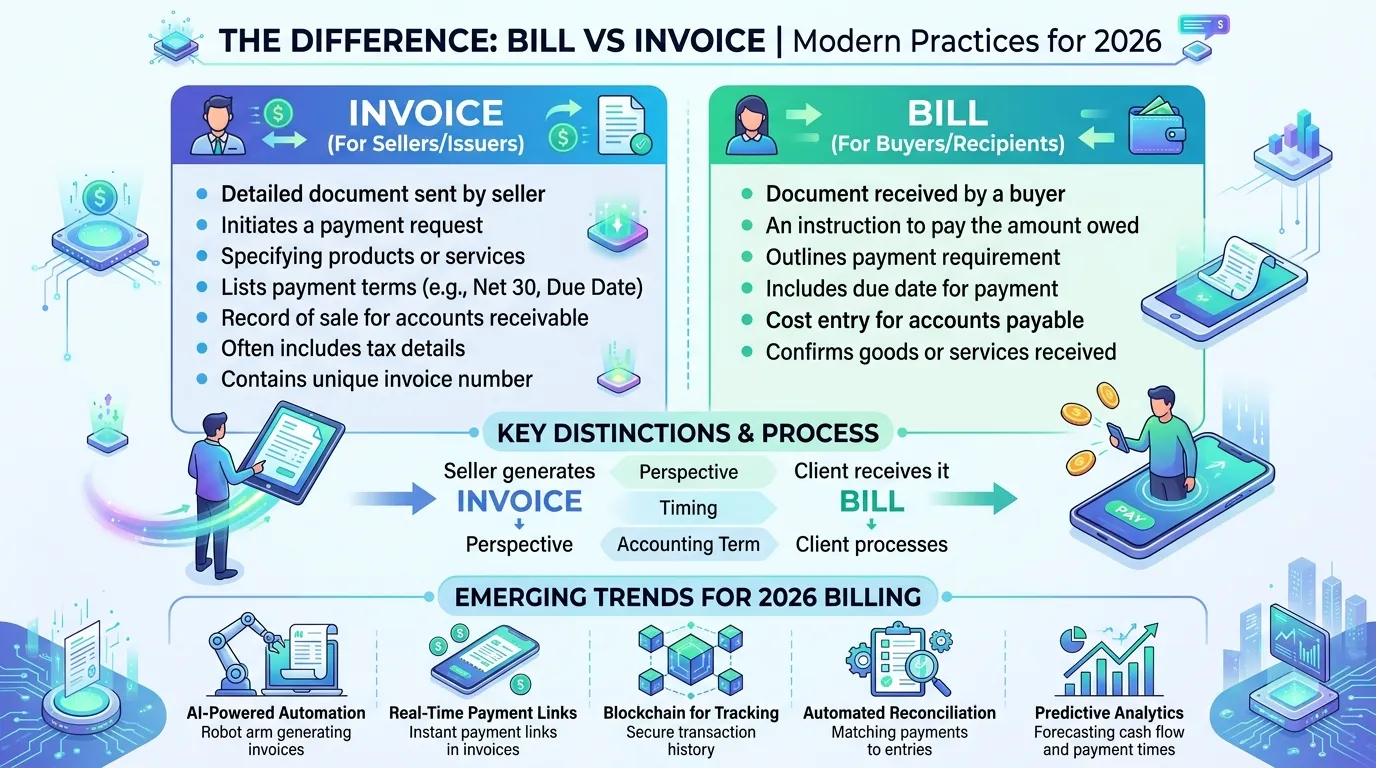
A bill is a paper or digital note that tells a person to pay money for goods or services. It usually asks for immediate payment. Restaurants, utility companies, and shops often use bills.
History of “Bill”
The word “bill” comes from the Latin word bulla, which meant a sealed paper or document. Later, people in Old English and Middle English used “bill” for written notices and payment papers. Over time, businesses started using bills to ask customers for money after giving a product or service. Today, bills are common in daily life. People receive electricity bills, water bills, phone bills, and restaurant bills. The word is now simple and widely used around the world for payment requests.
What is “Invoice”?
An invoice is a document sent by a seller to a buyer. It lists products, prices, taxes, and payment terms. It is often used in business and may allow payment later.
History of “Invoice”
The word “invoice” came from the French word envois, meaning “to send.” Traders and merchants used invoices many years ago when shipping goods between cities and countries. The document helped buyers know what products they received and how much they owed. As trade grew, invoices became more detailed and official. Today, companies use invoices in offices, online stores, and international business. Modern invoices may include tax numbers, due dates, and digital payment details to keep business records clear and organized.
Bill vs Invoice
A bill asks for payment now, while an invoice gives payment details and may allow payment later.
Although they both deal with money, they are used in different situations. Let us explore them in detail.
How “Bill” Works
A bill is usually given after a service or purchase. The customer often pays immediately.
Key Features
- Simple payment request
- Mostly used in daily life
- Payment is usually immediate
- Common in restaurants and utility services
- Short and easy format
Examples
🔵 The waiter gave us the bill after dinner.
🔵 I paid my electricity bill online yesterday.
Uses
- Restaurants
- Grocery stores
- Phone companies
- Electricity services
- Daily shopping
How “Invoice” Works
An invoice is more detailed and professional. Businesses often use it for record keeping and future payment.
Key Features
- Includes product details
- Shows payment deadline
- Used in business deals
- Helps with accounting
- Can include taxes and discounts
Examples
🟢 The company sent an invoice by email.
🟢 Our office paid the invoice after seven days.
Uses
- Business transactions
- Freelance work
- Online selling
- International trade
- Company accounting
Which One Should You Use?
Use a bill for quick and direct payment situations like restaurants or monthly utilities. Use an invoice in professional or business settings where payment records and details are important.
10 Differences Between Bill and Invoice
1. Purpose
Bill
A bill asks for payment right away.
🔴 The café bill was $20.
🔴 She paid the hospital bill today.
Invoice
An invoice records a business payment request.
🔴 The supplier emailed the invoice.
🔴 The client checked the invoice details.
2. Payment Time
Bill
Payment is usually immediate.
🔴 Please pay the bill before leaving.
🔴 He cleared the bill at the counter.
Invoice
Payment may happen later.
🔴 The invoice is due next week.
🔴 We paid the invoice after delivery.
3. Detail Level
Bill
Bills are usually short.
🔴 The bill showed only total cost.
🔴 My phone bill was simple to read.
Invoice
Invoices are more detailed.
🔴 The invoice listed all products.
🔴 Tax details were added to the invoice.
4. Business Use
Bill
Bills are common in daily services.
🔴 The hotel gave us a bill.
🔴 I received a gas bill yesterday.
Invoice
Invoices are common in companies.
🔴 The office created an invoice.
🔴 The vendor sent a monthly invoice.
5. Legal Record
Bill
Bills are less formal.
🔴 The shop printed a quick bill.
🔴 He lost the restaurant bill.
Invoice
Invoices are official records.
🔴 The accountant saved the invoice.
🔴 The invoice was used for taxes.
6. Audience
Bill
Bills are often for customers.
🔴 Customers pay bills daily.
🔴 The family checked the water bill.
Invoice
Invoices are often for businesses.
🔴 The company received an invoice.
🔴 Freelancers send invoices to clients.
7. Format
Bill
Bills are usually shorter.
🔴 The grocery bill was one page.
🔴 My bill had only three items.
Invoice
Invoices may be longer.
🔴 The invoice included payment terms.
🔴 The invoice had company details.
8. Payment Terms
Bill
Bills rarely include long payment terms.
🔴 I paid the bill immediately.
🔴 The café bill had no due date.
Invoice
Invoices often include due dates.
🔴 Payment is due in 30 days.
🔴 The invoice explained late fees.
9. Common Places
Bill
Bills are common in homes and shops.
🔴 I paid my internet bill.
🔴 The restaurant bill was expensive.
Invoice
Invoices are common in offices.
🔴 The manager approved the invoice.
🔴 The store sent an online invoice.
10. Tone
Bill
The tone is casual and direct.
🔴 Can I get the bill, please?
🔴 Your bill is ready.
Invoice
The tone is professional.
🔴 Please review the invoice carefully.
🔴 The invoice has been attached.
Why People Get Confused About Their Use
People get confused because both words relate to payment. In some places, people even use them in the same way. Both documents show money owed, products, or services. However, bills are more common in daily life, while invoices are more common in business. The small difference in purpose makes many learners mix them up.
Table: Difference and Similarity
| Feature | Bill | Invoice | Similarity |
| Purpose | Requests quick payment | Requests formal payment | Both ask for money |
| Detail Level | Short | Detailed | Both show costs |
| Usage | Daily life | Business | Both used in trade |
| Payment Time | Immediate | Later possible | Both involve payment |
| Formality | Less formal | More formal | Both are documents |
| Records | Simple | Official | Both keep proof |
Which is Better in What Situation?
A bill is better for fast and simple payments. Restaurants, shops, and utility companies use it because customers usually pay right away. It works well in everyday situations.
An invoice is better for business work and professional services. It helps companies track payments, taxes, and product details. Freelancers and offices often use invoices for clear records.
How Are “Bill” and “Invoice” Used in Metaphors and Similes?
🟣 “The final bill of mistakes arrived later.”
🟣 “His invoice of hard work brought success.”
🟣 “Life sends bills we never expect.”
🟣 “Her kindness was like an unpaid invoice waiting for thanks.”
Connotative Meaning
Bill
Usually neutral, but sometimes negative because it means payment.
🟣 “The medical bill shocked the family.”
🟣 “I received my phone bill today.”
Invoice
Mostly neutral and professional.
🟣 “The invoice looked very organized.”
🟣 “She emailed the invoice politely.”
Idioms or Proverbs
🟣 Foot the bill — to pay for something
Example: “My uncle footed the bill for dinner.”
🟣 Bill of goods — a false promise
Example: “They sold him a bill of goods.”
There are very few common idioms with “invoice.”
Works in Literature
🟣 Bleak House by Bleak House — Charles Dickens (1853) mentions bills and debts in society.
🟣 The Merchant of Venice by William Shakespeare (1600) includes payment and trade ideas similar to invoices.
Movies Related to the Keywords
🟣 The Accountant — 2016, USA
🟣 Wall Street — 1987, USA
🟣 Boiler Room — 2000, USA
Possible Questions
1. Is a bill the same as an invoice?
No. A bill usually asks for immediate payment, while an invoice may allow later payment.
2. Who uses invoices?
Businesses, freelancers, and companies use invoices.
3. Where do we use bills?
Bills are common in restaurants, stores, and utility services.
4. Can an invoice become a bill?
Yes. After the payment date arrives, an invoice may act like a bill.
5. Which one is more formal?
An invoice is more formal than a bill.
Final Words
Learning small word differences can improve your English and business skills. “Bill” and “invoice” may look similar, but they have different uses. Once you understand them, daily conversations and work documents become much easier.
Conclusion
The difference between bill and invoice is mainly about purpose and formality. A bill is simple and asks for quick payment. An invoice is detailed and often used in business settings with payment terms. Both are important in daily life and work, but they fit different situations. Understanding these terms can help students, workers, shop owners, and English learners communicate better. With regular practice and real-life examples, you can use both words correctly and confidently.

I’m Zahid Abbas, an educator, researcher, and digital publishing strategist with a passion for linguistics, grammar, and clear communication. As a content creator and SEO specialist, I craft research-driven, reader-focused content that empowers learners and makes knowledge accessible worldwide.