Ali was ready for his school photo day. However, he did not like his crooked teeth. His friend wore metal braces, while his cousin used clear trays called Invisalign. Ali became confused. What was the real difference between Invisalign and braces? Which one was better?
Many people ask about the difference between Invisalign and braces before starting dental treatment. Both help straighten teeth. Yet, they work in different ways. Knowing the difference between Invisalign and braces can help students, parents, and adults choose the right option.
This topic is useful because a healthy smile improves confidence. Also, straight teeth are easier to clean. In this guide, you will learn everything in simple words with clear examples.
What is “Invisalign”?
Invisalign is a clear aligner system. It uses transparent plastic trays to move teeth slowly into the correct place. People can remove the trays while eating or brushing.
Invisalign is almost invisible. Because of this, many teenagers and adults like it.
History of Invisalign
The company Align Technology created Invisalign in 1997. The treatment became popular in the early 2000s. Before Invisalign, metal braces were the main choice for straightening teeth. Invisalign changed dental care because it offered a clear and removable option. Dentists use computer scanning to design custom trays for every person. Over time, the system improved and became more comfortable. Today, millions of people around the world use Invisalign for mild and moderate teeth problems. Many students and office workers prefer it because the aligners are hard to notice during daily life.
What is “Braces”?
Braces are metal or ceramic tools attached to the teeth. They use brackets and wires to move teeth into the correct position over time.
Braces stay fixed on the teeth until treatment ends.
History of Braces
Braces have a very long history. Ancient people even tried using metal bands to straighten teeth. Modern braces started developing in the 1800s. Dentists improved the design over many years. Traditional metal braces became common in the 20th century. Later, ceramic braces and smaller brackets appeared. Braces remain one of the most trusted ways to fix serious teeth problems. Orthodontists use them for children, teenagers, and adults. Even today, braces are widely used because they can treat complex dental issues that clear aligners may not fully correct.
Invisalign vs Braces
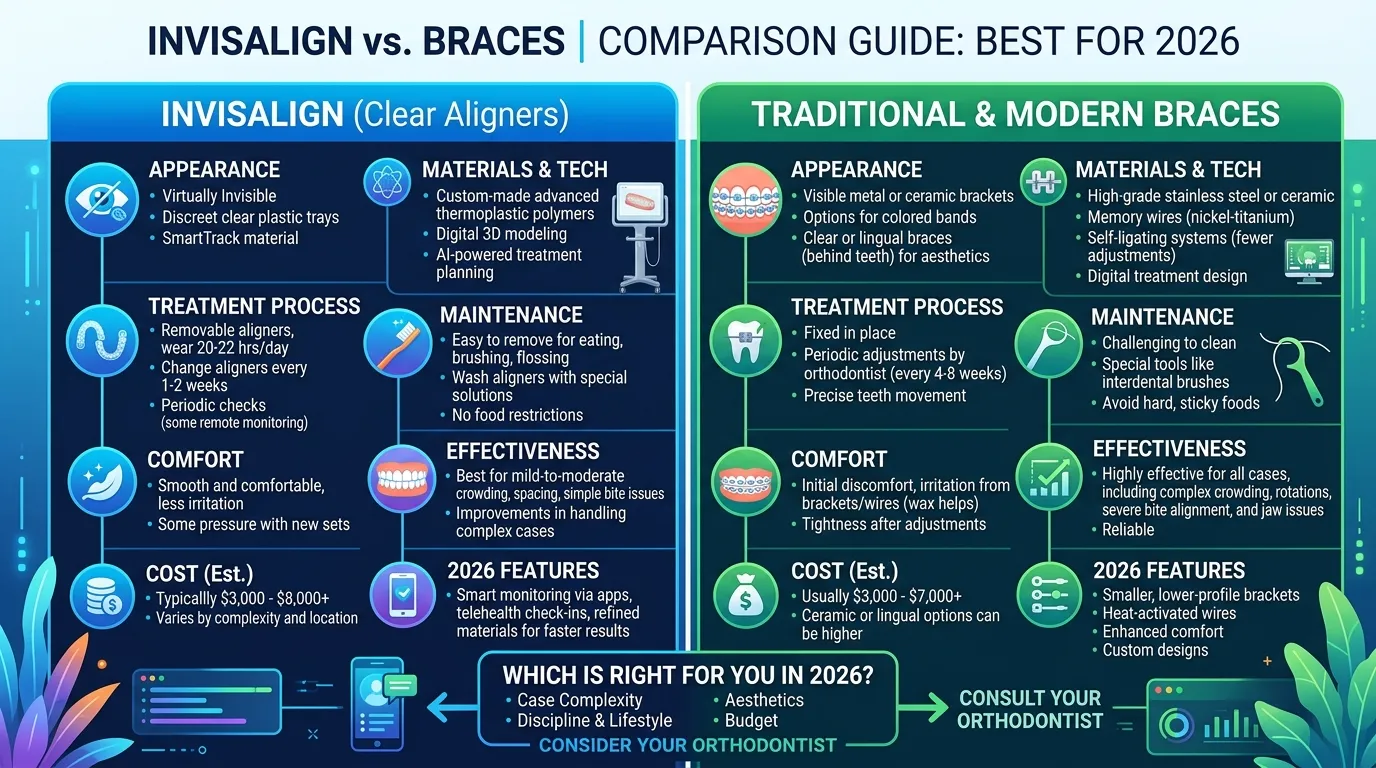
Invisalign uses clear removable trays, while braces use fixed brackets and wires.
Now, let us explore how both systems work in daily life.
How “Invisalign” Works
Invisalign slowly moves teeth using clear plastic aligners.
Key Features
- Clear and nearly invisible
- Removable while eating
- Comfortable smooth plastic
- Custom-made for each person
- Changed every few weeks
Examples
🔵 Sara removes her Invisalign trays before dinner.
🔵 Ahmed wears Invisalign during office meetings because it is hard to see.
Uses
- Straightening mild crooked teeth
- Closing small gaps
- Fixing bite problems
- Helping adults who want a hidden treatment
- Useful at work and school
How “Braces” Works
Braces move teeth with wires, brackets, and pressure.
Key Features
- Fixed on the teeth
- Strong and durable
- Good for serious alignment issues
- Available in metal or ceramic
- Cannot be removed at home
Examples
🟢 Bilal visits the orthodontist to tighten his braces.
🟢 Maria avoids sticky candy because she wears braces.
Uses
- Fixing severe crooked teeth
- Correcting jaw alignment
- Treating crowded teeth
- Helping children and teenagers
- Long-term dental correction
Which One Should You Use?
If you want a nearly invisible option, Invisalign may suit you better. It is also easier during meals.
However, braces may be better for difficult dental problems. They stay fixed, so users cannot forget to wear them.
10 Differences Between Invisalign and Braces
1. Appearance
Invisalign: Clear trays that are hard to notice.
🔴 Emma smiled confidently with Invisalign at her wedding.
🔴 Jake used Invisalign during job interviews.
Braces: Metal brackets are easy to see.
🔴 Tom’s braces shined in photos.
🔴 Lily chose colorful rubber bands for her braces.
2. Removability
Invisalign: Can be removed anytime.
🔴 Adam removed his aligners before lunch.
🔴 Nina cleaned her teeth easily with Invisalign.
Braces: Stay attached to teeth.
🔴 Omar could not remove his braces at home.
🔴 Sara needed a dentist to adjust her braces.
3. Comfort
Invisalign: Smooth plastic feels softer.
🔴 Mia said her trays felt gentle.
🔴 Ali avoided mouth cuts with Invisalign.
Braces: Wires may irritate the mouth.
🔴 Hasan used wax for brace discomfort.
🔴 Emma felt soreness after tightening.
4. Food Rules
Invisalign: Remove before eating.
🔴 Ryan ate popcorn after removing aligners.
🔴 Zoe drank juice without her trays.
Braces: Some foods are restricted.
🔴 Jack avoided chewing gum.
🔴 Anna skipped hard candy.
5. Cleaning
Invisalign: Easy to clean teeth normally.
🔴 Sam brushed after removing trays.
🔴 Hina cleaned aligners every morning.
Braces: Need careful brushing around brackets.
🔴 Mark used a small brush for braces.
🔴 Sara flossed carefully between wires.
6. Treatment Time
Invisalign: Often faster for small problems.
🔴 Liam finished treatment in one year.
🔴 Ava corrected a small gap quickly.
Braces: May take longer for serious issues.
🔴 Ben wore braces for two years.
🔴 Noor needed long treatment for crowded teeth.
7. Discipline Needed
Invisalign: Requires regular wearing.
🔴 Ella wore aligners 22 hours daily.
🔴 Zain forgot his trays once and delayed progress.
Braces: Always working because they stay fixed.
🔴 Chris did not worry about removing braces.
🔴 Ali’s braces worked day and night.
8. Dental Visits
Invisalign: Fewer adjustments needed.
🔴 Maya visited the dentist every few weeks.
🔴 Ibrahim changed trays at home.
Braces: Need regular tightening.
🔴 Leo had monthly brace adjustments.
🔴 Sana visited often for wire changes.
9. Cost
Invisalign: Sometimes more expensive.
🔴 Aisha paid extra for clear aligners.
🔴 Hamza chose Invisalign for appearance.
Braces: Often less costly.
🔴 Bilal selected metal braces to save money.
🔴 Tina found braces affordable.
10. Best For
Invisalign: Best for mild to moderate problems.
🔴 Sara fixed small gaps with Invisalign.
🔴 Ali corrected slightly crooked teeth.
Braces: Best for complex problems.
🔴 Omar corrected severe crowding with braces.
🔴 Lina fixed jaw alignment using braces.
Why People Get Confused About Their Use
People get confused because both Invisalign and braces straighten teeth. Also, dentists may recommend either option depending on the case. Advertisements and social media can make both look similar. However, the treatment method, comfort, and visibility are different.
Table: Difference and Similarity
| Feature | Invisalign | Braces | Similarity |
| Appearance | Clear trays | Metal or ceramic brackets | Both straighten teeth |
| Removal | Removable | Fixed | Both need regular care |
| Comfort | Smooth plastic | Wires may poke | Both may cause pressure |
| Cleaning | Easier | More difficult | Both require hygiene |
| Food | Few restrictions | Many restrictions | Both improve smiles |
| Visibility | Hard to notice | Easy to see | Both are dental treatments |
| Discipline | User must wear trays | Always attached | Both need patience |
| Cost | Often higher | Often lower | Both can be expensive |
| Best Use | Mild problems | Serious problems | Both improve alignment |
Which is Better in What Situation?
Invisalign is better for people who want a hidden treatment. Adults and office workers often prefer it because it looks clear and neat. It is also easier during meals and brushing.
Braces are better for difficult dental problems. Children and teenagers often use them because they stay fixed on the teeth. Braces are also strong and reliable for major corrections.
How Are “Invisalign” and “Braces” Used in Metaphors and Similes?
🟣 “Her Invisalign was as clear as glass.”
🟣 “His braces looked like tiny train tracks.”
🟣 “Invisalign works like a gentle guide for teeth.”
🟣 “Braces hold teeth tightly like a firm grip.”
Connotative Meaning
Invisalign
- Positive: Modern, clean, stylish
- Neutral: Dental aligner
- Negative: Expensive for some people
🟣 “She liked the modern look of Invisalign.”
Braces
- Positive: Strong and effective
- Neutral: Orthodontic treatment
- Negative: Visible and uncomfortable at times
🟣 “He trusted braces for serious correction.”
Idioms or Proverbs
These keywords are medical terms, so there are no direct idioms. However, people use related expressions.
🟣 “Smile with confidence” — meaning to feel proud of your appearance.
🟣 “Straighten things out” — meaning to fix problems.
Example: “Braces helped her straighten things out with her smile.”
Works in Literature
🟣 Smile by Raina Telgemeier (2010) — A graphic memoir about dental braces and teenage life.
🟣 Diary of a Wimpy Kid by Jeff Kinney (2007) — Mentions braces and school experiences.
Movies Related to the Keywords
🟣 Finding Nemo (2003, USA) — Features a girl with braces.
🟣 To All the Boys I’ve Loved Before (2018, USA) — Teen dental appearance and confidence themes.
🟣 Smile (short films and documentaries, different countries) — Some discuss orthodontic treatment and confidence.
Questions
1. Is Invisalign painful?
It may feel tight at first, but the pain is usually mild.
2. Are braces better than Invisalign?
It depends on the dental problem and personal choice.
3. Can children use Invisalign?
Yes, some children and teenagers can use it.
4. How long do braces stay on teeth?
Most people wear them for one to three years.
5. Can Invisalign fix severe problems?
Some severe cases still need braces.
Final Words
A healthy smile can change how people feel about themselves. Both Invisalign and braces help improve teeth and confidence. The best choice depends on comfort, budget, and dental needs. Learn carefully, ask your dentist, and choose the option that fits your life.
Conclusion
Invisalign and braces both help straighten teeth, but they work differently. Invisalign uses clear removable trays, while braces use fixed brackets and wires. Invisalign is often chosen for comfort and appearance. Braces are trusted for strong correction and complex dental problems. Understanding the difference between Invisalign and braces helps people make smart choices for their dental health. No matter which option you choose, patience and proper care are important for a healthy and beautiful smile.

I’m Zahid Abbas, an educator, researcher, and digital publishing strategist with a passion for linguistics, grammar, and clear communication. As a content creator and SEO specialist, I craft research-driven, reader-focused content that empowers learners and makes knowledge accessible worldwide.